


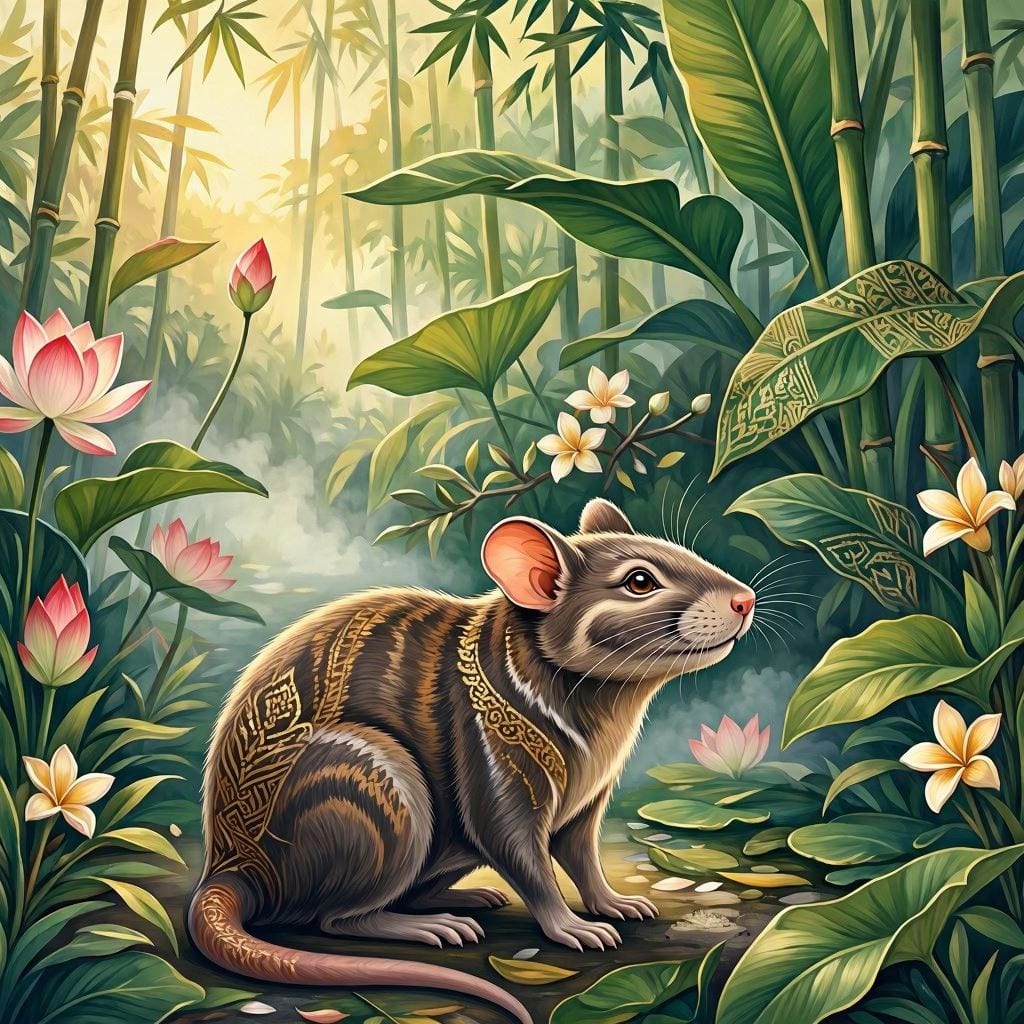
Chuat (Rat)
ชวด · หนู
Chuat, the Rat, is the first year of the Thai twelve-year cycle; the Royal Institute Dictionary gives the rat as its symbol. In the Brahmajati a male devatā rides the Rat, and its year recalls the Temiya Jātaka.
Source: พจนานุกรม ฉบับราชบัณฑิตยสถาน พ.ศ. ๒๕๕๔ (Royal Institute Dictionary, 2011), Office of the Royal Society, ชวด; H. G. Quaritch Wales, Divination in Thailand: The Hopes and Fears of a Southeast Asian People (London & Dublin: Curzon Press, 1983), pp. 9–10
- Place in the cycle
- 1 of 12
- Symbol
- Rat
- Element
- Water
- Rider
- A male devatā
- Tree of the khwan spirit
- Coconut or banana
- Jātaka
- Temiya Jātaka: the charioteer about to bury the Bodhisattva
Source: พจนานุกรม ฉบับราชบัณฑิตยสถาน พ.ศ. ๒๕๕๔ (Royal Institute Dictionary, 2011), Office of the Royal Society, ชวด, นักษัตร ๒; Royal Institute, หลักเกณฑ์การถอดอักษรไทยเป็นอักษรโรมันแบบถ่ายเสียง (Romanization of Thai, 1999), pp. 1–5; H. G. Quaritch Wales, Divination in Thailand: The Hopes and Fears of a Southeast Asian People (London & Dublin: Curzon Press, 1983), pp. 9–10
Born in the year of the Rat
The Brahmajati, the Thai book of destiny, reads a child’s future from the year of birth. Its method is the Chinese “fate calculation”, which the Thai may well have known since at least the thirteenth century, when they adopted the twelve-animal cycle; Indian learning added the planets of the week and the picture of the body as a small universe. Quaritch Wales, who called for a representative selection of the manuscripts in the National Library in Bangkok to satisfy himself of the general authenticity of the printed editions, notes that the text reflects old Siam: a freeman served a feudal patron, Brahmans were greatly respected, and slavery was finally abolished only about 1900. The portent for the month of birth can often be virtually the opposite of that for the day, and that is just what appeals to the Thai reader: one can be set off against the other, leaving, of course, a favourable balance.
According to the Brahmajati, for one born in the year of the Rat the Sun is the mouth: not afraid to talk to officials. Mars is the heart: rather inconstant, and satisfied with mediocre learning. Jupiter is the loins: strong sensuous desires. Moon and Mercury are the hands: hard-working but unskilful. Venus and Saturn are the feet: will like travel.
When young the child will be abandoned by relatives and must depend on others; later, however, will prosper. Will do government work well, assisting the patron and becoming an official. Inclined to be harsh to wife and children. Desires wealth and appreciates culinary delicacies, but likes to associate with Brahmans and is generous to the poor. A woman will have two sons on whom to depend. In infancy unhealthy and hard to rear; having left home at fifteen, will prosper elsewhere. Misfortunes at the ages of 11, 12, 16 and 31.
Source: H. G. Quaritch Wales, Divination in Thailand: The Hopes and Fears of a Southeast Asian People (London & Dublin: Curzon Press, 1983), pp. x–xi, 8–9, 9–10, 18–19, 35
The month of birth
5th, 6th or 7th month: a white-bellied Rat, whose element is sea water. It holds a crystal in its jaws, and this means prosperity.
8th, 9th or 10th month: a long-snouted Rat, element calm water. Good-hearted, though not a trustworthy speaker.
11th, 12th or 1st month: a ghost Rat, element jungle water. A brave disposition, but will find it hard to make a living.
2nd, 3rd or 4th month: a big field Rat, element canal water. A dim rat; benevolent, and will have many children.
Source: H. G. Quaritch Wales, Divination in Thailand: The Hopes and Fears of a Southeast Asian People (London & Dublin: Curzon Press, 1983), pp. 9–10
The day of birth
Sunday: will have much grief, but will be able to bear it.
Monday, Thursday, Friday and Saturday: very good days.
Tuesday and Wednesday: trouble.
Except for Monday and Wednesday, the days are tied to events in the career of Phya Sattalung, king of Cakravat and friend of the demon king Ravana in the Ramakien, the Thai Ramayana.
Source: H. G. Quaritch Wales, Divination in Thailand: The Hopes and Fears of a Southeast Asian People (London & Dublin: Curzon Press, 1983), pp. 9–10
The scenes of the manuscripts
A simpler system, very popular in the illustrated manuscripts, uses the year only as a calendar and trusts in numbers. The months are taken in pairs, beginning with months 5 and 11, each with a day of the week, or two days in the first case, to accommodate the odd seventh day (the days are numbered from Sunday, day 1). One looks up both the month and the day of birth: if both are good, very good; if one is good and one bad, take the mean; only if both are bad is the outlook truly depressing.
Month 5 or 11, or day 1 or 7: intelligent and able to fend for oneself, but liable to quarrel over a spouse.
Month 6 or 12, or day 2: a devatā in a grand boat. Will be wealthy and travel widely; trading by boat would succeed.
Month 7 or 1, or day 3: poverty, shown as a woman riding a cow. Trouble at least once, and much difficulty in making a living.
Month 8 or 2, or day 4: a woman in a house. Wealth from someone’s gifts; better for a woman, but not unsatisfactory for a man.
Month 9 or 3, or day 5: a couple pounding rice. Very poor; must work as hard as slaves.
Month 10 or 4, or day 6: a devatā riding a nāga. A severe disposition, liable to anger; will be powerful.
Source: H. G. Quaritch Wales, Divination in Thailand: The Hopes and Fears of a Southeast Asian People (London & Dublin: Curzon Press, 1983), pp. 19, 19–20, 24
The treatise of the seven numbers
The Treatise of the Seven Numbers trusts only the power of seven numbers. For the year of birth its seven classes are death, patron, fate, wealth, travel, and private and state employment. The years go in pairs: the Rat shares its predictions with the Goat.
Death: courageous but sad. Patron: will speak agreeably, so will be well received anywhere. Fate: has demerit from a former birth, and likes to talk about others. Wealth: likely to be rich. Travel: will probably travel and make many friends. Employment: would succeed in government work, with the help of friends.
Source: H. G. Quaritch Wales, Divination in Thailand: The Hopes and Fears of a Southeast Asian People (London & Dublin: Curzon Press, 1983), pp. 24–28
The years of the Rat
The animal changes on the first day of the waxing moon of the first month of the Royal Calendar, which falls between November and December. A child born on 28 November 2019, the second day of the first month of the Royal Calendar, was registered as a Rat. The table gives the first day of each year of the Rat from 1900 to 2027, the last year of the official calendar checked.
| Year | Begins |
|---|---|
| 1900 | December 3, 1899 |
| 1912 | November 21, 1911 |
| 1924 | December 8, 1923 |
| 1936 | November 26, 1935 |
| 1948 | December 13, 1947 |
| 1960 | December 1, 1959 |
| 1972 | November 18, 1971 |
| 1984 | December 5, 1983 |
| 1996 | November 22, 1995 |
| 2008 | December 10, 2007 |
| 2020 | November 27, 2019 |
Source: Department of Provincial Administration, Bureau of Registration Administration, Q&A (2566), p. 1; Loy Chunpongtong, Journal of the Royal Institute of Thailand 38(3) (2013), pp. 196–206, pp. 196–206; Bank of Thailand, Notifications on the holidays of financial institutions, B.E. 2545–2570 (2002–2027); Loy Chunpongtong, Journal of the Royal Institute of Thailand 36(4) (2011), p. 629
Compatibility
The Thai treatises judge a marriage in several ways. One compares the birth elements, with metal always counted as iron: most pairs are favourable, and only the unfavourable ones are listed. Another treatise looks at the animals of the two birth years: from it a girl could learn what her suitor would become if he married her. Quaritch Wales prints it in full because it gives an illuminating picture of the range of social positions theoretically open to anyone of the freeman class, and concludes that what a man makes of his life work depends in part on his wife.
According to one well-known system, marriages between men and women are favourable only for a few pairs of years, because for many people mixed marriages are contemplated between humans and partners who are actually devatā or demons (yakṣa or yakṣī) in disguise: a thought that is second nature to a Thai reader raised on the Ramakien.
- A woman of a water year, with a man of: earth, fire
Birth elements: most combinations are favourable, and only the unfavourable ones are listed. Metal always counts as iron.
- Chuat (Rat): trader
- Chalu (Ox): royal teacher
- Khan (Tiger): duck seller
- Tho (Hare): rich man
- Marong (Large Snake): boat hirer
- Maseng (Small Snake): fish trader (not good; should stop)
- Mamia (Horse): army officer (good)
- Mamae (Goat): devatā
- Wok (Monkey): attap palm dealer
- Raka (Rooster): mahout
- Cho (Dog): army officer
- Kun (Pig): low official
Birth animals: what the husband is likely to be. From this table a girl could learn her suitor’s future position, if he married her.
- A male and a female devatā, very happy, with many children: Mamia (Horse), Mamae (Goat)
- A woman and a devatā, best, with children, though liable to quarrel and part: Tho (Hare)
- A woman and a devatā, moderately favourable: Kun (Pig)
- A devatā and a yakṣī, only moderately good, mainly with this pair, where the children will not respect them: Khan (Tiger)
Mixed marriages: for many people, a partner may actually be a devatā or a demon (yakṣa, yakṣī) in disguise; and since none of them is immortal, they too follow the fortunes of their year of birth.
Source: H. G. Quaritch Wales, Divination in Thailand: The Hopes and Fears of a Southeast Asian People (London & Dublin: Curzon Press, 1983), pp. 63–70