


Kanya
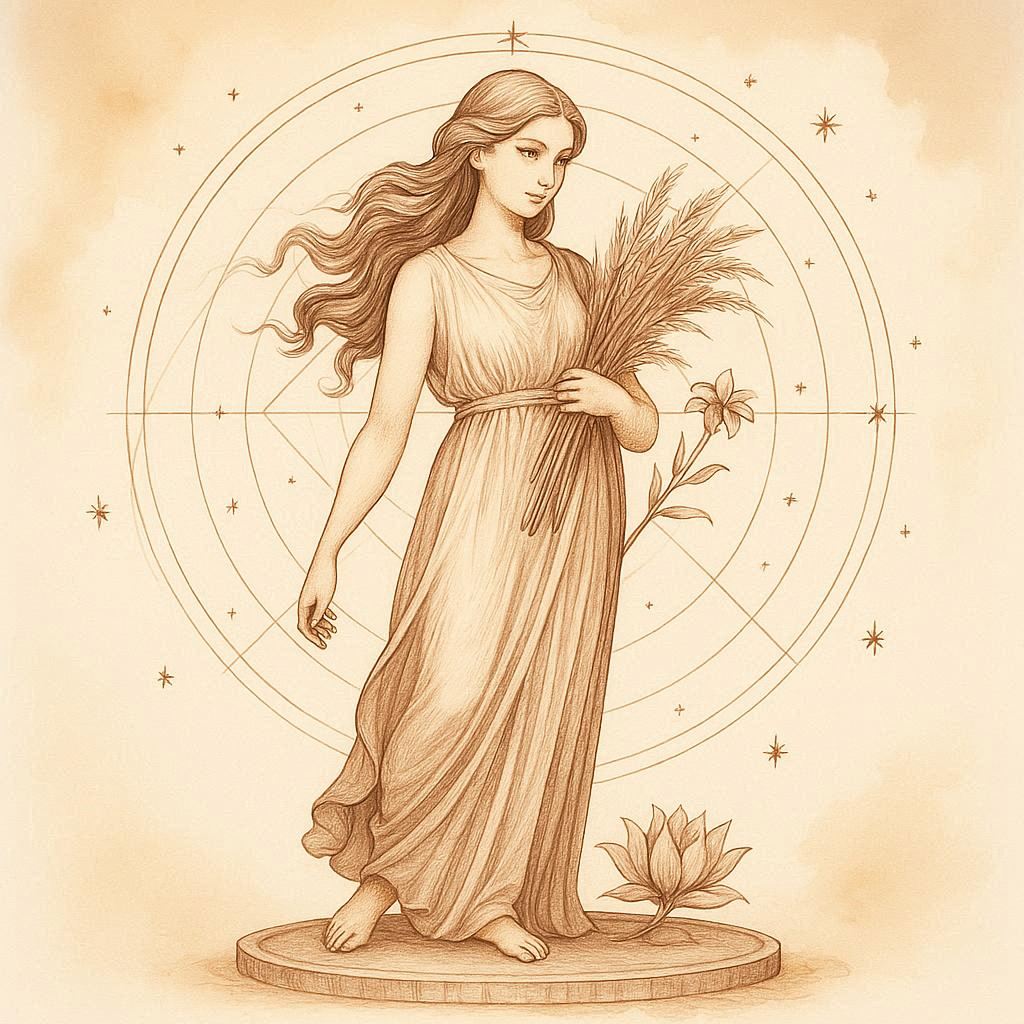
Kanya is the sixth rashi of Jyotish — the sign in which Budha (Mercury) reaches its deepest and most refined expression, operating in the Earth element where thought meets material reality with maximum precision. Where Mithuna (the other Budha-ruled sign) expresses Mercury's quality through the air of communication and connection, Kanya expresses it through the earth of discrimination, analysis, and perfection of craft. The sixth house — which Kanya governs by natural correspondence — rules health, service, enemies, debts, daily routines, and the purification of the self through work and discipline: these are the domains in which Kanya finds both its greatest challenges and its deepest fulfilment. The symbol of a maiden holding grain or a sheaf of wheat captures the Kanya essence: patient cultivation, careful selection of what is worth keeping, and the understanding that the finest results require the finest attention to detail. Kanya is the rashi of healers, craftspeople, analysts, and all those who take the raw material of existence and refine it into something useful and excellent.
- Dates
- September 16 – October 15 (sidereal). Note: Vedic astrology uses the sidereal zodiac — dates differ from Western tropical signs by approximately 23 days.
- Element
- Earth
- Ruling Planet
- Mercury (Budha)
- Quality
- Dwiswabhava (Dual/Mutable)
- Strengths
- Analytical · Meticulous · Helpful · Discerning · Practical
- Weaknesses
- Overcritical · Anxious · Perfectionistic · Inhibited · Worrisome
Personality
The Kanya personality is defined by an inner standard of excellence that few things in the external world ever fully meet. These individuals see what is wrong before they see what is right — not out of negativity but out of the genuinely Budha quality of discrimination (viveka), the capacity to distinguish the pure from the impure, the functional from the defective, the essential from the superfluous. This faculty, when directed outward without restraint, produces the Kanya reputation for criticism; when directed inward with equal force, it produces the perfectionism that can paralyse action and generate chronic anxiety. In Jyotish, the sixth house themes of purity, service, and refinement shape the Kanya character at a deep level: these individuals do not feel they have earned their place until they have served, until they have made themselves genuinely useful. The maturation journey involves learning that service from a place of wholeness is virtuous, while service from a compulsive need to justify one's existence is exhausting and ultimately unsatisfying.
Love & Relationships
In love, Kanya expresses devotion through acts of service and practical care rather than through grand declarations or dramatic displays. These individuals show love by remembering the details that matter to a partner: the specific way they take their tea, the anniversary that others forget, the health concern they mentioned casually months ago. This capacity for attentive, detailed care can be deeply nourishing — to be truly seen and remembered by a Kanya is to feel genuinely cherished. The challenge is the critical faculty that does not switch off in intimate relationship: Kanya can point out a partner's flaws with the same precision it brings to everything else, and must learn that love requires a conscious choice to prioritise appreciation over correction. In Jyotish, Budha's influence on the seventh house can create relationships built on mutual intellectual respect and shared projects — but the deeper emotional vulnerability that love requires must be consciously cultivated, as it does not come naturally to the analytical Kanya mind.
Work & Career
Kanya excels in any career requiring precision, systematic thinking, and the capacity to improve upon existing systems. Medicine, nutrition, accounting, data analysis, editing, quality control, pharmacy, research, and any form of skilled craftsmanship all resonate with the Kanya Budha-Earth combination. The Vedic tradition connects Kanya with the function of the Vaidya — the Ayurvedic physician whose role is not merely to cure disease but to maintain the balance of the doshas, prevent illness, and refine the conditions of health. In professional environments, Kanya is most effective when given detailed work with clear standards and the autonomy to perfect their output; broad, undefined mandates with vague success criteria are the professional environment in which Kanya's anxiety peaks and performance suffers. A well-placed Budha in the sixth or tenth house amplifies the Kanya capacity for professional excellence and the ability to develop genuine mastery in a chosen field.
Health & Wellbeing
Jyotish associates Kanya with the intestines, digestive tract, and the process of assimilation — the body's mechanisms for discriminating between what nourishes and what must be eliminated. This anatomical correspondence is exquisitely apt: Kanya's entire psycho-spiritual project is one of discrimination and refinement, and the intestinal intelligence (what modern science calls the enteric nervous system) is the body's version of this same faculty. Kanya natives are prone to digestive conditions — irritable bowel, food sensitivities, bloating — particularly when anxiety is high, because the gut-brain connection means that a restless Budha mind directly disturbs digestive function. In Ayurvedic terms, Kanya types often tend toward Vata and Pitta combination, with the precision of Pitta and the anxiety of Vata both contributing to the digestive sensitivity. The prescription for Kanya health: regular meals (the digestive fire needs consistent input), mindfulness practices that calm the analytical mind, and the explicit cultivation of physical rest as a counterweight to the Kanya instinct to remain perpetually useful and productive.
Mythology & Symbolism
In Vedic mythology, the image of the virgin maiden holding grain connects Kanya to Lakshmi in her aspect as the goddess of harvest and material sustenance — the principle of careful cultivation and the discerning preservation of what is most valuable. Budha, as the ruling planet, brings his mythology of the skilled craftsman and divine scribe: in some Vedic traditions, Budha is associated with the god Vishvakarman, the celestial architect who fashions the weapons of the gods with perfect precision and craft. The nakshatra Hasta, which falls within Kanya, is associated with the hand — the instrument of skilled work — and the quality of dexterity that allows the human being to shape the raw material of the world into something purposeful and beautiful. In the broader Vedic understanding, Kanya's correspondence to the sixth house of service also connects this rashi to the concept of seva — selfless service as a spiritual practice — the understanding that the purification of the ego through dedicated, quality work is itself a path to liberation.
This Sign in Other Cultures
The maiden figure of Kanya finds her most obvious cultural parallel in the Greek goddess Demeter and her daughter Persephone — the goddesses of grain, harvest, and the cycle of agricultural abundance that has sustained human civilisation. In Egypt, the equivalent position corresponds to Isis in her role as the great craftsperson and healer — the goddess who gathered the scattered pieces of Osiris and restored them to wholeness through her meticulous, devoted work, a perfect mythological image of the Kanya healing-through-service archetype. Western tropical astrology places Virgo from approximately August 23 to September 22 — about 23 days earlier than sidereal Kanya — with the same Mercury rulership and emphasis on service, health, and precision. In Chinese astrology, the Kanya period overlaps with the Rooster month, associated with meticulousness, industry, and the capacity to bring order and excellence to one's environment — qualities that resonate directly with the Jyotish Kanya archetype.