


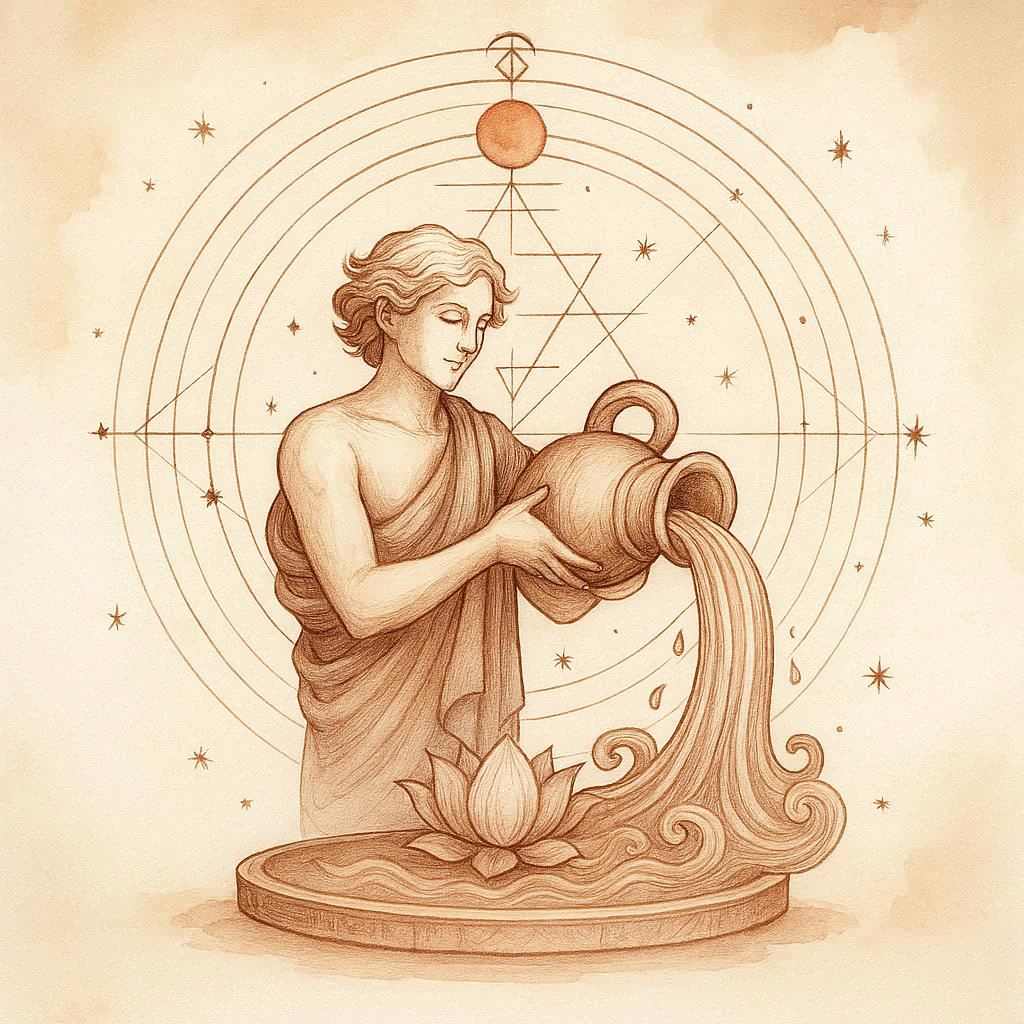
Kumbha
Kumbha is the eleventh rashi of Jyotish — the sign of the water-bearer, one of the most paradoxical symbols in the Vedic zodiac: an Air sign carrying water, the individual who serves the collective by bearing and distributing a precious resource without consuming it. Governed by Shani (Saturn) and Rahu (the north lunar node), Kumbha operates at the intersection of the conventional and the revolutionary, the structured and the visionary, the karmic past (Shani) and the future possibility (Rahu). In Jyotish, the eleventh house — which Kumbha governs by natural correspondence — rules gains, social networks, elder siblings, the realisation of long-term hopes, and the community of like-minded people: the domain in which individual effort connects to collective benefit. Kumbha is the rashi of reformers, humanitarians, scientists, and all those who have the unusual quality of seeing the future more clearly than the present — who live, in some sense, ahead of their time. The combination of Shani's discipline and Rahu's boundary-crossing energy creates an individual who can build unconventional structures, challenge established systems with practical alternatives, and embody the future while remaining functional in the present.
- Dates
- February 12 – March 12 (sidereal). Note: Vedic astrology uses the sidereal zodiac — dates differ from Western tropical signs by approximately 23 days.
- Element
- Air
- Ruling Planet
- Saturn (Shani) and Rahu
- Quality
- Sthira (Fixed)
- Strengths
- Humanitarian · Original · Independent · Inventive · Visionary
- Weaknesses
- Detached · Eccentric · Unpredictable · Contrary · Aloof
Personality
The Kumbha personality is one of the most genuinely individual in the Vedic zodiac — not in the Simha sense of seeking personal distinction, but in the sense of a fundamental inner orientation that cannot easily conform to conventional expectations. Rahu's influence creates an instinctive attraction to the unconventional, the experimental, and the not-yet-existing — these individuals are energised by ideas at the frontier of the possible, by people who are doing something genuinely different, and by the prospect of contributing to something larger than personal gain. Shani's co-rulership provides the structural intelligence and disciplined persistence that prevents the Rahu quality from remaining perpetually in the realm of unfulfilled possibility: Kumbha can actualise visionary ideas when the Shani discipline is engaged. The most notable Kumbha paradox is the simultaneous orientation toward collective humanity (they care deeply about the welfare of people in general) and the difficulty with close personal intimacy (they can give themselves fully to an abstract cause in ways they struggle to give themselves to a specific person). In Jyotish, this paradox is understood as the eleventh house quality: gains and social networks rather than the personal, intimate bonds of the seventh.
Love & Relationships
In love, Kumbha presents one of the most complex configurations in the Vedic zodiac: the simultaneous desire for deep personal connection and the instinctive resistance to the forms of closeness that most partners associate with intimacy. Rahu's influence creates an attraction to the unusual and the unconventional in romantic relationships — Kumbha is more likely than any other rashi to fall for someone who defies conventional categories, or to structure a relationship in a format that doesn't match the standard templates. Shani's influence creates the loyalty and long-term commitment capacity, but it comes wrapped in emotional reserve and the particular Kumbha difficulty with vulnerability: these individuals understand love better at the level of collective principle (care for all beings, the ethics of relationship, the vision of a world organised around human dignity) than at the level of the particular beloved in front of them. The deepest Kumbha love journey involves learning to value the specific over the general — to bring the same quality of devotion to an individual person that Kumbha naturally extends to humanity at large.
Work & Career
Kumbha excels in careers at the frontier of knowledge or social change — technology (particularly artificial intelligence, systems design, and disruptive innovation), social reform, humanitarian work, scientific research, astrology (significantly, Kumbha governs the transmission of astrological knowledge in Jyotish tradition), social entrepreneurship, broadcasting, and any career requiring the ability to see systemic patterns that others miss. The Vedic tradition connects Rahu's influence with the future — Rahu governs what is new, foreign, technologically innovative, and culturally emergent — and Shani provides the structural intelligence required to translate Rahu's visions into workable systems. In Jyotish career analysis, Kumbha natives often find their professional lives organised around a cause rather than a conventional career trajectory: they are most energised when their work serves a purpose larger than personal advancement, and most effective when they can bring their systemic vision to bear on practical problems that affect large numbers of people.
Health & Wellbeing
Jyotish associates Kumbha with the ankles, calves, circulatory system, and nervous system — the body's channels of flow and the structures that conduct energy from the core to the periphery. The circulatory connection is apt: Kumbha's role is distribution — the water-bearer who carries the resource that sustains life — and the body reflects this in its circulatory channels, which distribute oxygenated blood to the entire system. Kumbha natives are prone to conditions of the ankles and lower legs, circulatory irregularities, and the nervous system conditions that Rahu's erratic energy can generate: anxiety, insomnia, hyperactivity of the nervous system, and the health consequences of living mentally ahead of the present moment. In Ayurvedic terms, Kumbha types tend strongly toward Vata constitution: the qualities of the Rahu-Shani air combination create the classic Vata profile of dryness, lightness, mobility, and sensitivity to cold. The prescription for Kumbha health: grounding practices that bring the nervous system into the present, warm oil applications (especially on the feet and ankles), regular consistent sleep, and any form of practice that creates connection with the body rather than the mind.
Mythology & Symbolism
Kumbha's dual rulership by Shani and Rahu creates a mythological field of unusual complexity. Shani brings the mythology of karma, time, and the patient inevitability of consequence; Rahu brings the mythology of ambition, transgression, and the unsatisfiable hunger for experience that characterises the head without a body — because Rahu is precisely that: the severed head of Svarbhanu, the asura who drank the nectar of immortality before being discovered and cut in two. The Kumbha Mela — the great pilgrimage festival that gathers at the confluence of sacred rivers every twelve years — is one of the largest human gatherings on Earth and takes its name directly from this rashi: it commemorates the drops of Amrita that fell from the celestial pot (kumbha) as the gods carried it across the sky, creating sacred sites at the places where the nectar touched earth. The water-bearer as a symbol thus carries the most sacred substance in the Vedic tradition — not water but the nectar of immortality — and distributes it to the entire collective as an act of cosmic generosity.
This Sign in Other Cultures
The water-bearer of Kumbha is one of the most universally recognised zodiac symbols, appearing across cultures with remarkable consistency in its association with the distribution of a vital, life-sustaining resource. In Mesopotamian astrology, the equivalent figure was the Great One (GU.LA) — Enki as the water-flowing deity who oversees the irrigation systems upon which Mesopotamian civilisation depended. In Egyptian astrology, the equivalent figure is associated with the annual flooding of the Nile — the periodic gift of life-sustaining water that, when it came in the right measure at the right time, renewed the fertility of the entire land. Western tropical astrology places Aquarius from approximately January 20 to February 18 — about 23 days earlier than sidereal Kumbha — with the same Saturnian rulership (and, in modern Western astrology, the additional rulership of Uranus) and emphasis on originality, humanitarianism, and the forward-oriented collective vision. The Kumbha Mela in India — the largest human gathering on Earth — gives this rashi a cultural resonance that no other zodiac sign in any tradition can match in terms of sheer collective participation.
Compatibility
Challenging with