


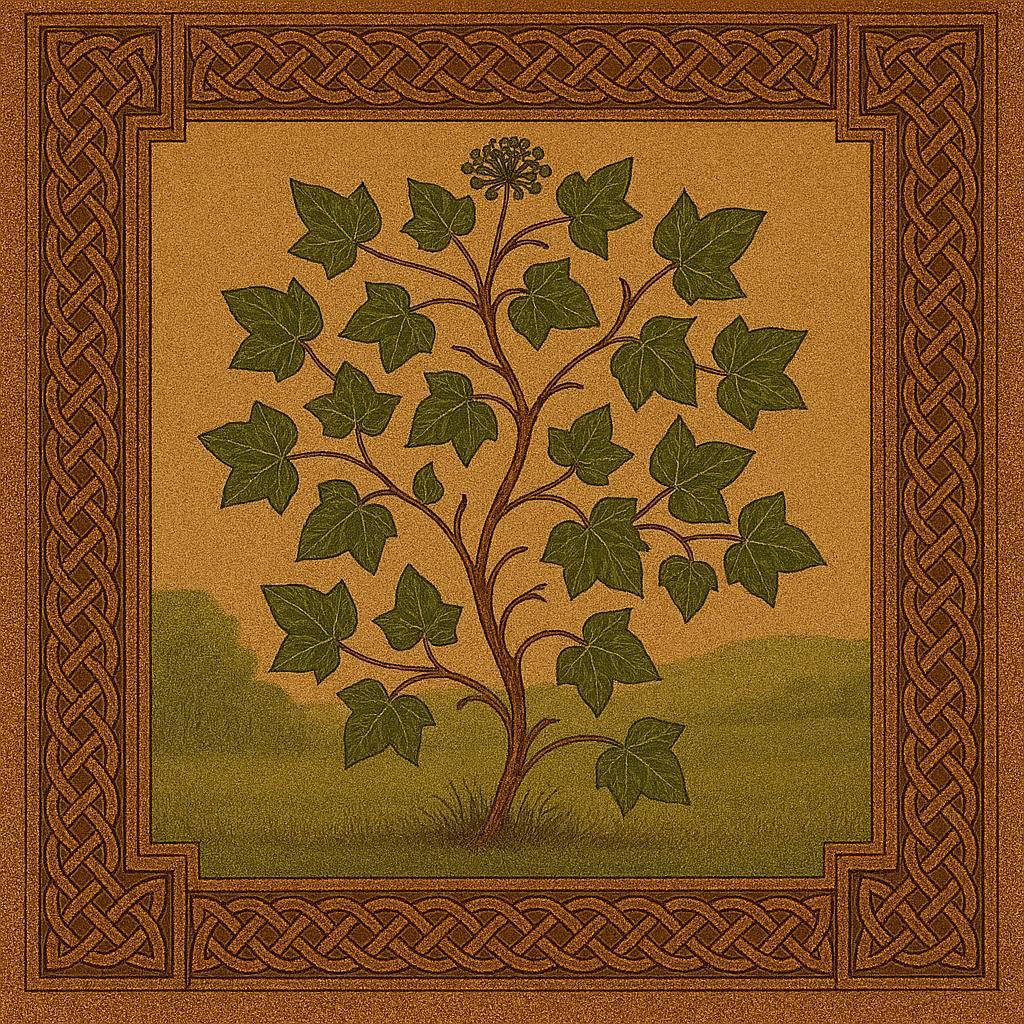
Ivy
Ivy is the Celtic sign of the survivor — a plant that clings, climbs, and conquers. Born under the waning light of autumn, Ivy people carry within them both shadow and remarkable strength. They navigate life's labyrinths with extraordinary persistence, finding paths where others see only walls. The Moon governs their deep emotional life, washing them in tides of feeling that fuel both their empathy and their inner storms. Ivy's climbing nature speaks to a soul that, despite setbacks, always finds a way to reach toward the light — slowly, steadily, unmistakably.
- Dates
- September 30 – October 27
- Element
- Water
- Ruling Planet
- Moon
- Quality
- Mutable
- Strengths
- Resilient · Compassionate · Loyal · Perceptive · Tenacious
- Weaknesses
- Clingy · Indecisive · Pessimistic · Manipulative · Self-doubting
Personality
Ivy people are the great survivors of the Celtic wheel. Life may knock them down repeatedly, but they always find a way to keep growing — through cracks in concrete, over stone walls, into the light. This tenacity is not aggressive or flashy; it is quiet, persistent, and ultimately unstoppable. Beneath their calm exterior, Ivy souls experience an intense inner world. The Moon's influence makes them emotionally receptive to a degree that can be both a gift and a burden — they feel everything deeply, absorb the moods of those around them, and carry wounds long after others have moved on. Ivy's natural duality is one of their most defining features. They can be simultaneously warm and withdrawn, open and secretive, light-hearted and profoundly melancholic. This paradox often confuses the people in their lives, and sometimes confuses Ivy themselves. They are not being deceptive — they genuinely contain multitudes. The challenge for Ivy is learning to accept and integrate these contrasting aspects of their nature rather than fighting against them. Compassion is one of Ivy's greatest gifts. They have a deep, instinctive understanding of suffering — both their own and others'. This makes them extraordinary friends and confidants, the type who sit with you in the dark without trying to turn on the lights too quickly. They do not shy away from the difficult conversations, the messy emotions, the complicated truths of the human experience. Where others offer platitudes, Ivy offers presence. However, Ivy can struggle with their own inner obstacles as much as with outer challenges. Self-doubt can creep in like a persistent vine, undermining their confidence at critical moments. The fear of being abandoned — of losing the structures they have wrapped themselves around — can lead them to cling too tightly to relationships and situations that have passed their natural lifespan. Learning to let go, and to trust that they will find new supports to climb, is among Ivy's most important life lessons.
Love & Relationships
In love, Ivy is deeply devoted — sometimes to a fault. They give their whole selves to relationships and can struggle enormously when those relationships end or change. Their fear of abandonment runs deep, and they may stay in partnerships long past their healthy expiration date simply because the thought of being alone feels unbearable. Partners who offer reliability, emotional depth, and genuine presence will bring out the very best in Ivy. In return, Ivy offers a loyalty that borders on the fierce — they will walk through fire for the people they love. The Moon's influence means that Ivy's emotional landscape shifts with the rhythms of life. There will be times of radiant warmth and connection, and times of withdrawal into the inner cave. A wise partner learns to recognize these cycles without taking them personally. In the deep places, Ivy loves with extraordinary tenderness and perceptiveness — they notice what you need before you say it, they remember what matters to you, and they show up in the small, consistent ways that build lasting intimacy.
Work & Career
Ivy brings remarkable persistence to professional life. They are the colleagues who keep the project alive when everyone else has given up, who find the workaround, who stay late not out of obligation but because they genuinely cannot leave something unfinished. Their emotional intelligence is a significant workplace asset — they read team dynamics with precision and can smooth over conflicts that others escalate. Ivy thrives in roles that involve supporting, healing, counselling, or caring for others — social work, healthcare, psychology, and teaching are natural fits. They also excel in creative fields where depth of feeling translates into resonant work — music, poetry, photography, and writing all benefit from Ivy's emotional richness. They do less well in highly competitive, ego-driven environments where their inclination toward collaboration and empathy can be mistaken for weakness. The Ivy worker is motivated by meaning more than by money or status. Give them work that matters — that helps real people, that creates beauty, that solves genuine problems — and they will give everything they have. Give them hollow ambition, and they will quietly wither.
Health & Wellbeing
The Ivy constitution is strongly influenced by emotional states, making mental and emotional wellbeing the cornerstone of physical health. When Ivy's inner world is calm, the body tends to follow. When they are in turmoil — grieving, anxious, trapped in cycles of worry — physical symptoms often arise: digestive troubles, disturbed sleep, tension headaches, and general depletion of vitality. Ivy benefits enormously from practices that address the nervous system: meditation, breathwork, time in nature, and gentle movement like yoga or walking. They are particularly responsive to the rhythm of the lunar cycle and may notice that their energy, mood, and physical wellbeing fluctuate in tune with the Moon's phases. Paying attention to these rhythms — rather than fighting against them — allows Ivy to work with their nature rather than against it. Ivy must be vigilant about emotional boundaries. Because they absorb the feelings of others so readily, spending extended time with highly stressed or negative people can leave them genuinely depleted. Regular solitude and practices of energetic clearing — whatever form that takes for the individual — are not luxuries for Ivy but necessities.
Mythology & Symbolism
In Celtic tradition, Ivy was one of the most spiritually potent plants — a perennial evergreen that grew without ceasing, binding itself to its host while never killing it outright. This ambiguous relationship between support and parasitism gave Ivy a complex mythology, representing both the blessings and burdens of attachment. Ivy was associated with Dionysus (Bacchus in the Roman tradition) across cultures — wound around the thyrsus staff and worn as crowns by his followers, the Maenads. This connection linked Ivy to the ecstatic states of divine intoxication, to the dissolution of ordinary boundaries, and to the primal creative force that flows through all living things. In this sense, Ivy was not merely a decorative plant but a portal — a way of touching the vine-god's transformative wildness. In the Ogham alphabet — the ancient Irish script carved into standing stones — Ivy was called Gort, the tenth letter. Gort meant "field" or "garden" in Old Irish, representing cultivated space where the human and the natural met in mutual relationship. Ivy was seen as a guide through the labyrinthine complexity of the natural world, a plant that knew the paths between the visible and invisible realms. Celtic herbalists associated Ivy with the mysteries of the inner world and with healing of the mind. Ivy water — collected from plants in certain sacred conditions — was believed to have properties that could clear the sight and sharpen intuition, qualities that resonate deeply with the introspective nature of Ivy-born individuals.
This Sign in Other Cultures
Ivy's spiritual significance extends far beyond the Celtic world. In ancient Greece and Rome, Ivy was the sacred plant of Dionysus/Bacchus and was believed to have the power to prevent intoxication when worn — creating the curious paradox of the plant associated with wine's god also being considered its antidote. Garlands of Ivy crowned revellers at festivals, and the plant was hung outside taverns and wine shops as a symbol of good drinking. In ancient Egypt, Ivy was dedicated to Osiris — the god of death, resurrection, and the eternal cycle. The plant's capacity to remain green through the darkness of winter linked it to the promise of rebirth and the persistence of life through apparent death. In Christian symbolism, Ivy came to represent eternal life, fidelity, and the clinging bond of love — it was planted on graves and trained over church walls as a symbol of the soul's undying nature. The plant's tendency to cling was reinterpreted as the soul's attachment to God. In Japanese tradition, though the symbolic system is different, similar climbing plants like wisteria (fuji) are associated with love, devotion, and the tender persistence of feeling — echoing Ivy's emotional themes across cultural boundaries. In the language of Victorian flowers, Ivy specifically signified "fidelity in friendship and marriage," "wedded love," and "undying affection" — the same devotional qualities that characterize Ivy-born people in the Celtic tradition.
Compatibility
Best with
Oak, Ash
Challenging with
Hawthorn, Holly