


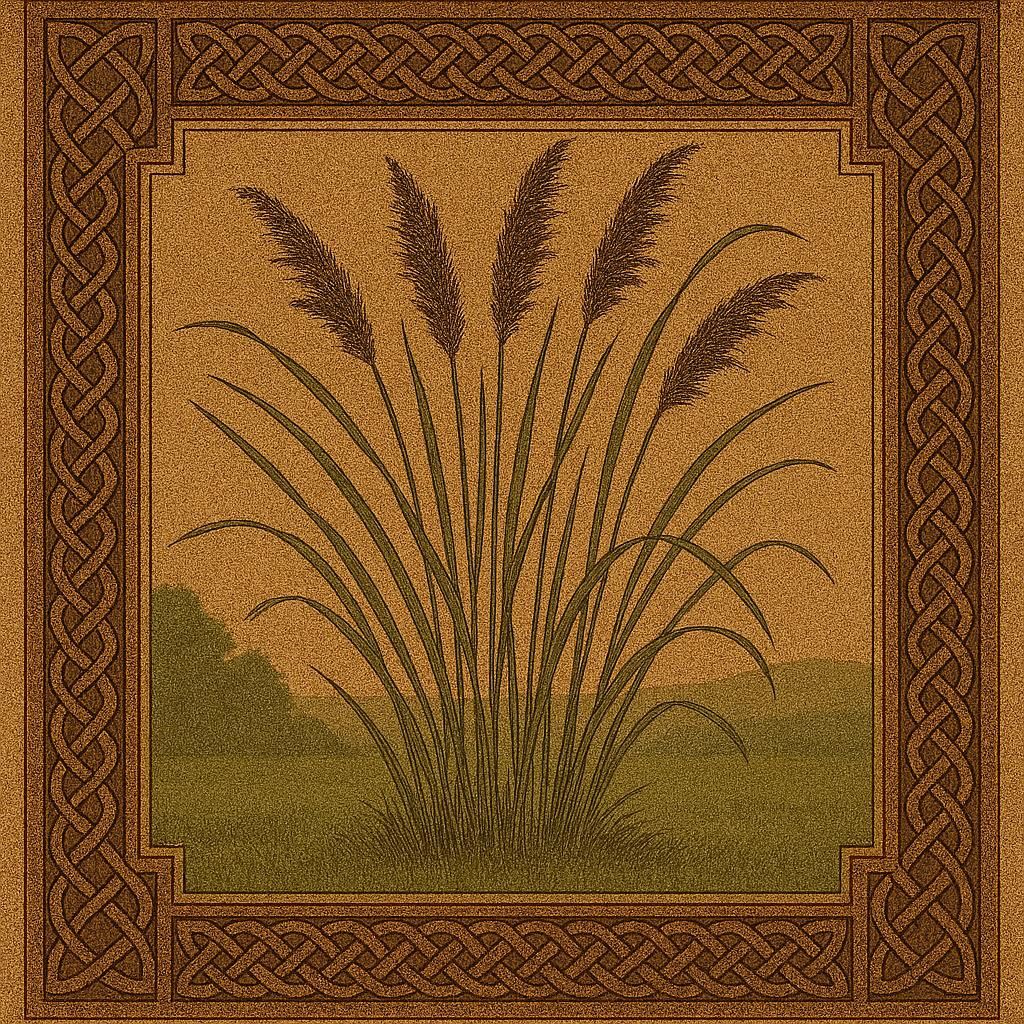
Reed
Reed is the Celtic sign of the seeker — deep, purposeful, and possessed of a vision that reaches beyond the surface of things. Born as the year turns toward its darkest hour, Reed people carry the intensity of approaching winter within them. They are not afraid of the dark; in many ways, they are its masters. Where others retreat from the depths of existence — from pain, from complexity, from the uncomfortable truths that lurk beneath polished surfaces — Reed moves deliberately inward, armed with a torch that illuminates what most prefer to leave unseen. The Reed grows in the liminal space between water and land, between the seen and unseen worlds. This in-between quality defines Reed people: they exist at the intersection of the ordinary and the profound, the practical and the mystical. Their gift is transformation — the capacity to enter the underworld of experience and emerge with something of value, renewed and remade by the journey.
- Dates
- October 28 – November 24
- Element
- Water
- Ruling Planet
- Pluto
- Quality
- Fixed
- Strengths
- Purposeful · Resourceful · Intense · Protective · Visionary
- Weaknesses
- Secretive · Controlling · Vengeful · Obsessive · Ruthless
Personality
Reed people are among the most complex and powerful individuals in the Celtic wheel. Pluto's influence grants them an instinctive understanding of power, hidden forces, and the mechanism of transformation — they can see what others miss, sense what others deny, and navigate realms of complexity that leave less perceptive people overwhelmed. This depth is their greatest gift, but it comes with significant challenges. Reed's intensity can be difficult for both themselves and others to manage. When focused on a purpose, they are formidable — completely committed, endlessly resourceful, capable of achieving things that seem impossible from the outside. When that intensity has no positive outlet, it can turn inward as self-destructiveness or outward as manipulation and control. Reed people have a powerful need to understand the truth of things — the real motivations behind actions, the genuine structures beneath appearances, the authentic core beneath the social performance. They are natural investigators, psychologists, shamans, and truth-seekers. Deception — even social niceties that most people accept without thought — bothers them profoundly. They would rather have a difficult truth than a comfortable lie. The shadow side of Reed involves power dynamics. At their best, Reed uses their perceptiveness and power to protect and transform — they are the ones who call out abuse, expose hypocrisy, and stand steadfast in the face of corruption. At their worst, they can become the very forces of control and manipulation they so despise in others. The greatest spiritual work for Reed is learning to hold power with wisdom rather than fear. Reed is also among the most loyal and protective of signs. Those who win Reed's trust and love receive a fierce, unwavering devotion. Those who betray Reed's trust would do well to remember that this is a sign ruled by Pluto — the planet of depth, transformation, and inexorable consequence.
Love & Relationships
Reed in love is an all-or-nothing proposition. They do not dabble in shallow relationships — they are not built for casual dating or the emotional tourism of connections that go nowhere. When Reed loves, they love completely, with every layer of their complex being. This makes them extraordinarily intimate partners, capable of a depth of connection that most people only dream of. The shadow side of Reed's love is possessiveness and the fear of loss — which can sometimes express as controlling behaviour. Reed must learn the paradox that true love requires releasing control rather than tightening it. The beloved flourishes when given freedom; they wither when caged, no matter how beautifully furnished the cage. Sexually, Reed is the most passionate of the Celtic signs — Pluto's domain includes the transformative power of physical and emotional merging. For Reed, intimacy is never merely physical; it is an act of mutual transformation, a death-and-rebirth of the separate ego in the space between two people. Partners who can meet them at this depth will find a devotion that is as close to eternity as human relationships can be.
Work & Career
Reed is most powerful in work that involves investigation, healing transformation, or the exercise of genuine authority. They excel in psychology, detective work, research, surgery, forensics, journalism (particularly investigative), and positions that require navigating complex power dynamics — management, politics, law, and strategic leadership. The Reed professional is not motivated by comfort or approval — they are motivated by impact. They want to change things, expose what is hidden, heal what is wounded, and build structures that last. Hollow work that neither challenges them nor serves a meaningful purpose leaves them restless and corrosive. Give Reed a problem worth solving and an environment that respects their intensity, and they will achieve results that exceed all expectations. Reed must be watchful of their relationship to workplace power. Their natural authority can be an enormous asset, but it requires conscious management — the line between strong leadership and controlling behaviour can blur for Reed when they are under stress or when they feel their purpose is being thwarted.
Health & Wellbeing
Reed's intense emotional and psychological life places significant demands on the body, particularly the nervous system, the immune system, and — given the Water element and Pluto's rulership — the reproductive system and organs of elimination. Reed can suppress and internalise stress to a remarkable degree, which makes regular emotional processing and physical release non-negotiable priorities. The most dangerous health pattern for Reed is holding on — holding onto anger, grief, resentment, and unexpressed intensity until it turns sour in the body. Physical symptoms that arise from this pattern include back pain (especially lower), digestive issues, and hormonal imbalances. Reed benefits from practices that facilitate genuine release: intense physical exercise, therapeutic bodywork, and psychotherapy are all highly effective. Reed must also attend to their relationship with power and control in health contexts. They can be resistant to seeking help — preferring to manage everything themselves — which can delay necessary medical attention. Learning to be a patient rather than always the healer or controller is part of Reed's health journey. Sleep and rest can be challenging for Reed, whose active mind rarely fully quiets. Establishing consistent sleep rituals and creating physical environments of genuine safety and comfort supports their deep nature.
Mythology & Symbolism
Reed holds a singular place in Celtic mythology as the plant of the underworld journey and the keeper of secrets. In the Ogham alphabet, Reed was called Ngetal — the twelfth letter, associated with the hidden, the curative, and the transformative. The Reed month coincided with the festival of Samhain — the Celtic new year and the night when the veil between the living and the dead grew thin. Reed therefore governed the liminal space of death and transformation at the year's threshold. In ancient Irish tradition, the Reed was used to make musical instruments — pipes and flutes that could carry the voice of the otherworld into the human realm. The music of the Reed was considered to have shamanic properties: it could call spirits, heal illness, and guide souls of the recently departed toward their rest. Reed music was played at funerals, at healing rituals, and at the great celebrations of the seasonal cycle. One of the most powerful Reed myths appears across multiple Indo-European cultures: the story of the reed that could speak the truth. In the Turkish and Persian Sufi tradition, Rumi's Masnavi opens with the mournful song of the Reed — cut from the reed bed, longing to return to its source, and in that longing expressing the universal soul's yearning for reunion with the divine. The Reed is the voice of loss and the voice of transcendence simultaneously. In Celtic tales, Reed people were often the shamans, the seers, and the underworld guides — those who could cross the threshold between death and life and return with wisdom. The Dagda's sacred Cauldron of Plenty, which could restore the dead to life, was associated with Reed energy — the power to transform death into nourishment.
This Sign in Other Cultures
The Reed's spiritual significance as a liminal plant — connecting the worlds of the living and the dead, the visible and the invisible — appears across many cultures and traditions. In ancient Egypt, Reed was used extensively in the construction of the Book of the Dead papyri — the very texts that guided souls through the underworld. Reed pens wrote the sacred words that protected the deceased on their journey. Egyptian mythology also associated marshland Reed with the birth of Horus: the infant god was hidden in the Reed beds of the Nile Delta by his mother Isis to protect him from Set, making Reed a symbol of protection and concealed sacred power. In the Sufi poetry tradition, the Reed flute (ney) is among the most sacred of instruments — the opening verses of Rumi's Masnavi describe the ney crying out for its homeland, the reed bed from which it was cut. This image of separation and longing became one of the central metaphors of Islamic mysticism, representing the soul's exile from divine union and its perpetual yearning to return. In Japanese culture, the name Yamato — the ancient poetic name for Japan itself — derives from words meaning "reed plains," reflecting the Reed's sacred association with the land and with origin. Reed was woven into the very identity of Japanese civilization. In Greek mythology, the god Pan famously crafted his syrinx (panpipes) from Reed — the plant transformed into music by a god's grief at the transformation of his beloved nymph Syrinx into a Reed bed by the river god. The myth encodes Reed's essence perfectly: loss, transformation, and the creation of beauty and voice from that transformation.
Compatibility
Best with
Ash, Oak
Challenging with
Birch, Rowan