


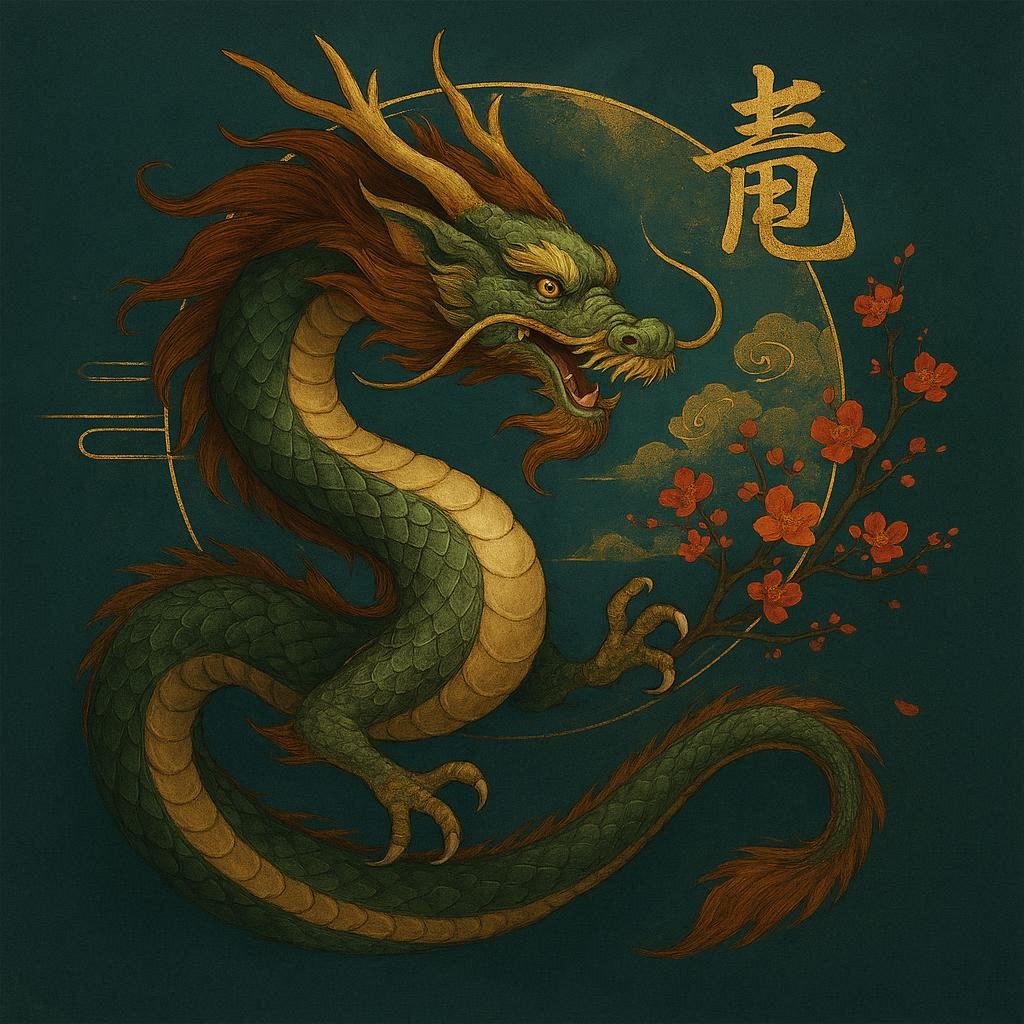
Dragon
The Dragon is the only mythical creature in the Chinese zodiac — and it holds the most coveted position. Unlike the Western dragon, which is a symbol of evil to be slain, the Chinese Dragon is a divine creature: the guardian of water, controller of rain and rivers, bringer of luck and abundance. It is the symbol of the emperor, of imperial authority, and of the kind of greatness that does not require explanation. To be born in a Dragon year is considered the greatest fortune in the Chinese system, and Dragon years reliably see spikes in birth rates across East Asia as families try to ensure their children carry this sign. The Dragon does not disappoint its mythology. People born under this sign carry an unmistakable vitality — a blazing, forward-moving energy that seems to fill whatever room they enter and to make things happen wherever they direct their attention.
- Dates
- Years: 2024, 2012, 2000, 1988, 1976, 1964 (every 12 years). Note: Chinese New Year falls between Jan 21–Feb 20 — those born in January or early February should verify their animal year.
- Element
- Earth
- Ruling Planet
- Venus
- Quality
- Yang
- Strengths
- Magnanimous · Visionary · Energetic · Fearless · Inspiring
- Weaknesses
- Arrogant · Impatient · Dogmatic · Demanding · Tactless
Personality
The Dragon is a storehouse of energy. It approaches life at full throttle — goals pursued with religious zeal, opinions delivered as imperial edicts, projects undertaken on a grand scale because there is simply no other scale that interests the Dragon. This is the sign most likely to make headlines, for good or ill. The Dragon is direct, outspoken, and genuinely incapable of small deception; it cannot maintain pretense because it moves too fast and too openly for subterfuge. Its honesty can be brutal, its impatience can be devastating, and its self-certainty can calcify into a refusal to hear counsel that might actually save it. The shadow is not malice — the Dragon is not cruel by nature — but it is a kind of magnificent blindness: the Dragon does not always see the traps ahead because it is too busy charging toward the horizon. It needs people around it who can see what it cannot, and it must learn to actually listen to them.
Love & Relationships
The Dragon does not take love for granted as a concept — but it does take it for granted as a personal entitlement. It expects admiration, loyalty, and a partner who is secure enough not to require constant reassurance. What the Dragon offers in return is genuine and fierce: when it loves, it loves completely, defends its partner without hesitation, and brings an intensity to the relationship that lesser signs find overwhelming. The danger is that the Dragon tends to operate on its own terms and its own schedule, which can make a partner feel overlooked. The Dragon is not deliberately inconsiderate; it simply assumes that everyone in its orbit shares its ability to keep up. A partner who can meet the Dragon's energy, challenge its thinking, and maintain their own independent life will hold its attention. A partner who asks it to slow down will eventually lose it.
Work & Career
The Dragon is built for leadership and for the kind of work that requires vision, magnetism, and the willingness to operate at scale. It excels as an entrepreneur, politician, military commander, activist, artist, or any role that gives it a platform and a cause. The Dragon does not perform well in structures that require subordination, routine, or the suppression of its considerable personality. It needs to be the lead. Given that lead, it can produce results that genuinely seem miraculous. The Dragon does not manage resources efficiently — it burns through them, betting on its own capacity to generate more — and it does not always plan carefully enough, trusting momentum over method. But what it generates in inspiration and forward motion is rare. Most teams that have a Dragon at their center do not want to lose it, despite everything. The Dragon is the engine that makes things happen.
Health & Wellbeing
The Dragon has formidable physical energy but manages it poorly. This is the sign most likely to run at unsustainable intensity for extended periods and then crash dramatically. It does not naturally pace itself, does not respond well to weakness in itself, and may ignore medical symptoms that it interprets as inconvenient interruptions to its actual work. The cardiovascular system and the adrenal system bear particular stress in Dragon natives — the body is running a constant high-performance program, and the maintenance costs accumulate. The Dragon benefits enormously from regular physical exercise vigorous enough to match its energy output, and from learning to treat its own body with the same fierce loyalty it extends to the people it loves. It also needs to understand that recovery is not failure: the Dragon that rests strategically performs better, lives longer, and achieves more.
Mythology & Symbolism
The Chinese Dragon — Lóng — is a composite creature of tremendous power: the body of a serpent, the scales of a fish, the claws of an eagle, the antlers of a stag, and the face of a camel or horse. It commands the water — rivers, seas, rain — and serves as the divine guardian of the emperor, whose throne was called the Dragon Throne and whose ceremonial robes bore the Dragon symbol. In the legend of the zodiac race, the Dragon could have won easily — it can fly. But it stopped along the way to bring rain to a drought-stricken village, and was further delayed when it helped the Rabbit cross the river on a log. It arrived fifth and accepted the delay with equanimity. Even in this story, the Dragon is generous almost to its own detriment — a quality that is distinctly its own.
This Sign in Other Cultures
In Western astrology, the Dragon's qualities most closely align with Aries and Leo — the same solar energy, the same need for significance, the same capacity for both greatness and overreach. In Hindu mythology, the Nāga — divine serpent-dragon beings — are powerful and ambivalent figures who inhabit the waters and possess secret knowledge. In Japanese mythology, the Ryū are dragon-gods of the sea, benevolent and majestic, depicted in shrines across the country. The Dragon's uniqueness among the zodiac — being the only creature that does not exist in nature — is interpreted by many scholars as a statement about the Dragon's character: it belongs to a category that transcends ordinary classification.
Compatibility
Best with
Rat, Monkey, Rooster
Challenging with
Dog, Rabbit