


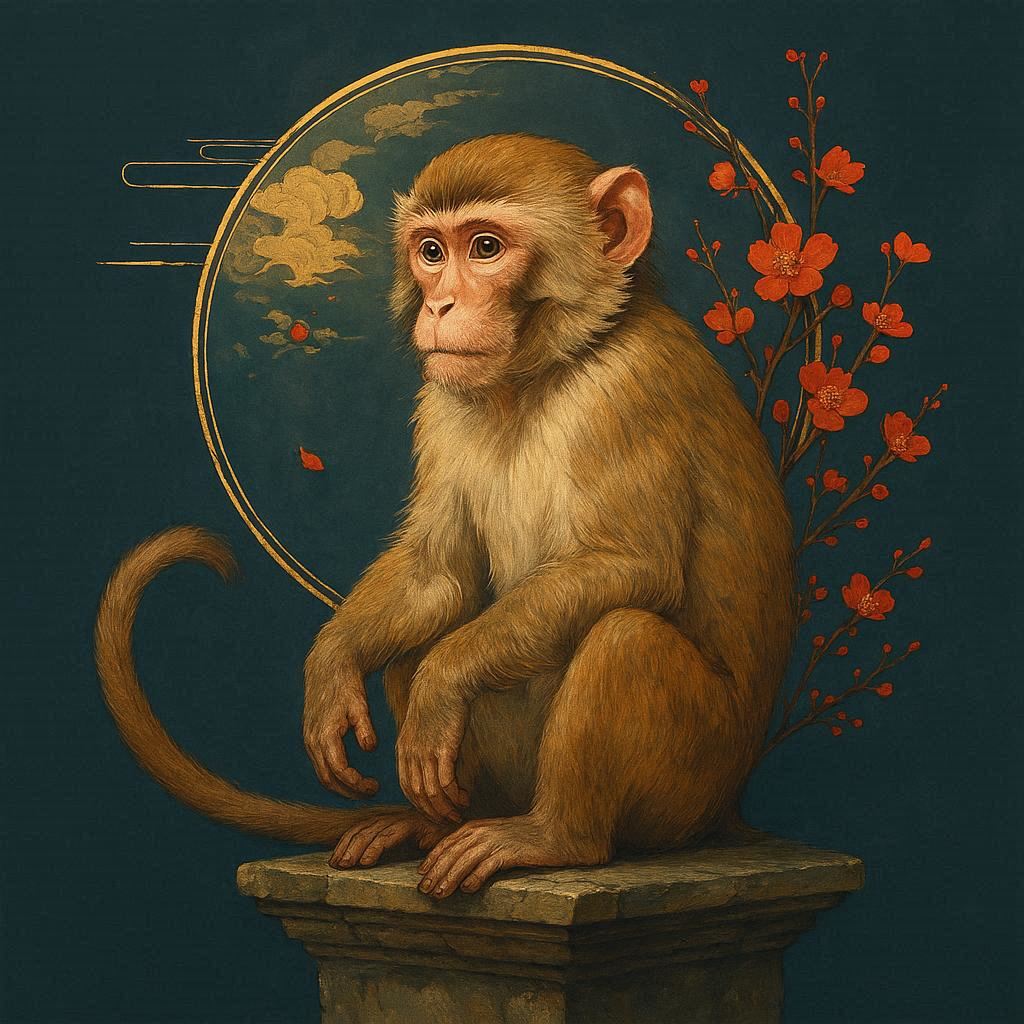
Monkey
The Monkey is the ninth sign of the Chinese zodiac and occupies a singular position in the cycle: it is the supreme inventor, the problem solver, the sign whose intelligence is so conspicuous that even its rivals concede it. Quick-witted and multi-talented, the Monkey can master virtually anything it turns its attention to. In Chinese culture, the Monkey is associated with ingenuity, cleverness, and the ability to find a solution where no one else sees one. The Monkey's cleverness is famous throughout Chinese history, and its name is synonymous with both genius and guile. The challenge of this sign is not capacity but trustworthiness: the Monkey's formidable mind works just as easily in the service of manipulation as in the service of creation, and it must consciously choose which master it serves.
- Dates
- Years: 2028, 2016, 2004, 1992, 1980, 1968 (every 12 years). Note: Chinese New Year falls between Jan 21–Feb 20 — those born in January or early February should verify their animal year.
- Element
- Metal
- Ruling Planet
- Venus
- Quality
- Yang
- Strengths
- Clever · Innovative · Versatile · Witty · Resourceful
- Weaknesses
- Cunning · Vain · Jealous · Restless · Unscrupulous
Personality
The Monkey's most defining quality is not its intelligence per se but the ease with which that intelligence operates. Problems that stump other signs for weeks are dismantled by the Monkey in an afternoon. It thinks several steps ahead without effort, reads people accurately, and improvises solutions on the spot that turn out to work. This natural competence creates the Monkey's central paradox: because things come easily, the Monkey does not always treasure what it has. It wins, loses interest, moves on. Loyalty and constancy require a conscious effort that the Monkey must choose to make. The Monkey is also deeply competitive — it cannot help measuring itself against others, and it is stung by the success of rivals in a way it conceals beneath a surface of breezy confidence. This jealous streak is the crack in the armor: the Monkey that admits it is more formidable than the one that pretends it doesn't exist.
Love & Relationships
The Monkey is irresistible when it wants to be — charming, attentive, amusing, and capable of making a partner feel like the most interesting person in the world. The complication is that this intensity is partly performance: the Monkey genuinely enjoys the theatre of courtship, the game of discovery, the pleasure of being irresistible. When the novelty fades and the relationship requires sustained attention rather than inspired bursts, the Monkey can grow restless. Its ideal partner is someone who remains genuinely surprising — someone whose depth the Monkey cannot exhaust — and someone who matches its independence rather than needing constant reassurance. The Monkey is compatible with the Rat and the Dragon, both of whom operate at a similar intellectual pitch. It will clash with the Tiger, which sees through its maneuvers and refuses to be managed.
Work & Career
The Monkey performs brilliantly in any field that rewards quick thinking, adaptability, and innovation. Finance, technology, law, diplomacy, writing, performance, politics — the Monkey can master any of these and often excels in fields that combine several. It is an outstanding negotiator: it reads the room, identifies leverage, and secures outcomes others thought were impossible. The professional weakness is follow-through on routine work. The Monkey is drawn to the exciting opening moves of any venture and the clever closing maneuver, but the grinding middle ground tests its patience. It also needs to be careful about using its intelligence to cut corners in ways that eventually undermine trust. The Monkey that builds a reputation for delivering what it promises, and not just for being impressive, will go further than the one that relies entirely on brilliance.
Health & Wellbeing
The Monkey is physically resilient and generally healthy, but its primary vulnerability is the nervous system. An overactive mind that never fully rests generates a chronic low-level tension that, over time, manifests as irritability, insomnia, or skin conditions. The Monkey is also prone to overextending itself — taking on too many projects simultaneously, burning bright, and then crashing. The prescription is counterintuitive for a sign that prizes efficiency: genuine rest, not the managed rest of someone planning their next move, but actual stillness. Meditation, time in nature, or any practice that quiets the mental commentary gives the Monkey's extraordinarily active nervous system the recovery it needs. Dietary discipline also matters; the Monkey's tendency toward excess in pleasures extends to food.
Mythology & Symbolism
In the legend of the Great Race, the Monkey arrived ninth — not for lack of ability, but because it crossed part of the river on a raft together with the Goat and the Rooster, sharing the journey rather than competing alone. Once ashore, the Jade Emperor awarded the three positions in the order they stepped off: Goat eighth, Monkey ninth, Rooster tenth. The Monkey accepted its place without apparent complaint. In the broader Chinese literary tradition, the Monkey's most celebrated incarnation is Sun Wukong — the Monkey King — protagonist of the sixteenth-century novel *Journey to the West*. Sun Wukong is one of the most complex figures in Chinese literature: born from a magic stone, he masters the 72 Transformations, steals the peaches of immortality, defeats armies of heaven, and ultimately requires a Buddha to contain him. His journey from chaos and ego to wisdom and compassion mirrors the Monkey sign's deepest arc.
This Sign in Other Cultures
In Western astrology, the Monkey's qualities resonate most strongly with Gemini — the same quicksilver intelligence, the same versatility, the same ability to hold multiple perspectives simultaneously, the same reputation for unreliability. In Hindu tradition, the monkey god Hanuman is one of the most revered figures in the entire pantheon — a being of extraordinary strength, intelligence, and devotion whose intelligence is always in service of something greater than himself, which points to the Monkey sign's highest expression. In Japanese culture, the three wise monkeys — *mizaru* (see no evil), *kikazaru* (hear no evil), *iwazaru* (speak no evil) — originate from a Shinto shrine at Nikkō and have become one of the most globally recognized symbols of ethical conduct. Across cultures, the monkey consistently represents intelligence that can serve either the highest or lowest human impulses.
Compatibility
Best with
Rat, Dragon
Challenging with
Tiger, Snake