


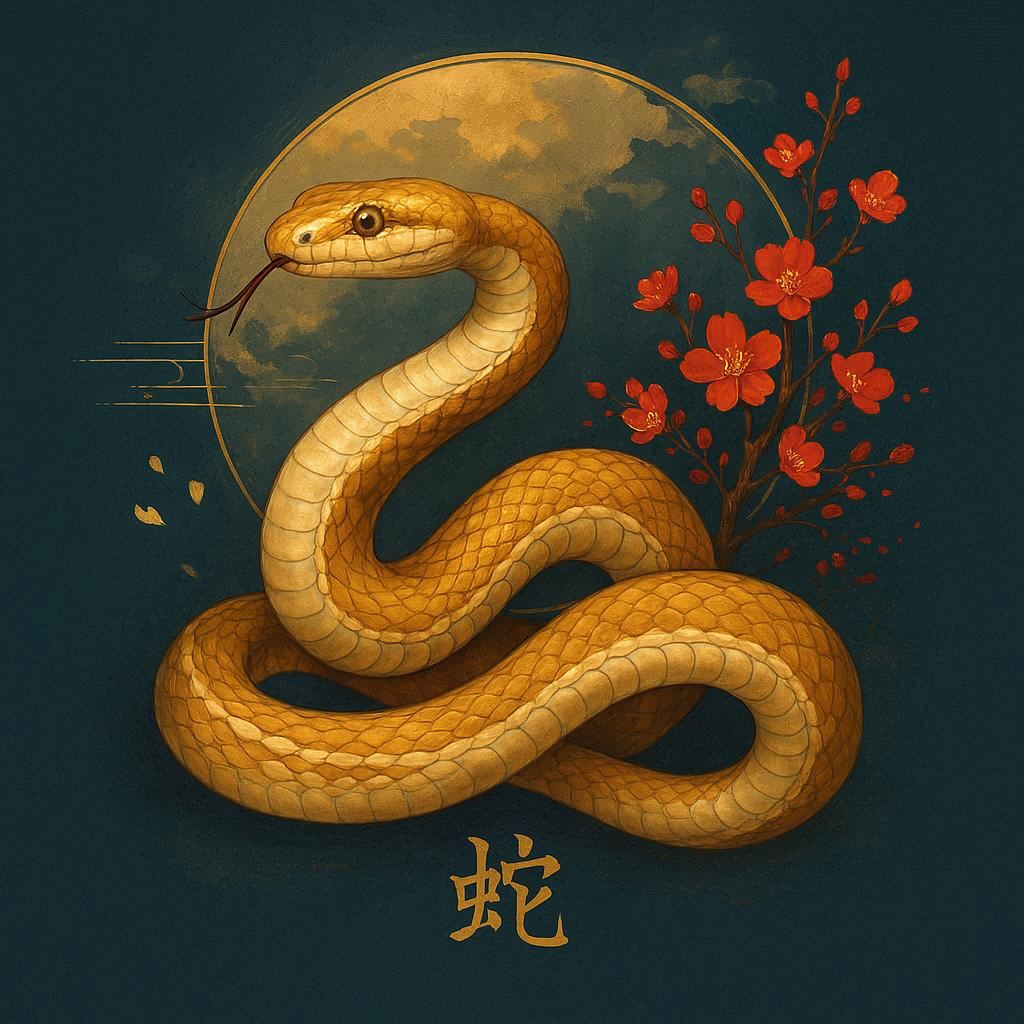
Snake
The Snake is the sixth sign of the Chinese zodiac and the deepest thinker of the cycle. In Chinese culture, the Snake is regarded not with the Western connotations of deception but as a symbol of wisdom, mystery, and the quiet kind of power that does not announce itself. The Snake moves without sound and strikes with precision — not from aggression but from a perfect understanding of the moment. People born under this sign are the philosophers, the mystics, and the strategists of the zodiac: endowed with an inborn wisdom that operates through intuition rather than logic, and with a personal magnetism that others find difficult to explain and impossible to resist. The Snake is not the loudest presence in a room, but it is invariably the most interesting one.
- Dates
- Years: 2025, 2013, 2001, 1989, 1977, 1965 (every 12 years). Note: Chinese New Year falls between Jan 21–Feb 20 — those born in January or early February should verify their animal year.
- Element
- Fire
- Ruling Planet
- Mars
- Quality
- Yin
- Strengths
- Wise · Intuitive · Elegant · Determined · Sophisticated
- Weaknesses
- Secretive · Suspicious · Possessive · Unforgiving · Manipulative
Personality
The Snake's primary tool is not force, not charm in the conventional sense, but perception. It reads situations and people with an accuracy that borders on the uncanny. It knows what you want before you say it, what you fear before you reveal it, and what you are likely to do before you decide. This knowledge is not obtained through calculation alone but through something more instinctive — a sensitivity to emotional and psychological reality that operates continuously and quietly. The Snake does not blurt this knowledge out; it files it away and uses it when precision matters. The shadow is a suspicion that can curdle into paranoia. The Snake does not trust easily and does not forget betrayal — ever. When its anger is aroused, it does not explode like the Tiger or confront like the Dragon: it simply waits, with enormous patience, for the right moment. The Snake is the most formidable long-term opponent in the zodiac.
Love & Relationships
The Snake in love is possessive, passionate, and deeply committed — but on its own inscrutable terms. It will not tell you everything it feels; it communicates through presence, through the quality of its attention, through acts that demonstrate investment rather than declarations that announce it. The Snake is genuinely sensual — it lives through its senses and needs physical and aesthetic beauty around it. In a relationship, it gravitates toward intensity and requires a partner who can match its depth. What it cannot tolerate is superficiality, disloyalty, or public humiliation. The Snake's jealousy, when triggered, is cold and total — it will not make a scene, but it will make a decision. Partners who betray a Snake's trust discover that its forgiveness is not available at any price. The Snake needs a companion who can appreciate its complexity, accept its privacy, and understand that its silence is not distance but depth.
Work & Career
The Snake is one of the most capable professionals in the zodiac — precise, thorough, strategic, and possessed of a depth of judgment that takes decades to fully develop. It excels in roles where analysis, discretion, and long-term thinking are the primary requirements: finance, law, research, intelligence work, medicine, philosophy, and the arts. The Snake never reveals its full hand; it enters negotiations knowing more than it shows and leaves with more than others realize it gained. The professional risk is paralysis through over-analysis. The Snake's need to understand every dimension of a problem before acting can delay action past the optimal moment. It also needs to guard against using its perceptive gifts for manipulation rather than genuine service — a temptation this sign faces more than most. At its best, the Snake is the wisest advisor in the room.
Health & Wellbeing
The Snake's constitution is finessed rather than robust. It tends to be physically sensitive — not fragile, but exquisitely tuned, so that stress, poor diet, or environmental disruption registers quickly in the body. The digestive system and the nervous system are the primary areas of vulnerability; the Snake holds tension internally with impressive composure, but the body accumulates what the face does not show. Stomach ulcers, nervous exhaustion, and tension-related conditions are characteristic. The Snake needs adequate sleep, high-quality nutrition, and physical environments that are genuinely beautiful and calm. Vigorous exercise — especially practices with a meditative dimension such as yoga, swimming, or tai chi — helps release the tension the Snake otherwise stores indefinitely. The most important health prescription for this sign is the periodic practice of letting go: releasing what it has been holding, which is usually more than anyone suspects.
Mythology & Symbolism
In Chinese mythology, the Snake is closely associated with the founding legend of Chinese civilization itself. Nüwa and Fuxi — the primordial creator deities of Chinese myth — are depicted as human from the waist up and serpentine from the waist down, their tails entwined. Nüwa created humanity from yellow clay, and Fuxi taught the first humans the arts of civilization. The snake-body represents their connection to the primal, generative forces of the earth. The Snake also sheds its skin and is reborn — a symbol of renewal, transformation, and the cyclical nature of life. In the zodiac legend, the Snake secured its sixth place by hiding in the Horse's hoof, emerging at the last moment to startle the Horse and claim its position — a move perfectly in character.
This Sign in Other Cultures
In Western astrology, the Snake's qualities most closely align with Scorpio — the same depth, the same intensity, the same combination of perceptive intelligence and the capacity for devastating silence. In Vedic astrology, the Nāga (serpent beings) are complex figures associated with wisdom, the underworld, and secret knowledge — an alignment with the Snake's essential character. Across cultures, the snake is one of the oldest and most universal symbols in human mythology: it appears on the caduceus of Hermes, in the Garden of Eden, in the Aztec deity Quetzalcoatl, and in Hindu iconography around Shiva's neck — always associated with transformation, hidden knowledge, and the dual nature of creation and destruction.
Compatibility
Best with
Ox, Rooster
Challenging with
Tiger, Pig