


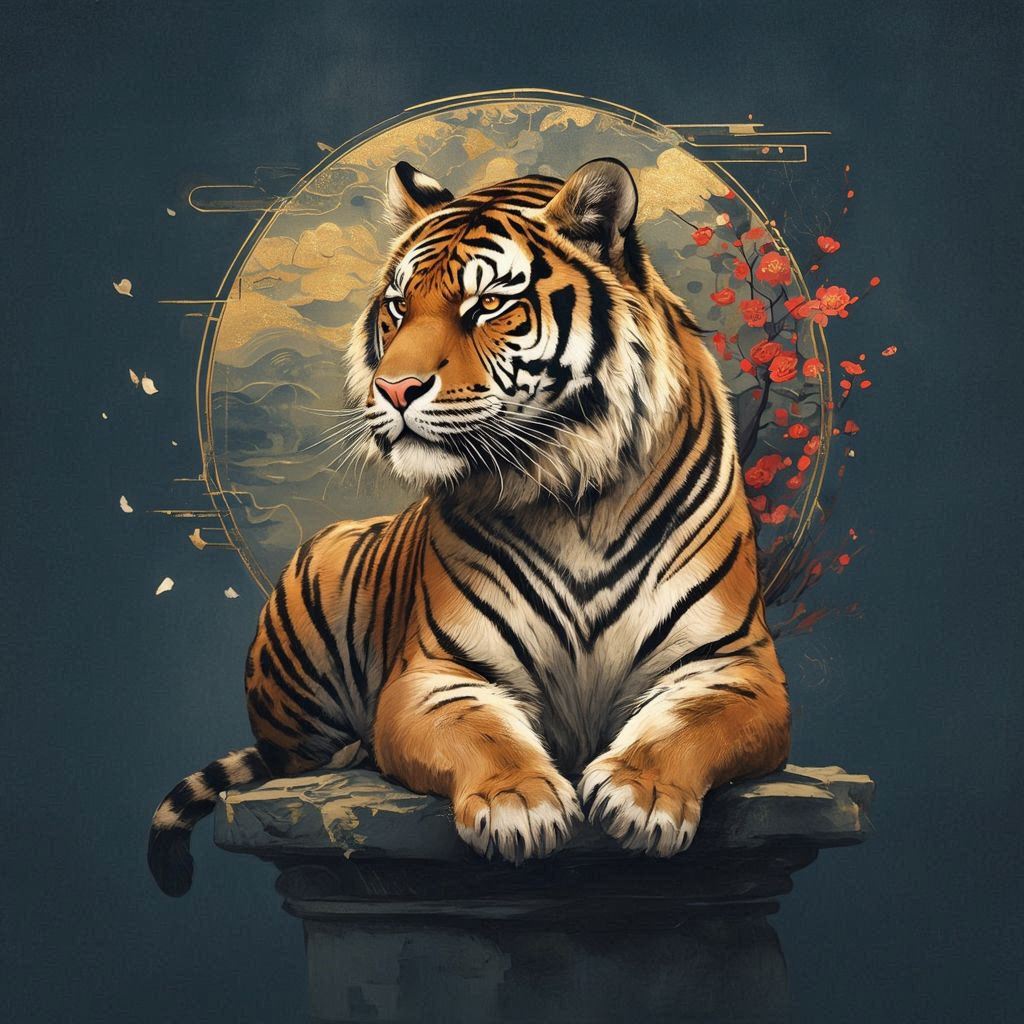
Tiger
The Tiger is the third sign of the Chinese zodiac and perhaps its most magnetic. Where the Rat wins by cleverness and the Ox by endurance, the Tiger wins by force of personality — a raw, compelling vitality that draws others into its orbit whether it intends to or not. In Chinese culture, the Tiger is the lord of the terrestrial animals, as the Dragon rules the sky: it represents power, bravery, and the primal energy of the living world. To be born in a Tiger year is to carry something restless and bright. The challenge of this sign is learning to direct that energy rather than be consumed by it.
- Dates
- Years: 2022, 2010, 1998, 1986, 1974, 1962 (every 12 years). Note: Chinese New Year falls between Jan 21–Feb 20 — those born in January or early February should verify their animal year.
- Element
- Wood
- Ruling Planet
- Jupiter
- Quality
- Yang
- Strengths
- Courageous · Charismatic · Passionate · Protective · Adventurous
- Weaknesses
- Impulsive · Reckless · Domineering · Rebellious · Unpredictable
Personality
The Tiger does not do anything halfway. Its enthusiasms are total, its commitments are passionate, and its grievances — when they arise — are equally intense. This is a sign of extremes: extreme generosity, extreme risk-taking, extreme loyalty, extreme rebellion. The Tiger needs a cause. Without one, its energy has nowhere to go, and it becomes either restless and irritable or reckless and self-destructive. With a cause, the Tiger is one of the most effective forces in the zodiac — it will face opposition that would stop most other signs, and it will usually win through sheer force of will and the kind of courage that looks like madness to bystanders. The shadow is impulsiveness: the Tiger moves before it thinks, commits before it has calculated, and burns bridges with a spectacular finality.
Love & Relationships
The Tiger in love is all-consuming. It falls hard and fast, commits with total intensity, and expects the same depth of feeling in return. A partner who holds back or who plays emotional games will lose the Tiger's interest quickly — this sign cannot sustain a relationship that operates on surface energy. The Tiger is fiercely protective of those it loves: it will step into any conflict on their behalf without hesitation. The downside is possessiveness. The Tiger's intensity, which can feel like devotion, can also feel like suffocation. The Tiger needs a partner who is secure enough not to be overwhelmed by its force, and independent enough to maintain their own identity within the relationship.
Work & Career
The Tiger is built for leadership — not the administrative kind, but the kind that requires vision, nerve, and the willingness to go first. It excels in professions that demand courage and initiative: military, politics, law enforcement, entrepreneurship, performing arts, emergency response. The Tiger is not suited for long stretches of routine and will become restless and disruptive in environments that reward conformity over results. It needs autonomy and challenge. When given responsibility, the Tiger takes it seriously and inspires enormous loyalty in those who work under it. The risk is the inability to delegate: the Tiger can do too much itself and exhaust its team, or it can act unilaterally when coordination is what the situation requires.
Health & Wellbeing
The Tiger burns energy at a rate most signs cannot sustain. In youth this feels like superpower — it can push through anything. But Tiger energy is not infinite, and the sign's tendency to ignore warning signs means that when it does crash, it crashes hard. The nervous and cardiovascular systems bear most of the strain. The Tiger is prone to stress-related disorders when its energy has no productive outlet, and to injury when it acts without calculating risk. The medicine for the Tiger is not rest in the Ox's sense — it is redirection. The Tiger needs movement, vigorous physical exercise, and ideally a sporting discipline that requires both power and technique. It also benefits from practices that develop patience and self-regulation: martial arts, yoga, anything that teaches the body to be fierce and still at once.
Mythology & Symbolism
In Chinese mythology, the Tiger is the guardian of the west and the protector against evil spirits, fire, and thieves. It is one of the Four Symbols of the Chinese constellations — the White Tiger (Bái Hǔ) of the west, alongside the Azure Dragon of the east, the Vermilion Bird of the south, and the Black Tortoise of the north. Door gods and protective talismans often incorporate tiger imagery, and the character for "king" (王) is said to have been derived from the markings on a tiger's forehead. In legend, the Tiger fought the Dragon for dominance of the world — a conflict that ended in an eternal draw, reflecting the cosmic balance of opposing forces.
This Sign in Other Cultures
In Western astrology, the Tiger's qualities resonate most closely with Aries — the same yang energy, the same courageous initiative, the same potential for impulsiveness. In Hindu tradition, the tiger is associated with the goddess Durga, who rides one as her vehicle: the tiger here represents both the raw power of nature and the disciplined force of divine protection. Across Asian cultures broadly, the tiger is the king of the terrestrial animals — a symbol of military valor, protection, and the fierceness that keeps the world's darker forces at bay.
Compatibility
Best with
Horse, Dog
Challenging with
Monkey, Snake