


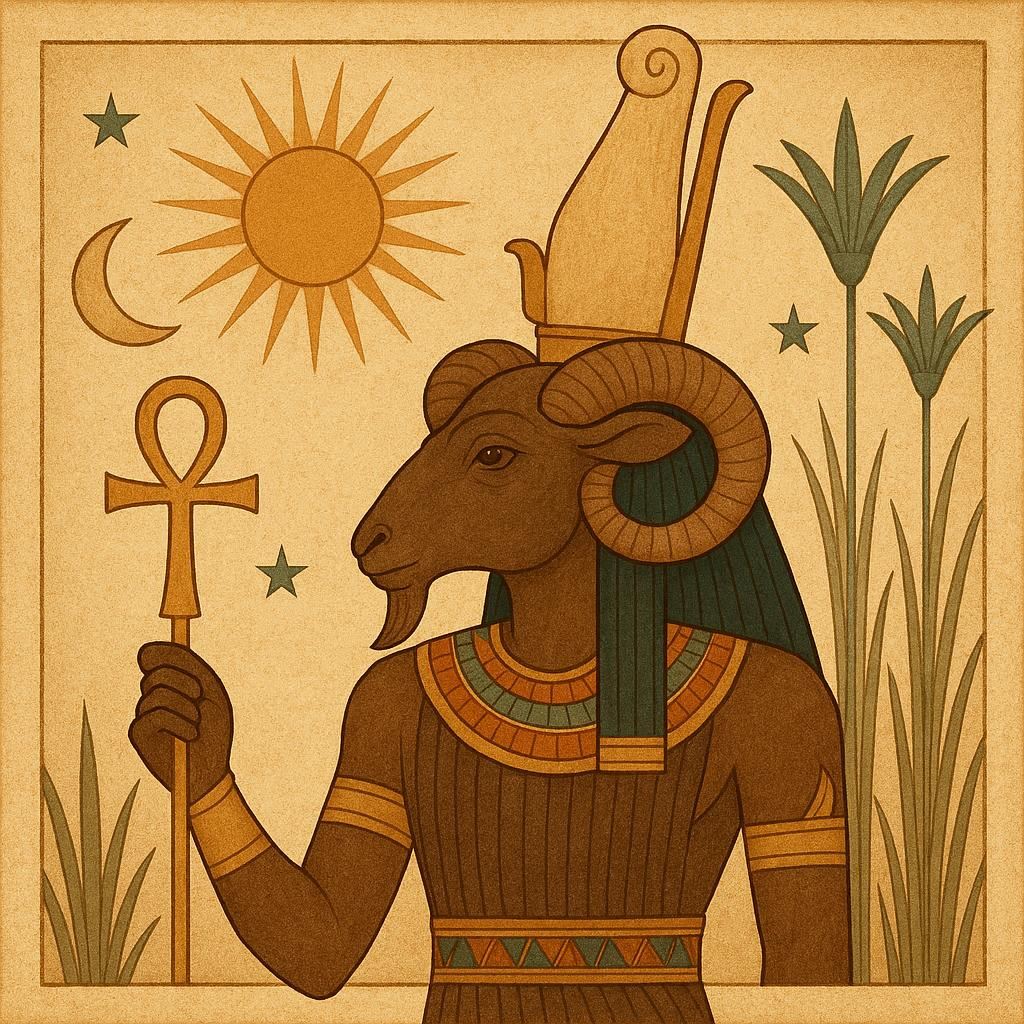
Amon-Ra
Amon-Ra is the sign of the king of the gods — the supreme solar deity who represented the absolute zenith of divine power in the Egyptian pantheon. To be born under Amon-Ra is to carry within you the energy of the sun at its highest, most radiant, most commanding point. This is a sign of natural authority, sovereign confidence, and the capacity to illuminate everything it touches. Amon-Ra people do not enter a room — they arrive. They do not participate in conversations — they direct them. They are not drawn to power; power is drawn to them.
- Dates
- January 8–21 · February 1–11
- Element
- Fire / Air
- Ruling Planet
- Sun (Ra)
- Quality
- Fixed
- Strengths
- Optimistic · Charismatic · Leadership · Confident · Generous
- Weaknesses
- Domineering · Arrogant · Impatient · Demanding · Self-centred
Personality
Amon-Ra people are born leaders — not because they have studied leadership or pursued it strategically, but because authority is simply their natural mode of being. From childhood, they are the ones others look to for direction, reassurance, and inspiration. This is rarely something they seek; it is something that happens to them, a gravitational consequence of the solar energy they radiate. The confidence of Amon-Ra runs so deep that it can be difficult for others to distinguish from arrogance — and sometimes, when undeveloped, it genuinely crosses that line. At their best, Amon-Ra's confidence is the generous confidence of the sun: it illuminates others rather than casting them into shadow, it warms without scorching, it calls out the best in everyone it touches. At their worst, it becomes the blinding glare that makes others invisible. Amon-Ra has a profound need to be seen, acknowledged, and respected. This is not vanity in the shallow sense but a deep alignment with their essential nature — they are solar beings, and the sun exists to be seen. When they are overlooked or dismissed, when their authority is challenged without justification or their generosity goes unacknowledged, they feel it as an existential affront. The work for Amon-Ra is learning to distinguish between genuine disrespect and the ordinary invisibility of a world that is simply too busy to notice. The generosity of Amon-Ra, when activated, is among the most spectacular in the zodiac. They give with the abandon of the sun — broadcasting warmth and light without calculation, lifting those around them without expectation of return. The friends, communities, and organisations that have an Amon-Ra at their centre tend to flourish; their solar energy is genuinely life-giving.
Love & Relationships
Amon-Ra in love is devoted, passionate, and dramatically whole-hearted. When they love, they love with the full force of the solar personality — warmly, visibly, generously. They want a partner they can be proud of, someone who matches their level and stands beside them rather than behind them. Amon-Ra is never truly happy in relationships where they must diminish themselves; they need a partner who can celebrate rather than feel threatened by their light. The challenge is their need for admiration and acknowledgement within the relationship. Amon-Ra thrives on appreciation — not because they are shallow but because recognition is as essential to their nature as sunlight is to a solar panel. Partners who forget to express admiration, or who take Amon-Ra's qualities for granted, will find the relationship cooling as the sun withdraws its warmth. At their best, Amon-Ra creates relationships of extraordinary warmth, generosity, and mutual glorification — partnerships where both people bring out the finest version of each other, where love is an expanding rather than a limiting force.
Work & Career
Amon-Ra is built for leadership, visibility, and authority. They excel as CEOs, directors, politicians, heads of state, judges, military leaders, and in any role where command is the primary skill. They are also exceptional in creative fields where vision and charisma are central — film direction, performance, conducting — any domain where one person's solar energy animates and coordinates many others. The Amon-Ra professional expects — and generally receives — respect and recognition. They are willing to work extraordinarily hard in exchange for genuine authority and acknowledgement. What they cannot tolerate is micromanagement, having their decisions second-guessed, or being treated as a subordinate when they know themselves to be a leader. Their greatest professional gift is vision — the capacity to see the big picture with solar clarity and to inspire others to work toward it with genuine enthusiasm. Where Amon-Ra leads, things get done. The challenge is ensuring that their leadership illuminates rather than overshadows the contributions of those around them.
Health & Wellbeing
Amon-Ra's health is closely tied to their sense of purpose and authority. When they are in their proper domain — leading, creating, illuminating — their vitality tends to be robust and nearly inexhaustible. When they are thwarted, subordinated, or denied expression of their solar nature, physical symptoms can emerge quickly: heart and circulation issues, back and spine problems (the areas associated with the sun's structural support in the body), and the depletion that comes from sustained suppression. The sun, for all its power, also needs balance. Amon-Ra types are prone to excess — overworking, overindulging, burning too bright for too long. Rest is essential but often resisted; Amon-Ra must learn that even the sun sets, and the night is not a defeat but a restoration. Physical vitality for Amon-Ra is often expressed through vigorous, sun-centred activities — outdoor sports, hiking, swimming, anything that involves exposure to light and the satisfaction of physical power and movement.
Mythology & Symbolism
Amon-Ra was formed from the merging of two of Egypt's most powerful deities: Amon, the hidden primordial god of Thebes who represented the invisible, creative breath behind all existence; and Ra, the visible sun god who crossed the sky each day in his solar barque. This union of the hidden and the manifest, the invisible source and the radiant expression, made Amon-Ra the most complete and most powerful of the Egyptian gods — simultaneously the invisible cause and the visible effect. The daily journey of Ra across the sky was one of Egypt's most important myths. Each dawn, Ra was reborn as Khepri the scarab beetle, rolling the sun above the horizon as a scarab rolls a ball of dung. At noon, Ra stood at his most powerful as the falcon-headed sun god. At sunset, he became Atum the old man and descended into the Duat — the Egyptian underworld — to battle the serpent Apophis through the night before being reborn again at dawn. This cycle of death and rebirth made Ra not just a god of power but a god of endurance — a model for how to face darkness and emerge renewed. The Pharaoh was considered the living embodiment of Ra on earth — a walking solar deity whose authority was not merely human but divine. The elaborate rituals of the Egyptian court were designed to maintain the cosmic order by ensuring that the solar king fulfilled his divine function: ruling justly, defeating chaos, maintaining Ma'at (cosmic balance). The merger with Amon gave Ra a dimension of mystery and hiddenness that pure solar symbolism lacks. Amon-Ra's power was not merely the visible, measurable power of sunlight but the deeper, invisible creative force that sunlight expressed — the divine will behind all manifestation.
This Sign in Other Cultures
The solar deity archetype that Amon-Ra represents appears with extraordinary consistency across virtually every human culture. The sun god — radiant, powerful, royal, and life-giving — is one of the universal symbols of divinity and legitimate authority. In Greek mythology, Apollo was the closest parallel to Ra — god of the sun, light, music, prophecy, and rational order. Like Ra, Apollo crossed the sky in a chariot, and his radiant beauty was both inspiring and dangerous in excess. The cult of Apollo at Delphi was one of the most powerful religious institutions in the ancient Mediterranean world. In Hinduism, Surya is the solar deity — a powerful, radiant god who drives across the sky in a chariot drawn by seven horses, representing the seven colours of visible light. Surya is both a deity in his own right and the source of all biological life on earth, making his worship both cosmological and practically vital. In Norse mythology, Sol (or Sól) was the solar deity — a goddess who drove the sun across the sky, pursued by the wolf Sköll who would eventually catch and devour her at Ragnarök. This more vulnerable portrayal of solar divinity acknowledges what the Egyptian and Greek traditions sometimes forgot: that even the most powerful light is temporary, and the darkness will eventually come. In Japanese mythology, Amaterasu — the goddess of the sun and the universe — is the highest deity in the Shinto pantheon, ancestor of the imperial dynasty, and the source of all light and warmth in the world. Her temporary withdrawal into a cave, plunging the world into darkness, and her eventual coaxing back out by the laughter and revelry of the other gods is one of the most beautiful solar myths in world tradition.
Compatibility
Best with
Horus, Bastet
Challenging with
The Nile, Mut