


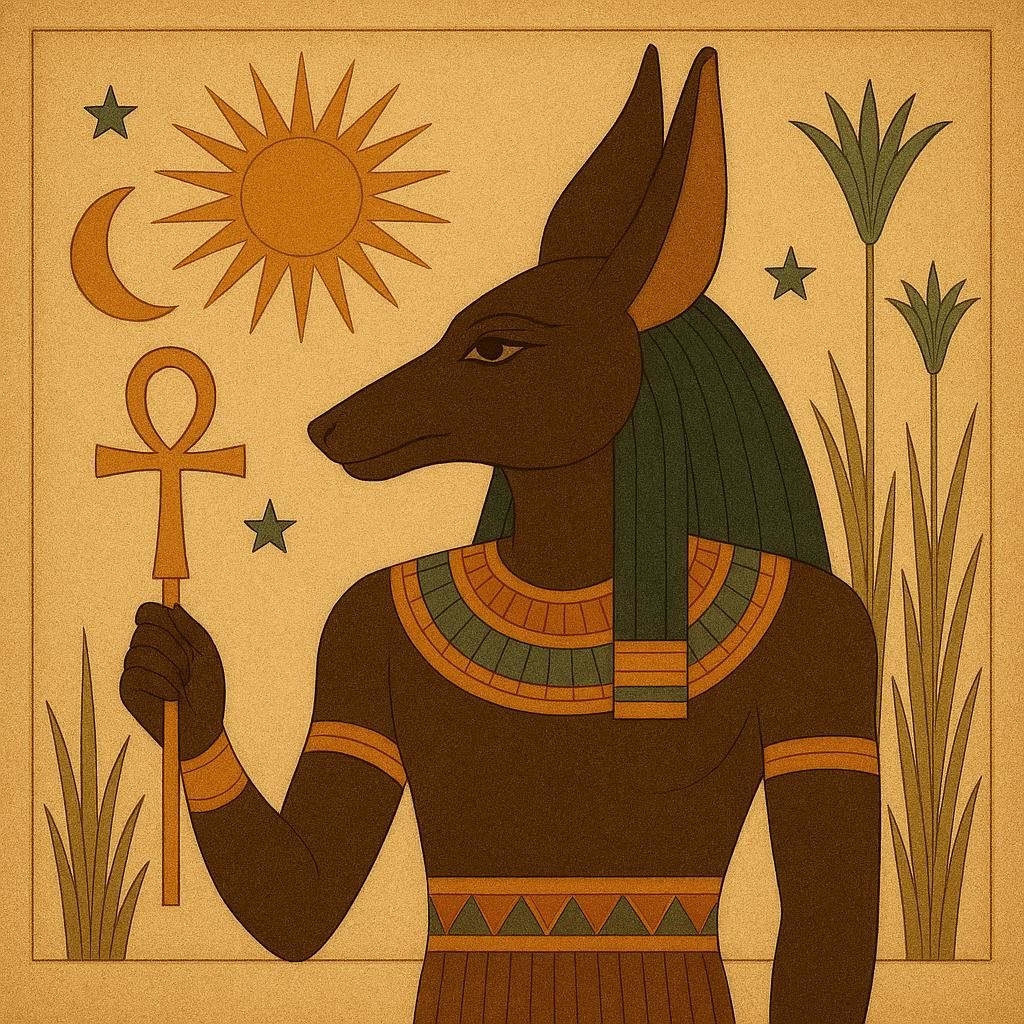
Anubis
Anubis is the guardian of the threshold — the god who stands at the boundary between the living and the dead, who guides the souls of the departed through the darkness of the Duat to the Hall of Judgment, who weighs the heart against the feather of Ma'at. To be born under Anubis is to have a natural intimacy with the liminal — with the places, experiences, and transitions that others avoid: with death, with loss, with endings, with the kind of transformation that can only happen in the dark. Anubis people see what others do not want to see, and they guard what others cannot bear to approach.
- Dates
- May 8–27 · June 29 – July 13
- Element
- Earth / Water
- Ruling Planet
- Anubis (God of Embalming)
- Quality
- Mutable
- Strengths
- Perceptive · Loyal · Protective · Discerning · Transformative
- Weaknesses
- Brooding · Obsessive · Suspicious · Isolated · Uncompromising
Personality
Anubis people are among the most perceptive in the Egyptian system — and among the most misunderstood. They see into situations with an acuity that others find both invaluable and unsettling; they perceive what is hidden, what is denied, what is approaching from around the corner. This gift makes them exceptional diagnosticians in any field — the person who identifies the problem before it has fully manifested, the counsellor who hears what is not being said, the friend who knows something is wrong before you have admitted it to yourself. The emotional signature of Anubis is depth combined with restraint. They feel intensely but express selectively; the interior world is rich and often turbulent, but the exterior world sees only what Anubis chooses to show. This restraint is not dishonesty but protection — protection of themselves, and protection of others from the full weight of what Anubis perceives. Not everyone can bear to know what Anubis knows. The shadow quality of Anubis is the isolation that can accompany their intimacy with darkness. They can become so comfortable with the underworld of experience — with loss, with what others avoid — that they lose their connection to the simpler joys and lighter experiences of ordinary life. The growth challenge for Anubis is to maintain their capacity to be present with darkness without being consumed by it — to be the guardian of the threshold without becoming a permanent inhabitant of it.
Love & Relationships
In love, Anubis is one of the most intensely loyal partners in the zodiac — loyal to a degree that can survive almost any test. When they commit, they commit to the whole of a person, including the parts that others would flinch from. Their capacity to witness darkness without retreating makes them extraordinary companions through life's most difficult passages; a partner of Anubis will never feel that they must hide their worst or most frightening self. The challenge in love for Anubis is vulnerability. They give loyalty freely, but emotional openness — the willingness to be seen in their own need, their own fear, their own uncertainty — is much more difficult. Letting someone else into the underworld of their own experience requires a trust that Anubis builds slowly, and a partner who lacks the patience to wait for that trust to develop will find Anubis perpetually guarded. The ideal partner for Anubis is someone who is not frightened by depth or silence, who does not need constant reassurance that everything is fine, who understands that Anubis's guardedness is not rejection but protection, and who can offer the kind of steady, patient presence that allows Anubis to gradually open the doors they usually keep firmly closed.
Work & Career
Anubis is naturally drawn to work that involves the processes of transformation, transition, and the care of the vulnerable — particularly in their most extreme moments. Medicine, surgery, emergency care, forensics, mortuary science, and grief counselling are all natural territories. They are also exceptional researchers and investigators — capable of the sustained focus and the willingness to enter uncomfortable territory that serious inquiry requires. The diagnostic gift of Anubis — the ability to perceive what is hidden and identify what is wrong — makes them particularly effective in medicine, psychology, criminal investigation, intelligence work, and any domain where the ability to see through surface appearances to underlying realities is the central professional competence. Their professional challenge is the tendency toward isolation and the difficulty of maintaining professional boundaries when the work is emotionally demanding. Anubis people can take on their clients' darkness in ways that compromise their own wellbeing; the ability to witness without absorbing, to be present without being consumed, is the central professional skill they must develop.
Health & Wellbeing
Anubis health reflects the sign's characteristic orientation toward the invisible, the hidden, and the liminal. They tend to be highly sensitive to environmental and emotional toxins — to the energetic residue of difficult experiences, to the accumulated weight of what they have witnessed and carried for others. This sensitivity is both a gift (it makes them attentive to subtle signals their own body is sending) and a vulnerability (it means they can be depleted by exposure to environments or relationships that others would find merely unpleasant). The characteristic vulnerabilities for Anubis involve the immune system, the lymphatic system, and the nervous system — all systems associated with the body's capacity to process and eliminate what has entered it and what is no longer needed. When Anubis is carrying too much of others' darkness — when the professional or personal boundary has broken down and they are absorbing what should be transformed and released — these systems tend to falter first. The most important health practice for Anubis is the regular clearing of accumulated energy and emotion. Whatever practice allows them to discharge what they have taken on — whether ritual, exercise, time in water, or time in wilderness — is not optional but essential. They must periodically cross the threshold in the other direction: from the underworld back to the land of the living.
Mythology & Symbolism
Anubis is one of the oldest deities in the Egyptian pantheon — older, in some traditions, than even Osiris and Ra. He is the original lord of the dead, whose function was later absorbed by Osiris; in the later unified mythology, Anubis became Osiris's son (or, in some versions, the son of Osiris and Nephthys, conceived in secret), and his role shifted from ruler of the dead to guide and guardian of the process of death and transition. Anubis is depicted as a man with the head of a jackal — the desert scavenger whose habit of digging in the ground near gravesites led to his association with the dead. The Egyptians, rather than fearing the jackal's presence near burials, transformed it into divine protection: Anubis became the protector who prevented jackals (and other animals) from disturbing the dead. His primary role in the developed mythology is the embalming and mummification of the dead. He is credited with inventing the art of mummification — the process through which the physical body is preserved for the resurrection that was the central promise of Egyptian religion. In imagery, he is shown attending to the mummy, wrapping the body, performing the Opening of the Mouth ceremony, and weighing the heart in the Hall of Two Truths. The weighing of the heart is Anubis's most iconic act: the heart of the deceased is placed on one pan of the scales, and the feather of Ma'at on the other. If the heart is equal in weight to the feather, the soul is admitted to the Field of Reeds. If heavier — burdened with wrongdoing and untruth — the heart is consumed by Ammut, and the soul is annihilated.
This Sign in Other Cultures
The Anubis archetype — the divine psychopomp who guides the souls of the dead, the guardian of the threshold between life and death, the weigher of souls and enforcer of cosmic justice — appears in many of the world's traditions, fulfilling the universal human need for a divine presence at the moment of death. In Greek mythology, Hermes Psychopomp (Hermes as guide of souls) shares with Anubis the function of escorting the dead to the underworld — though where Anubis is solemn and protective, Hermes is quick and mercurial. Charon, the ferryman of the Styx, also shares the threshold-guardian function, though in a grimmer, more passive form. In Hindu tradition, Yama is the lord of death and the cosmic judge — sharing with Anubis the role of judging the souls of the deceased and administering justice according to the moral weight of their earthly lives. Chitragupta, Yama's divine accountant, parallels the recording function that Anubis and Thoth share in the Hall of Two Truths. In the Christian tradition, the function of psychopomp belongs to the archangel Michael, who conducts souls to judgment and wields the scales in which the soul is weighed — a direct iconographic parallel to Anubis with his scales. The concept of purgatory — the intermediate state of purification before the soul is admitted to paradise — also parallels the process that Anubis oversees in the Duat. In Celtic and Norse traditions, Valkyries and similar figures serve the psychopomp function — choosing the slain and conducting them to the appropriate realm. The Black Dog in British folklore, though often feared, may have ancient roots in the Anubis tradition via Roman occupation.
Compatibility
Best with
Osiris, The Nile
Challenging with
Horus, Bastet