


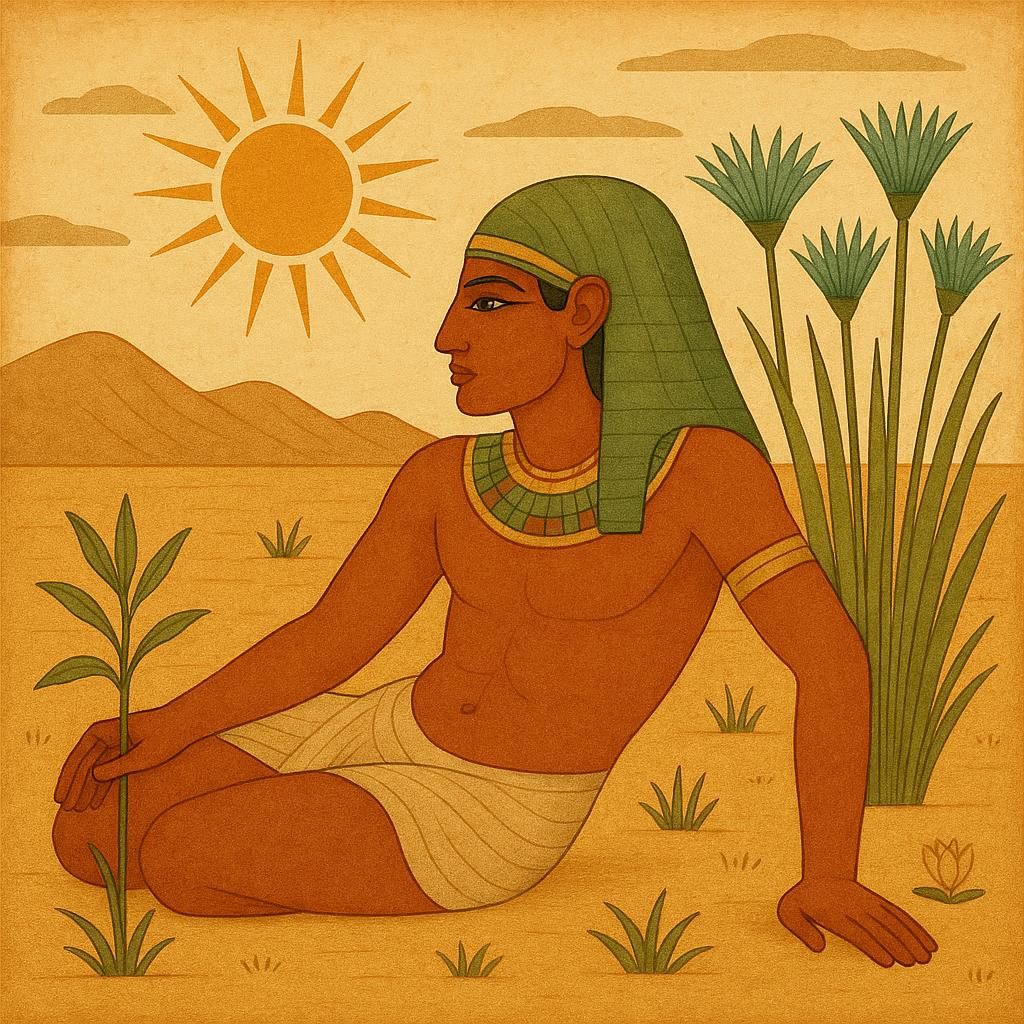
Geb
Geb is the great Earth God of ancient Egypt — the divine personification of the land itself, father of the four most powerful deities in the Egyptian pantheon: Osiris, Isis, Seth, and Nephthys. As the son of Shu (Air) and Tefnut (Moisture), Geb lies beneath the sky goddess Nut in the eternal mythological embrace that defines the Egyptian cosmos: Earth below, Sky above, held apart by the god of air. Those born under Geb carry the weight and the gift of the earth itself — an unshakeable solidity, a deep patience, and the extraordinary capacity to sustain life through steady, unhurried, inexhaustible care.
- Dates
- February 12–29 · August 20–31
- Element
- Earth
- Ruling Planet
- Geb (Earth God)
- Quality
- Cardinal
- Strengths
- Grounded · Stable · Fertile · Patient · Enduring
- Weaknesses
- Stubborn · Overly cautious · Possessive · Inert · Resistant to change
Personality
Geb people are the bedrock of every community they inhabit. Where others rush, they are slow. Where others scatter, they are concentrated. Where others flit from one enthusiasm to the next, Geb remains — present, solid, unwavering. This is not inertia but a different relationship with time: the Earth God does not hurry because the earth itself does not hurry. The wheat grows at the pace of the sun and rain, not at the pace of human impatience, and Geb understands this at a cellular level. The psychological foundation of Geb is a profound sense of place and belonging. They are deeply rooted people — to land, to family, to community, to tradition. While other signs might reinvent themselves every few years, Geb builds: slowly, deliberately, generation upon generation, creating something that will outlast them. They are the people who plant oak trees knowing they will never sit in their shade. This long-term orientation gives them an equanimity and solidity that can seem almost supernatural in its unshakeability. Fertility is Geb's great gift in both the literal and metaphorical sense. The Earth God was thought to actually be the soil itself — when the Nile receded and left its fertile black silt, that was Geb's body nourishing everything. Geb people create conditions in which others flourish. They are the gardeners, the cultivators, the ones whose steady, patient presence allows fragile things to take root and grow. Their homes, gardens, and workplaces tend to be extraordinarily productive precisely because they tend them with such consistent care. The shadow side of Geb is the resistance to change that can calcify into genuine immovability. When the earth shifts, it does so in earthquakes — sudden, disruptive, impossible to control. Geb people who have suppressed their need for change too long can experience the same: a sudden rupture of everything they thought was permanent. Learning to allow gradual change — to be a living earth that shifts slowly but continuously — is the key growth challenge for this sign.
Love & Relationships
In love, Geb is the most dependable of partners — not necessarily the most exciting, but the one who will still be there a decade later, having quietly built something remarkable in the meantime. They love through consistency rather than intensity, through sustained presence rather than dramatic gesture. For those who understand this language — who find security more romantic than passion — a Geb partner is the most precious thing in the world. The challenge for Geb in love is the possessiveness that can shadow their devotion. The earth holds — sometimes too tightly. A Geb partner who feels threatened by change in the relationship can become controlling: insisting on stability even when growth requires movement, clinging to what was rather than flowing toward what could be. Learning to hold lightly, to love toward growth rather than toward preservation, is the central romantic challenge for this sign. Geb is most compatible with partners who can root them further while also encouraging their occasional need to stretch. They need someone who appreciates solidity without demanding excitement, and who is willing to tend a love that grows slowly and steadily, like a great tree — modest in its early years, magnificent across the long arc of a shared life.
Work & Career
Geb people excel in professions that require sustained, patient effort over long timescales — agriculture, architecture, geology, archaeology, real estate, conservation, urban planning, and any work that involves building something meant to last. They are the people who can see the forest while others see only the trees; who can work steadily toward a goal twenty years out without losing motivation or focus. Their capacity to manage complexity over time also makes them exceptional project managers, institutional administrators, and long-term strategists. The Geb approach to professional challenge is to take it apart layer by layer, systematically, patiently — not seeking a brilliant solution but working methodically toward the best available one. The professional challenge for Geb is adapting to rapidly changing environments. In fields that require constant reinvention — technology, media, fashion — Geb can feel left behind, their strengths undervalued. They are best served by finding roles where depth and persistence are rewarded over agility, or by building organisations that provide stability to more dynamic colleagues who lack their endurance.
Health & Wellbeing
Geb's health is most robust when they are literally connected to the earth — when they garden, farm, walk barefoot on grass, work with their hands, or spend time in natural settings that remind the body of its primal relationship with land. Physical work is medicine for Geb; they need to move their body in ways that involve the full engagement of muscle, earth, and gravity. The characteristic health vulnerabilities for Geb involve the bones, joints, and lower body — particularly the legs, knees, and spine. These are the structural elements of the body just as Geb represents the structural element of the world; when the structure is under strain, it is these regions that signal the imbalance. Regular weight-bearing exercise, adequate mineral intake, and attention to posture are important preventive practices. The psychological health challenge for Geb is allowing themselves to change without experiencing it as a loss of identity. When life demands that they shift — that they leave a home, a job, a relationship that has defined them — Geb can fall into depression or physical illness as a way of refusing the movement. Learning to distinguish healthy stability from pathological rigidity is the central emotional health work for this sign.
Mythology & Symbolism
In the Egyptian mythological cosmology, Geb occupied one of the most fundamental positions: he was the earth itself, lying flat beneath the arching body of Nut the sky goddess, separated from her by Shu the god of air. This image of the earth god lying beneath the curved sky is one of the most distinctive and immediately recognisable images in all of Egyptian religious art — a man lying flat, often shown with an erect phallus as a symbol of generative creative power, while the stars and celestial bodies traverse the body of his wife above him. The Egyptians conceived of Geb not merely as a personification of earth but as a living being whose laughter caused earthquakes, whose tears of longing for Nut became the rain, and whose body was literally the land of Egypt. When the Nile flooded and withdrew, it was Geb's flesh that was revealed — the black fertile soil (called kemet, the black land, from which the name Egypt itself derives). The very identity of the civilisation was written in the body of the Earth God. Geb was also intimately connected to the dead. As Lord of the Earth, he received the bodies of the deceased, and the dead were sometimes described as 'those who are in Geb' — enclosed within the earth, waiting for rebirth. In this sense Geb's role was not only generative but protective and preserving: the earth holds the dead safely until resurrection is possible. Geb's most important narrative role in Egyptian mythology was as the father of the great gods. From his union with Nut came Osiris, Isis, Seth, and Nephthys — the four deities who would become the central figures in Egypt's most important mythological cycle. Geb thus stands at the origin of the divine drama, the ground from which everything else grows.
This Sign in Other Cultures
The Earth God archetype appears in virtually every human religious tradition, testifying to the universal human need to personalise and reverence the ground beneath our feet. In Greek mythology, Gaia occupies the equivalent position to Geb — the primordial Earth from whom all life and all the gods descended. The Greeks imagined Gaia as the original creative force, existing before differentiation, from whose body the mountains and seas and living creatures all emerged. Like Geb, Gaia was connected to the dead: the Underworld was inside her, and she was the origin and the destination of all living things. In Norse tradition, the earth was personified as Jörð — a giantess and one of Odin's consorts — whose son was Thor. The parallels with Geb, father of the great gods, are striking. Both traditions understand the earth deity as fundamentally generative: the source from which heroic and divine power grows. In Hindu cosmology, the earth is Bhudevi or Prithvi — the patient, enduring, nurturing mother whose capacity to sustain life without complaint even under the heaviest burdens is seen as the supreme expression of selfless tolerance. The earth endures everything placed upon it: this quality of inexhaustible patience is Geb's most recognisable characteristic across all cultures. Indigenous traditions around the world understand the earth as a living being — not metaphorically but literally. The Lakota concept of Unci Maka (Grandmother Earth), the Andean Pachamama, the Aboriginal understanding of Country — all express the same fundamental insight that Geb embodies: that the earth is not merely a resource but a relationship, a living presence that sustains us and to which we owe reverence, care, and reciprocity.
Compatibility
Best with
Osiris, Isis
Challenging with
Seth, The Nile