


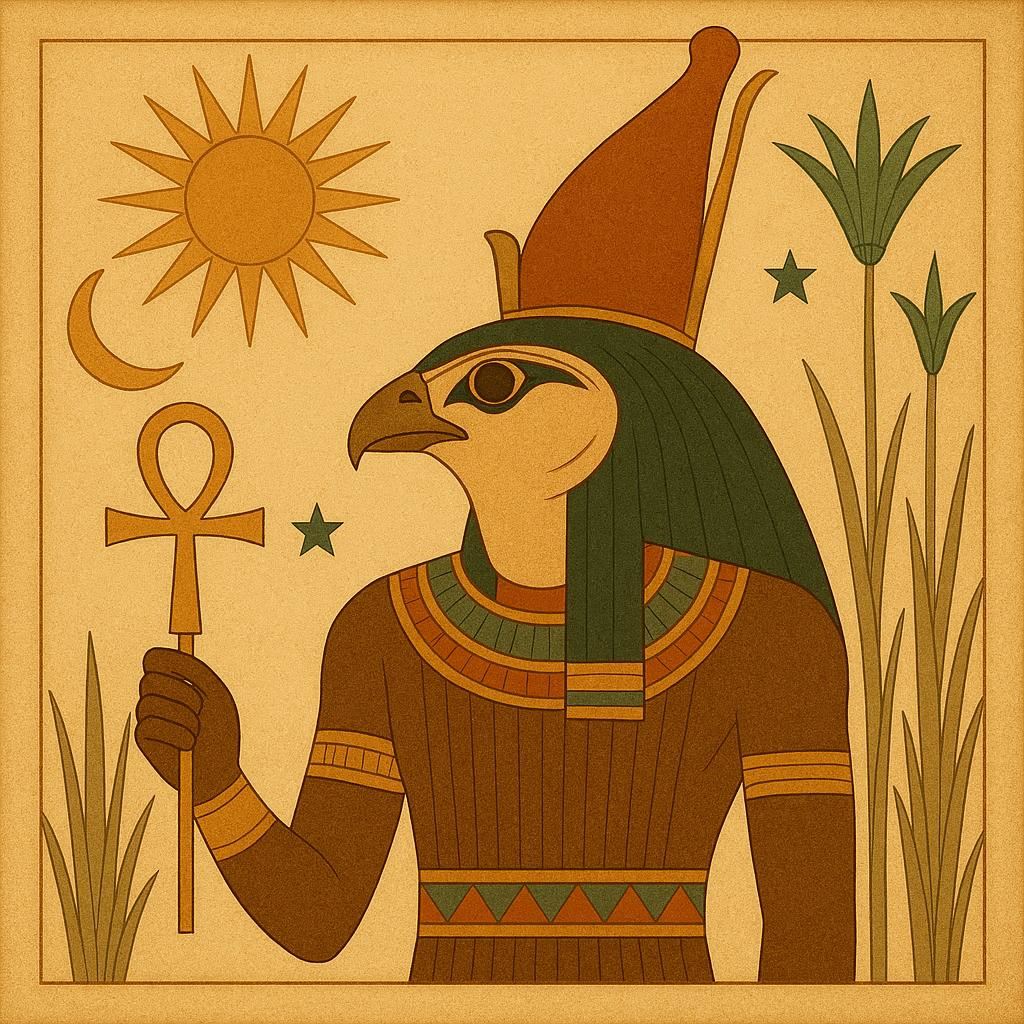
Horus
Horus is the divine king — the young hawk-god who claimed his rightful throne after the long battle with Seth, who united the divided kingdoms of Egypt into a single realm, who carries in his two eyes the sun and the moon. To be born under Horus is to carry an innate sense of rightful purpose — a deep, unquestioned sense that one has a place in the world, a role to fulfil, a kingdom to claim. Horus people are natural leaders, not because they seek power but because they embody authority — the kind of authority that comes not from dominance but from the clarity of being exactly what one is meant to be.
- Dates
- April 20 – May 7 · August 12–19
- Element
- Fire / Air
- Ruling Planet
- Horus (God of the Sky)
- Quality
- Fixed
- Strengths
- Courageous · Determined · Visionary · Loyal · Purposeful
- Weaknesses
- Impulsive · Stubborn · Domineering · Unforgiving · Righteous to a fault
Personality
Horus people carry themselves with a natural dignity that is not arrogance but a kind of ease within their own authority. They know who they are, and this knowledge — when it is working well — gives them a groundedness that others find both reassuring and compelling. They do not need to perform confidence because they have it; they do not need to assert their importance because their presence asserts it. The defining quality of Horus is purpose. These people know what they are for — or they need to find out, and the finding-out is the central quest of their life. Without purpose, Horus is lost; the energy that should be channelled into leadership, vision, and constructive action becomes aggressive, restless, or self-destructive. With purpose, Horus is one of the most effective forces in the world: determined, resourceful, undeflectable, and capable of inspiring others by the simple power of their committed example. The shadow quality of Horus is the rigidity that can accompany their sense of rightness. They can be correct and still be wrong in the manner of their being correct — right in substance but too absolute in approach, too unwilling to consider that others may have legitimate perspectives that differ from their own. The growth challenge for Horus is to hold their sense of purpose strongly without letting it become a prison that excludes the complexity of reality.
Love & Relationships
In love, Horus is loyal, protective, and genuinely committed — the partner who shows up, who does not run from difficulty, who takes their responsibilities seriously. They bring a quality of solar warmth to their relationships — a generosity of spirit and energy that can make their beloved feel genuinely seen, valued, and protected. The challenge for Horus in love is the same dominance that can appear in other areas. They can have difficulty accepting a partner as a genuine equal — someone whose perspectives are as valid as their own, whose choices deserve respect even when Horus would choose differently, whose autonomy is not a challenge to Horus's leadership but a complementary gift. The ideal partner for Horus is not a subordinate but a fellow sovereign — someone who has their own kingdom, their own authority, their own sense of purpose, and who invites Horus into genuine partnership rather than simple agreement.
Work & Career
Horus is one of the most naturally gifted leaders in the Egyptian system — not a manager who coordinates, but a visionary who inspires and directs. They are most effective in roles where they can set the vision, build the team, and navigate the organisation through the challenges that others would find overwhelming. They have the combination of long-term strategic thinking and short-term tactical decisiveness that is rarest in leadership. The most natural professional homes for Horus are roles of genuine authority and responsibility: executive leadership, military and strategic roles, politics and civic leadership, entrepreneurship, and any domain that requires the combination of vision, courage, and the willingness to take responsibility for outcomes. They are also drawn to work that has an explicit justice dimension — work that involves righting wrongs, correcting imbalances, or restoring what has been unfairly taken. The professional challenge for Horus is working within structures they did not create and do not control. They are not natural followers; being managed rather than managing is a significant adjustment that requires them to find ways to exercise their authority within the constraints they have been given rather than around them.
Health & Wellbeing
Horus health is closely tied to their sense of mission and purpose. When they are engaged with meaningful work and feel that they are making genuine progress toward their goals, they can display remarkable physical vitality — the kind of energy that comes from a life fully aligned with its purpose. When they are thwarted, when their path is blocked, when they are forced to work against their own sense of rightness, the physical body registers the frustration. The characteristic vulnerabilities for Horus involve the eyes — symbolically and literally the organ most associated with Horus, whose right eye is the sun and whose left eye is the moon, and who lost his left eye in battle with Seth before it was restored. Vision problems, eye strain, and headaches are characteristic. The cardiovascular system is also associated with this sign — the heart that drives the purposeful action. The most important health practice for Horus is the management of intensity. They have a tendency to push through, to ignore signals of depletion in the service of their mission, to subordinate the needs of the body to the demands of the purpose. Learning to rest, to recover, and to trust that the mission will survive their restoration is not weakness but strategic wisdom.
Mythology & Symbolism
Horus is one of the oldest and most complex deities in the Egyptian tradition — and one of the most important, since every Pharaoh of Egypt was considered to be the living embodiment of Horus, and upon death became Osiris. The myth of Horus is thus not merely a religious story but the theological foundation of Egyptian kingship itself. The most familiar version of the Horus myth concerns the contest between Horus and his uncle Seth for the throne of Egypt, following the murder of Horus's father Osiris. This contest is one of the longest narratives in Egyptian mythology — a complex, often humorous, frequently violent sequence of trials, transformations, and competitions that takes decades (in mythological time) to resolve. Seth uses every trick and power at his disposal: he transforms himself into a hippopotamus, challenges Horus to a series of contests that he cheats in, and even temporarily blinds Horus by gouging out his left eye. But Horus, supported by Isis and by the wisdom of Thoth and the authority of Ra, ultimately prevails. The restored left eye of Horus — the Wedjat, or Eye of Horus — became one of the most important symbols in Egyptian religion and art: a symbol of healing, protection, and the restoration of what has been damaged or lost. It is still one of the most recognisable symbols from ancient Egypt. The resolution of the contest between Horus and Seth was understood not simply as a personal victory but as the establishment of cosmic order — the return of Ma'at (truth, justice, balance) after a period of disruption. And the young Pharaoh, as the living Horus, was responsible for maintaining this order throughout his reign.
This Sign in Other Cultures
The Horus archetype — the divine young king who must battle injustice to claim his rightful inheritance, the solar god whose victory establishes cosmic order, the child who grows into heroic destiny — is one of the most universal mythological patterns in human culture, appearing in forms that range from the heroic to the cosmic. In Greek mythology, Apollo is the closest parallel to Horus: the young solar god, the god of light and clarity and truth, the divine archer whose arrows are both destructive and healing. Both Apollo and Horus are associated with the sun, with prophecy, with music and the arts, and with the defeat of chaos and darkness. The myth of the young hero who must defeat a monstrous uncle or usurper to claim his father's throne appears in many cultures: Hamlet is its Shakespearean version; the young Arthur pulling the sword from the stone is its Celtic version; the myth of Krishna defeating Kamsa is its Hindu version. All share the essential Horus pattern: the divine child, the usurping enemy, the long journey to power, the ultimate victory. In Christian tradition, the parallel with Horus has been extensively noted: the divine son, born of a miraculous conception, raised in hiding from a murderous king, who grows to bring truth and justice to the world. The theological parallels between the Horus-Osiris-Isis trinity and the Father-Son-Holy Spirit trinity were discussed in antiquity and continue to be explored in comparative religion.
Compatibility
Best with
Isis, Mut
Challenging with
Seth, Anubis