


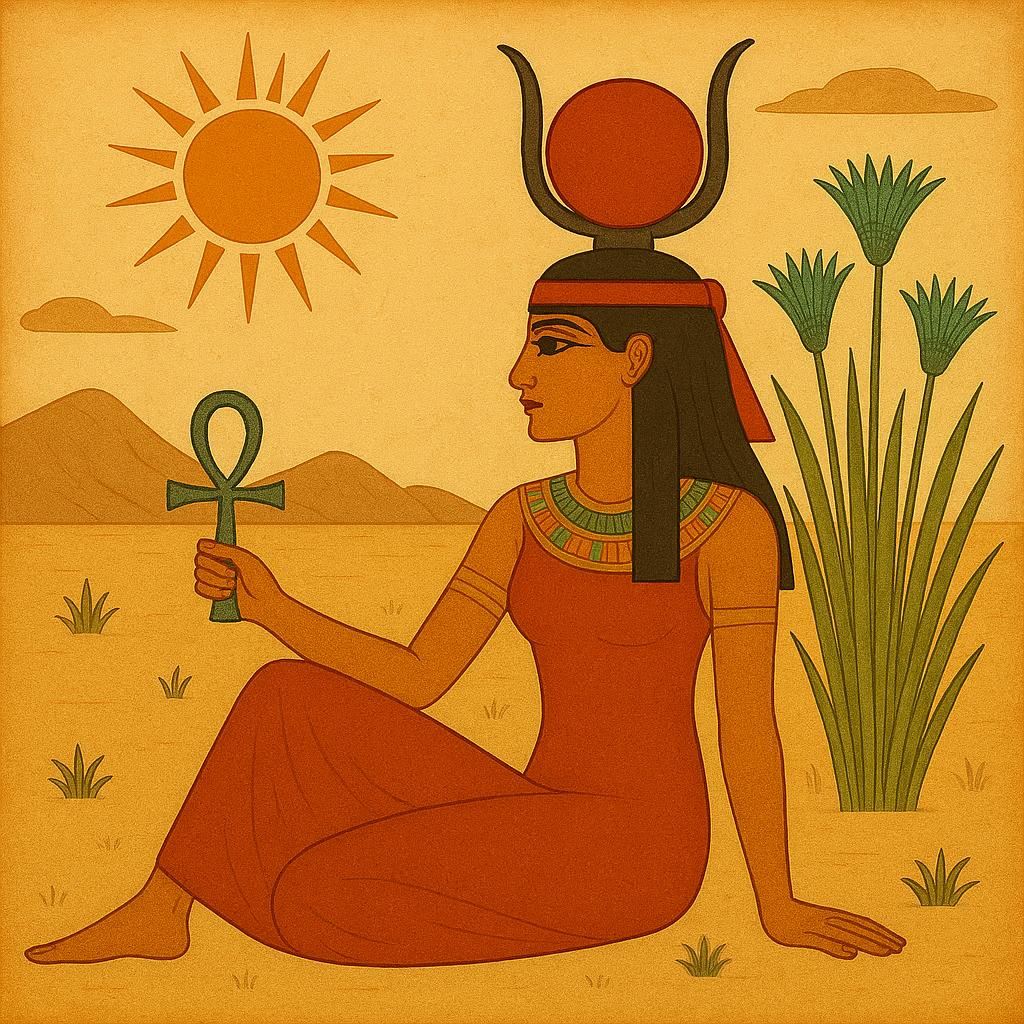
Isis
Isis is the greatest of the Egyptian goddesses — the supreme magician, the devoted wife who searched the world to resurrect her murdered husband, the fierce mother who protected her son Horus through every danger, and the teacher of humanity in all the healing arts. To be born under Isis is to possess an extraordinary depth of feeling combined with an extraordinary capacity to act on that feeling: this sign does not merely love — it loves with the full force of a will that can move heaven, earth, and the underworld itself when those it loves are threatened. Isis people are the ones who do not give up, who find a way when there is no way, who hold the whole world together through the simple power of their refusal to abandon what they love.
- Dates
- March 11–31 · October 18–29 · December 19–31
- Element
- Water / Air
- Ruling Planet
- Isis (Goddess of Magic)
- Quality
- Cardinal
- Strengths
- Intuitive · Devoted · Resourceful · Protective · Magical
- Weaknesses
- Possessive · Manipulative · Martyr-prone · Over-protective · Secretive
Personality
Isis people are defined above all by the intensity of their attachments and the extraordinary lengths to which they will go in service of those attachments. This is not mere sentimentality — it is a profound and purposeful orientation toward the people, causes, and values that they hold sacred. When Isis commits, she commits completely; when she protects, she draws on resources that even she did not know she possessed; when she loves, she loves with the whole of herself. The signature gift of Isis is resourcefulness — the ability to find a way when there appears to be no way. In the myth, Isis was faced with the apparently impossible task of resurrecting the dead, and she succeeded — not through brute force but through the combination of intelligence, magical knowledge, relentless determination, and an absolute refusal to accept that what she loved was truly gone. Isis people bring this same quality to every significant challenge in their lives. The shadow quality of Isis is the possessiveness that can shadow their devoted love. Because they love so completely, they can struggle to allow the people they love to exist independently — to have lives, choices, and even errors that have nothing to do with Isis. Their protectiveness can tip into control, their devotion into demands, their magic into manipulation. The spiritual challenge for Isis is to love freely — to offer the depth of care that is their greatest gift without the strings that can strangle.
Love & Relationships
In love, Isis is the most devoted of partners — the one who will stand by their beloved through every difficulty, who remembers anniversaries and the small significant details, who actively creates the conditions in which love can flourish. They bring a quality of sacred commitment to their relationships that is genuinely rare; for Isis, love is not a feeling that comes and goes but a decision that is remade every day. The challenge in love for Isis is the same as the challenge in all areas: the possessiveness that accompanies their depth of attachment. They can want to know everything about their partner, to be present at every important moment, to have a role in every significant decision — and their partners can feel simultaneously cherished and suffocated. Learning that love is given rather than secured, that the beloved is a person rather than a possession, is the central romantic lesson for this sign. When Isis loves well — with the open hands of a truly liberated spirit rather than the closed hands of fear — the depth and completeness of what they offer is extraordinary. Their partner feels genuinely seen, genuinely cherished, genuinely accompanied through both the light and dark passages of life.
Work & Career
Isis brings to her professional life the same qualities that define her personally: extraordinary devotion to her work, formidable problem-solving ability, and the capacity to draw on resources — including resources she did not know she had — when a situation demands it. She is the colleague who finds a way when the team has given up, the leader who holds things together in a crisis, the healer who does not close the door. The most natural professional homes for Isis are the healing arts in all their forms — medicine, nursing, psychotherapy, holistic health — and any work that involves the protection of the vulnerable: social work, advocacy, law, and child protection. Isis is also naturally gifted in the esoteric and spiritual domains: astrology, shamanism, ritual work, and any practice that bridges the seen and unseen worlds. The professional challenge for Isis is the same as the personal one: the tendency to give so completely that they lose themselves in the giving. They can become so identified with their role — as healer, protector, or servant — that they forget they also need to be served, healed, and protected. Boundaries are not a limitation for Isis but an act of wisdom that allows them to give sustainably over the long term.
Health & Wellbeing
Isis health is deeply tied to the state of their emotional world. When their relationships are thriving, when they feel that their love and devotion are received and valued, they can display remarkable physical vitality — the kind of energy that comes from a life fully engaged with what one loves. When their emotional world is troubled — when they feel rejected, when love has been betrayed, when someone they care for is suffering — the physical body quickly registers the imbalance. The characteristic vulnerabilities for Isis involve the immune system, the thyroid, and the hormonal systems — all areas that are closely linked to the emotional regulation of the body. Isis people who are chronically giving without receiving, protecting without being protected, or loving without being loved tend to develop conditions that express the body's exhaustion. The most important health practice for Isis is the recovery of self-care as a spiritual discipline — not selfish indulgence but the maintenance of the vessel through which their great capacity to love and serve flows. They must learn that they cannot give from an empty cup, and that replenishing themselves is not a betrayal of their devotion but its necessary prerequisite.
Mythology & Symbolism
Isis is one of the most complex and powerful figures in all of Egyptian mythology — and one of the most beloved. Her story is inseparable from that of Osiris, her brother-husband, and together they represent the central divine couple of the Egyptian pantheon: the cosmic king and his queen, the god of the dead and the supreme magician, the victim of betrayal and the one who refused to accept that betrayal as final. When Seth murdered Osiris and scattered his body across Egypt, Isis did something unprecedented: she refused to accept the death of what she loved as permanent. She searched all of Egypt for the dismembered parts of her husband's body, accompanied by her sister Nephthys, and she found them. Using her extraordinary magical knowledge — she was the greatest magician in the Egyptian tradition, greater even than Thoth who had taught her — she assembled the pieces, created the first mummy, and breathed enough life back into the body to conceive a child. That child was Horus, and Isis became the protector of her infant son against the murderous jealousy of Seth — a mother armed with magic, cunning, and absolute ferocity in defence of her child. She hid Horus in the reed marshes of the Delta, nursed him through illnesses and attacks, and ensured that he grew to manhood and claimed the throne of his father. In the later phases of Egyptian history, Isis expanded into a universal goddess whose cult spread throughout the Greco-Roman world. Her temples were built from Britain to Mesopotamia. She was identified with Demeter, Aphrodite, and the Virgin Mary; her iconic image of mother nursing child became one of the primary prototypes for the Madonna and Child in Christian iconography.
This Sign in Other Cultures
The Isis archetype — the devoted mother-goddess, the supreme healer, the woman who refuses to accept the finality of death, the divine protector of children — appears with striking consistency across the world's mythological traditions, suggesting that this figure addresses a universal human experience of love, loss, and the miraculous persistence of life. In Greek mythology, the closest parallel is Demeter, the goddess of the harvest who descended into the underworld to recover her daughter Persephone from Hades — sharing with Isis the defining act of refusing to accept the permanent loss of the one she loved, and the use of her divine power to reverse an apparently irreversible death. Both goddesses also share the maternal protector role and the connection to cycles of death and renewal in nature. Aphrodite/Venus shares with Isis the dimension of divine love and beauty, and the power of eros as a creative and transformative force. In the Hellenistic period, Isis was directly identified with both Demeter and Aphrodite, and her temples served functions that combined both traditions. In Hindu tradition, Kali and Durga share with Isis the fierce maternal protector quality — the goddess who is gentle with her children and absolutely ferocious with any threat to them. Isis's magical healing power also echoes in the tradition of Dhanvantari, the divine healer. The most enduring parallel, however, is with the Virgin Mary in Christian tradition. The image of Isis nursing the infant Horus — which was one of the most common devotional images in the ancient world — was directly adopted and transformed into the Madonna nursing the Christ child. Many of the earliest Marian shrines were built on the sites of Isis temples, and the theological attributes of the two figures — queen of heaven, mother of the divine son, intercessor for humanity — are remarkably parallel.
Compatibility
Best with
Osiris, Thoth
Challenging with
Seth, Sekhmet