


Mut
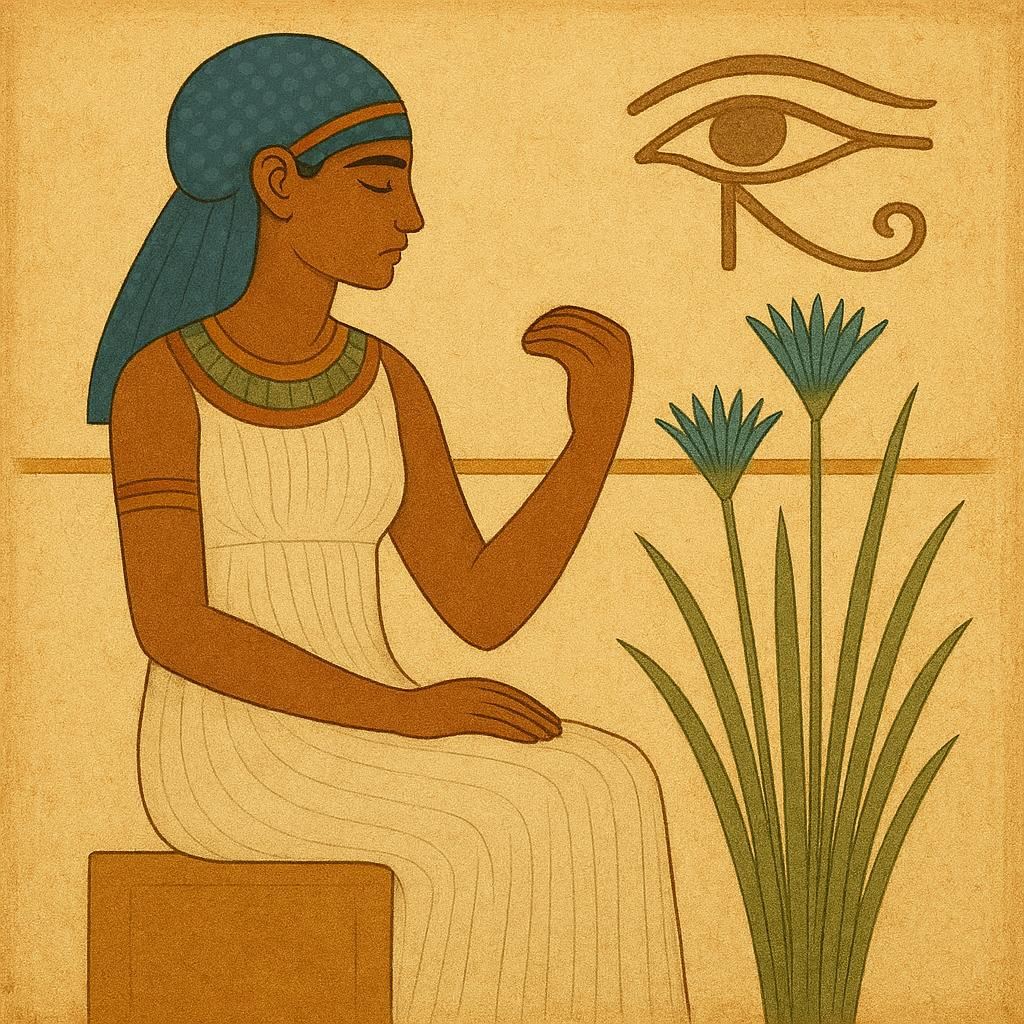
Mut is the Great Mother of the Egyptian pantheon — the divine feminine in its most complete and sovereign expression. Where other goddesses embody particular aspects of femininity, Mut contains all of them: she is simultaneously creator and sustainer, protector and destroyer, queen and mother. Her name in ancient Egyptian simply means "mother" — the most fundamental, most universal of all titles. To be born under Mut is to carry this primordial maternal energy: the capacity to create, protect, and nurture life with a fierce, unconditional devotion that encompasses both tenderness and terrible power.
- Dates
- January 22–31 · September 8–22
- Element
- Water / Earth
- Ruling Planet
- Moon
- Quality
- Fixed
- Strengths
- Protective · Maternal · Powerful · Wise · Devoted
- Weaknesses
- Possessive · Overbearing · Inflexible · Judgmental · Smothering
Personality
Mut people are among the most formidable presences in the Egyptian zodiac. There is a quiet authority about them that is difficult to define but impossible to miss — a certainty, a settledness, a sense that they know exactly who they are and what they are for. This psychological solidity comes not from arrogance but from genuine self-knowledge and the kind of mature confidence that can only come from having truly met oneself. The protective instinct in Mut runs very deep. Once they have accepted someone into their inner circle, that person is defended with extraordinary ferocity. Mut does not threaten; Mut does not warn twice. The Egyptian goddess was depicted wearing the Double Crown of Egypt, holding the Was sceptre of power and the Ankh of life — symbols that together convey: I hold both life and power in my hands, and I use them in service of those I love. The shadow of Mut's protective strength is the possessiveness that can accompany it. The mother who would die for her children can also become the mother who cannot let them go. Mut people must learn to distinguish between protection and control — to love in ways that give freedom rather than constraining it. Mut's wisdom is another of their defining qualities. Unlike the fiery wisdom of Thoth or the solar clarity of Amon-Ra, Mut's wisdom is deep, quiet, and accumulated over time. They know things about people — not through supernatural means but through the patient, careful attention they have given the world throughout their lives. This makes them extraordinary counsellors, elders, and leaders in the truest sense.
Love & Relationships
Mut in love is the most devoted of partners — completely committed, fiercely loyal, and willing to sacrifice almost anything for the wellbeing of those they love. When Mut chooses someone, that choice is made for life; they are not casual about love or given to the constant recalibration that characterises more restless signs. The challenge is the intensity of that devotion and the difficulty of distinguishing love from ownership. Mut can love so completely and so unconditionally that the beloved can sometimes feel they are being held rather than held up — contained by love rather than expanded by it. The spiritual work for Mut in love is learning to love toward freedom rather than toward possession. When Mut is loved well — when a partner can receive their protectiveness without feeling smothered, appreciate their wisdom without feeling judged, and return their devotion with constancy — the result is a love of extraordinary depth, stability, and mutual sustenance. Mut relationships, at their best, are the kind that endure for decades and grow more profound with time.
Work & Career
Mut excels in roles that combine authority with care — positions where genuine power is exercised in service of others' wellbeing. They make extraordinary school principals, hospital administrators, heads of NGOs, senior judges, and leaders of communities. The combination of fierce protectiveness and accumulated wisdom makes them formidable advocates for those who need defence. They are also exceptional in any healing or counselling role where deep presence and patient wisdom are the primary tools. Mut does not offer quick fixes; they offer the kind of profound, sustained engagement that actually transforms. They are the therapist clients stay with for years because the relationship itself becomes part of the healing. Mut's professional challenge is delegation and the training of successors. Their protective instinct can make them reluctant to step back and allow others to make mistakes and learn — but this reluctance, if unchecked, creates dependence rather than growth in those they lead.
Health & Wellbeing
Mut's health is deeply affected by the wellbeing of those she loves. When those in her care are thriving, Mut thrives. When they are struggling, Mut often takes that struggle into her own body — manifesting as tension, fatigue, digestive problems, and the various physical symptoms that accompany sustained emotional vigilance. The key health insight for Mut is that they are not responsible for everyone they love. Their protective nature can cause them to monitor and maintain the emotional state of everyone around them at enormous energetic cost. Learning to let others — including those they love most — handle their own difficulties without Mut's intervention is a health-preserving practice. Physical health benefits enormously from activities that connect Mut to the earth and to their own body: gardening, cooking, walking in nature, bodywork, and any practice that brings them out of the monitoring mind and into present physical sensation.
Mythology & Symbolism
Mut was one of the oldest and most powerful goddesses in the Egyptian pantheon, venerated from the earliest dynasties. Her primary cult centre was at Thebes (modern Luxor), where she formed part of the great Theban Triad with Amon and their son Khonsu. The magnificent temple complex of Karnak included a special precinct dedicated to Mut — the Precinct of Mut — which contained a sacred lake in the shape of a crescent moon, reflecting her lunar associations. Mut's iconography was uniquely powerful: she was depicted wearing the Double Crown of Egypt (combining the white crown of Upper Egypt and the red crown of Lower Egypt), indicating that she encompassed the entire kingdom. She was often shown with the head of a vulture — the Egyptian vulture, specifically, which was understood to be entirely female (the Egyptians did not know about male vultures) and which therefore became a symbol of pure maternal power. The vulture headdress became one of the most important symbols of queenship in ancient Egypt. In some traditions, Mut was described as the Eye of Ra — one of the most powerful of all divine titles, indicating that she was the active, fierce, protective manifestation of the solar god's power. The Eye of Ra was capable of going out from the solar god in a terrible form to protect him against his enemies; when appeased, it became the benevolent mother who nourished rather than destroyed. Mut's name, meaning "mother," was also connected to the ancient Egyptian word for vulture (mwt) — this punning connection between the protective bird and the primordial goddess was considered deeply meaningful by the Egyptians, who saw in the vulture's fierce maternal protection of its young the perfect image of Mut's own character.
This Sign in Other Cultures
The Great Mother archetype that Mut embodies appears in virtually every human religious tradition, testifying to the universality of the maternal principle as a face of the divine. In Hindu tradition, the concept of Shakti — the primordial divine feminine energy — encompasses everything that Mut represents. Shakti in her protective, fierce form becomes Durga, the warrior goddess who rides a lion and defeats the buffalo-demon Mahishasura. In her nurturing form, she is Parvati, the devoted wife and mother. In her most terrible form, she is Kali — destroyer of illusion and death itself. The range of Mut's character maps almost perfectly onto the range of Shakti's manifestations. In Greek mythology, Hera was the most powerful of the Olympian goddesses and the queen of heaven — a direct parallel to Mut's role as queen of the Egyptian gods. Like Mut, Hera combined fierce protectiveness of her domain with demanding standards and the capacity for terrible wrath when crossed. Demeter, the Earth mother who searched for her lost daughter Persephone, expressed the more purely nurturing aspect of the archetype. In Celtic tradition, the Morrigan embodied the fiercer aspects of Mut — a goddess of protection, prophecy, and death who appeared as a crow and who watched over the fates of warriors in battle. Like Mut's vulture aspect, the crow-goddess represented the mother who both nurtures and destroys. In contemporary psychology, the archetype of the Great Mother — described by Carl Jung as one of the most fundamental of the collective unconscious archetypes — contains exactly the duality that Mut represents: the nourishing, protective Mother who is also capable of being the devouring, consuming Mother when her love is not integrated with wisdom.
Compatibility
Best with
Osiris, Horus
Challenging with
Amon-Ra, Seth