


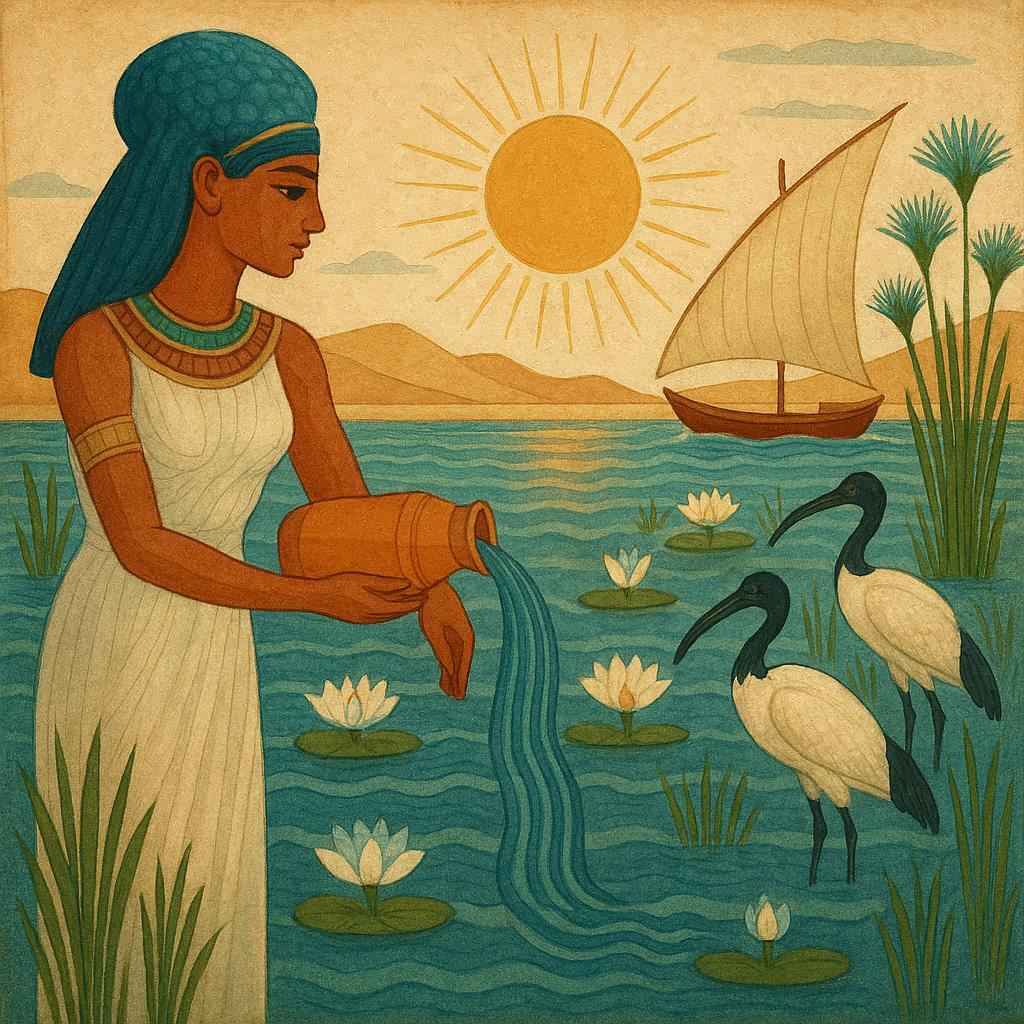
The Nile
The Nile is the first and most fundamental sign of the Egyptian zodiac — named for the great river that made Egyptian civilization possible. Just as the Nile nourished the land with its annual flood, Nile-born people carry within them an inexhaustible capacity to nurture, sustain, and bring life to those around them. They are the quiet source of strength in every group they join, often unnoticed until they are absent — and then felt profoundly in that absence. The Nile's nature is paradoxical: calm on the surface, unfathomably deep beneath, capable of both gentle nourishment and transformative flood. Those born under this sign contain the same contrasts.
- Dates
- Jan 1–7 · Jun 19–28 · Sep 1–7 · Nov 18–26
- Element
- Water
- Ruling Planet
- Hapi (God of the Nile)
- Quality
- Mutable
- Strengths
- Nurturing · Intuitive · Adaptable · Generous · Peaceful
- Weaknesses
- Indecisive · Passive · Overly sensitive · Avoidant · Complacent
Personality
Nile people move through the world with a quiet, steady power that is easy to underestimate. They are not the loudest in the room or the first to act; they are the ones who keep the whole ecosystem alive through their consistent, generous presence. Like the river for which they are named, they flow around obstacles rather than through them — patient, persistent, finding the path of least resistance without abandoning their destination. The Nile's emotional depth is one of their most defining qualities. They feel everything more intensely than they show, maintaining a calm surface that conceals tidal forces within. This means that Nile people are remarkable listeners — they absorb the emotional landscape of every conversation, remembering details others forget, carrying the burdens of those they love. The shadow side of this gift is that they can become so attuned to others' needs that their own go chronically unmet. Adaptability is the Nile's great survival strategy. Across thousands of years, the river has shaped itself to the landscape while simultaneously shaping the landscape to itself. Nile people do the same — they adjust, they accommodate, they find ways to work within situations that would defeat less flexible personalities. But this flexibility has limits. Push the Nile too far from its natural course, and the flood will come — overwhelming, unstoppable, and transformative. The Nile type is drawn to creation and cultivation in all its forms. They make extraordinary parents, teachers, healers, and farmers — anyone whose work involves bringing something from seed to fruition over long periods of patient, consistent effort. They are not built for the sprint; they are built for the endurance journey, and over that journey, they achieve things that more spectacular personalities only dream of.
Love & Relationships
In love, the Nile gives with extraordinary completeness — once they have opened their heart to someone, that person receives the full force of the river's generosity. Nile lovers are devoted, attentive, and deeply invested in their partner's wellbeing. They remember what matters, they show up consistently, and they create the conditions in which love can grow rather than simply burning bright and fading. The challenge for Nile in love is the chronic tendency to give more than they receive. Their natural selflessness can lead them into partnerships where they become the emotional sustainer for someone who takes without reciprocating. Learning to ask for what they need — to allow themselves to be a river that is replenished, not only one that flows — is the central relationship work for this sign. The ideal partner for the Nile is someone who sees and appreciates the quiet depths, who understands that still waters run deep, and who has the patience to receive the Nile's slow-building, enduring form of love rather than seeking something more immediately dramatic.
Work & Career
The Nile excels in work that involves sustained care, nurturing growth, and long-term cultivation. Healthcare, education, agriculture, conservation, social work, counselling, and any role that involves supporting the development of others over time are natural fits. The Nile worker does not seek the spotlight; they seek the satisfaction of watching something grow under their care. Their adaptability makes them valuable in roles that require navigating complex, changing environments. They are the ones who keep functioning when everything around them is in flux, finding the path through the chaos with calm persistence. Crisis management, coordination, and support roles all suit the Nile's capacity to flow around obstacles. What the Nile struggles with professionally is self-advocacy — asking for recognition, negotiating for what they deserve, making their contributions visible. They are often undervalued precisely because they do their work so quietly and so well.
Health & Wellbeing
The Nile constitution is deeply connected to emotional and environmental conditions. When their world is in harmony — when the people they love are well, when their relationships are nourishing rather than draining — Nile people tend toward robust good health. When the emotional environment is toxic or turbulent, physical symptoms follow: digestive disorders, fatigue, immune weakness, and fluid-related conditions are all common. The Nile must learn to distinguish between empathy and absorption. Feeling others' pain is a gift; carrying it in their body as if it were their own is a health risk. Practices that help with energetic clearing — regular time in or near water, breathwork, creative expression — are especially effective for the Nile type. Given their tendency toward over-giving, depletion is the primary health risk. Rest is not a luxury for the Nile but a necessity — the river must have time to replenish between floods. Sleep, solitude, and regular withdrawal from the demands of others are not selfishness but survival.
Mythology & Symbolism
In ancient Egyptian religion, the Nile was not merely a geographical feature but a living god — the embodiment of abundance, renewal, and the possibility of life itself. The annual inundation of the Nile was the single most important event in the Egyptian calendar, transforming barren desert into fertile farmland and making the entire civilization possible. This flood was personified as Hapi — a plump, blue-skinned deity who carried offerings of food and lotus flowers, the very image of nourishing abundance. The Nile's annual flood was governed by precise celestial timing: it began when Sirius (the star of Isis) rose on the horizon just before dawn — an event the Egyptians called the heliacal rising of Sothis, which marked the beginning of their new year. The timing of the flood determined whether Egypt would experience abundance or famine; getting it wrong meant death on a civilizational scale. No wonder the Egyptians paid such close attention to the heavens. Osiris, one of Egypt's most important gods, was also intimately connected to the Nile — his dismembered body was said to have been thrown into the river by Set, and his resurrection was symbolically enacted by the river's annual renewal. The Nile thus carried both death and rebirth in its waters, making it a perfect emblem of the full cycle of existence. In the mythological geography of Egypt, the Nile divided the world: the east bank, where the sun rose, was the land of the living; the west bank, where it set, was the land of the dead. The river itself was the threshold between worlds — a fitting symbol for a sign that exists at the boundary between one year and the next, carrying the endings of one cycle into the beginnings of another.
This Sign in Other Cultures
The Nile's cosmic significance extended far beyond Egypt's borders. For ancient Mediterranean civilizations — Greeks, Romans, Persians, and later Arabs — the Nile was one of the wonders of the world, a river that flowed from mysterious sources deep in Africa, flooded on a schedule that seemed divinely ordained, and sustained a civilization of staggering antiquity and achievement. Greek scholars called Egypt "the gift of the Nile" (a phrase attributed to Herodotus), and Greek philosophers including Thales and later Aristotle wrote extensively about the Nile's mysterious flooding cycle, which they struggled to explain because it occurred in summer when other rivers typically ran low. The Nile's southward source, so long unknown to the ancient world, made it a symbol of mystery and divine hiddenness. In Sufi mystical poetry, rivers — and the Nile in particular — appear as metaphors for the divine flow of grace through the world. The river's journey from hidden source to open sea mirrors the soul's journey from divine origin through earthly life back to the ocean of the divine. In this sense, the Nile sign carries resonances of spiritual seeking and homecoming that echo across traditions. In African traditional religions and among the peoples of the Nile Valley and Great Lakes regions, the river itself was and is sacred — a living ancestor, a source of oracular wisdom, a deity in the most literal sense. These traditions predate Egyptian civilization and continue alongside it, testifying to the river's enduring power to inspire reverence across millennia.
Compatibility
Best with
Amon-Ra, Thoth
Challenging with
Seth, Sekhmet