


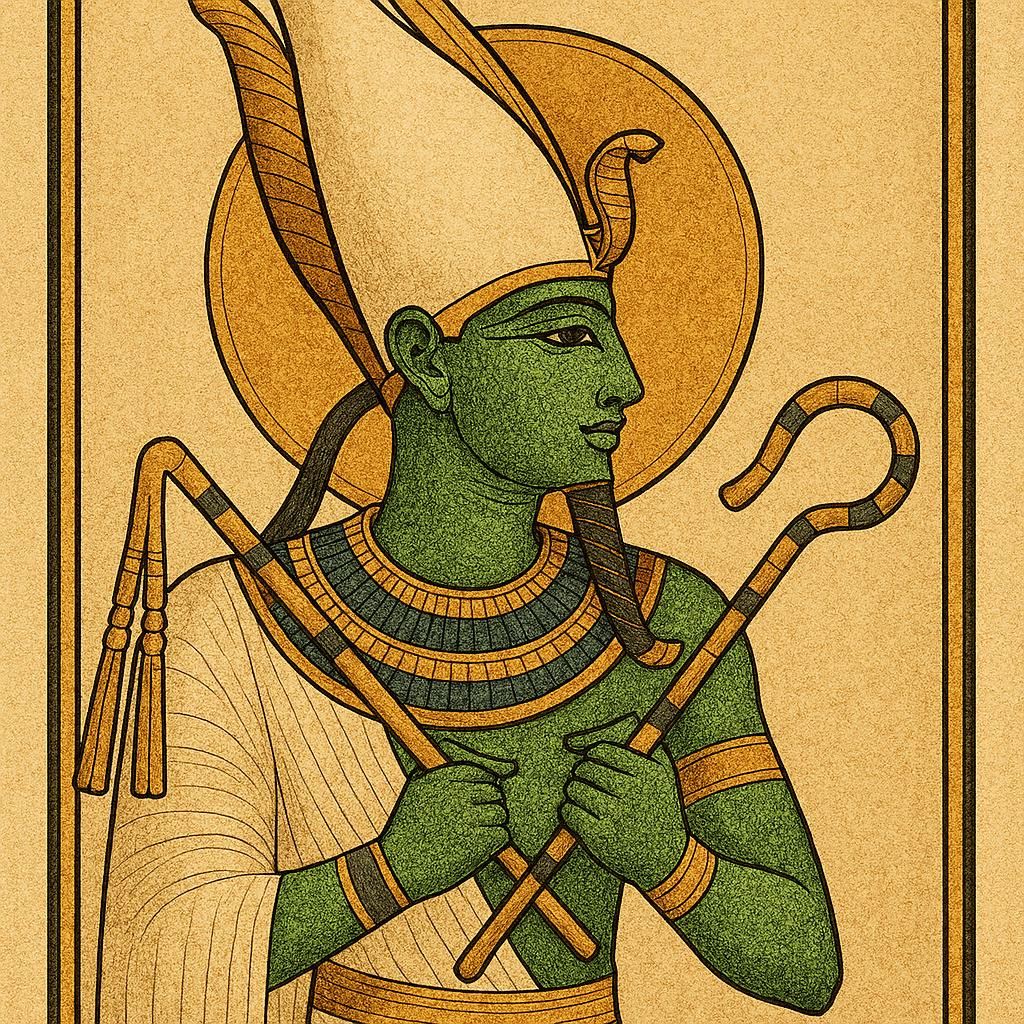
Osiris
Osiris is the most beloved and most profound of the Egyptian gods — the divine king who was murdered, dismembered, and resurrected; the lord of the dead who guarantees that death is not the end; the god of grain and vegetation who dies every winter and is reborn every spring. To be born under Osiris is to carry the great mystery of transformation: the knowledge, at a cellular level, that endings are also beginnings, that what appears to be destruction is often the necessary precondition for a more profound form of life. Osiris people are drawn to the deep questions — justice, meaning, mortality, redemption — and they carry these questions not as burdens but as sacred responsibilities.
- Dates
- March 1–10 · November 27 – December 18
- Element
- Earth / Water
- Ruling Planet
- Osiris (God of the Dead)
- Quality
- Mutable
- Strengths
- Just · Wise · Compassionate · Transformative · Forgiving
- Weaknesses
- Passive · Self-sacrificing · Melancholic · Indecisive · Overly idealistic
Personality
Osiris people move through the world with a quiet gravity that others find both compelling and mysterious. There is a depth to them that is immediately apparent but never fully plumbed — the sense that behind the composed exterior there are entire worlds of interior experience, ancient wisdom, and carefully considered understanding. They have been through things. They carry the weight of experience not as bitterness but as a kind of seasoned understanding that makes them extraordinary counsellors, judges, and witnesses. Justice is not merely a professional interest for Osiris but a deeply personal one. They feel injustice with unusual acuteness — not only injustice done to themselves but injustice done anywhere they can see it. This makes them natural advocates, activists, and reformers. The Osiris person cannot pass by suffering without at minimum bearing witness, and often without acting. The world's pain touches them; they have a genuine calling to respond to it. The shadow quality of Osiris is the passivity that can accompany their depth and acceptance. Having understood the great cycles of life and death, having accepted that things end and that this acceptance is wisdom — Osiris can sometimes use this philosophy to justify inaction in situations that actually call for intervention. True acceptance is active engagement with what is; false acceptance is the use of wisdom as an excuse not to act. Transformation is the central theme of the Osiris life. These people will experience, more than most, the kind of complete life-reshaping that follows a great loss: a death, a divorce, a career collapse, a health crisis. These transformations are not punishments but initiations — the dismemberment that precedes the resurrection. Osiris people who understand this are among the most remarkable humans alive: they have died to themselves and been reborn, and they carry that knowledge as a source of inexhaustible compassion.
Love & Relationships
In love, Osiris brings a depth and completeness of commitment that is rare in the modern world. When they love, they love the whole person — the shadow as well as the light, the history as well as the present, the potential as well as the reality. They are not frightened by complexity, by darkness, by the parts of a person that are wounded or unfinished; in fact, these aspects often draw them more deeply in, because Osiris understands that the most profound love is the love that holds all of someone, not just the appealing parts. The challenge for Osiris in love is the melancholy that can shadow their depth. They can love with such intensity that loss — even anticipated loss — weighs on them heavily. They may pull back before they are hurt, or they may stay in situations that have already ended because they cannot bear the grief of letting go. Learning to love while accepting impermanence — to hold with open hands rather than closed ones — is the central romantic challenge for this sign. The ideal partner for Osiris is someone who can meet their depth without being overwhelmed by it, who can offer steadiness when Osiris is lost in the underworld of their own interior, and who understands that the Osiris person's capacity for transformation — their willingness to die and be reborn within a relationship — is a sign of profound commitment rather than instability.
Work & Career
Osiris excels in any work that involves judgment, evaluation, and the discernment of truth from appearance. The law, ethics, philosophy, psychology, mediation, and restorative justice are all natural territories. They are gifted at seeing what is actually happening in a situation — cutting through rationalisations, self-deceptions, and power dynamics to arrive at the essential truth — and at articulating that truth in a way that carries authority. They are also drawn to transformational work in all its forms: therapy, grief counselling, hospice work, addiction recovery, and any field that supports people through the kinds of profound life-change that Osiris themselves understand intimately. Their lived experience of transformation makes them unusually effective in these roles; they do not offer hope as a platitude but as testimony. The professional vulnerability for Osiris is the weight of the work they take on. They can become vicarious carriers of others' suffering — absorbing grief, injustice, and tragedy in ways that eventually compromise their own wellbeing. Regular practices of clearing, releasing, and renewal are not optional for Osiris in a helping profession but essential.
Health & Wellbeing
Osiris health is profoundly cyclical — they tend to move through periods of great vitality and periods of deep depletion in a rhythm that mirrors the mythological cycle of death and resurrection. Understanding this rhythm rather than fighting it is essential: the periods of withdrawal are not failure but necessary descent, the prerequisite for the subsequent renewal. The characteristic vulnerabilities for Osiris involve the digestive system and the emotional processing centres — the body's capacity to take in, transform, and release experience. When they are carrying grief, unresolved loss, or unprocessed emotion, these physical systems often register the imbalance first. Regular practices that support the release of what has been held — cathartic expression, ritual, water-based therapies, and any form of conscious grieving — are particularly valuable. The greatest health gift Osiris can give themselves is permission to complete cycles fully — to grieve what needs grieving, to let go of what has ended, and to trust that the descent into the underworld is temporary. The resurrection follows the dismemberment. This is not optimism but the testimony of experience.
Mythology & Symbolism
The myth of Osiris is the central narrative of ancient Egyptian religion — the story of divine murder, dismemberment, resurrection, and judgment that shaped Egyptian theology, funerary practice, kingship ideology, and moral philosophy for three thousand years. No other myth in the ancient world had such profound and comprehensive influence on the civilisation that produced it. In the beginning, Osiris was the perfect king — a divine ruler who brought law, agriculture, and civilisation to Egypt, who was deeply loved by his people and by his sister-wife Isis. His brother Seth, consumed by jealousy and desire for power, tricked Osiris into entering a coffin and threw him into the Nile, where he floated to Byblos in Phoenicia. Isis, using her extraordinary magical abilities, tracked down the coffin and brought Osiris back to Egypt — but Seth discovered him, tore his body into fourteen pieces, and scattered them across Egypt. What followed was one of the most moving stories in all mythology: Isis searched all of Egypt for the scattered pieces of her husband's body, accompanied by her sister Nephthys. She found all the pieces except one — his phallus, which a fish had eaten — and reassembled the body, creating the first mummy. Using her magical knowledge, she breathed life into the reconstructed body long enough to conceive a child: the hawk-god Horus, who would avenge his father and reclaim the throne of Egypt. Osiris himself did not return to the land of the living but became the ruler of the Duat — the Egyptian underworld — where he presided over the judgment of the dead. In the Hall of Two Truths, the heart of every deceased person was weighed against the feather of Ma'at (truth and justice): if the heart was light, the person entered the eternal paradise of the Field of Reeds; if heavy with wrongdoing, it was consumed by the crocodile-headed Ammut.
This Sign in Other Cultures
The Osiris archetype — the dying and rising god, the lord of the dead who guarantees resurrection, the just judge of human souls — appears with remarkable consistency across the world's religious traditions, suggesting that this figure addresses something fundamental in the human experience of mortality, justice, and hope. In Greek tradition, the closest parallel to Osiris is Dionysus — also a god who was dismembered (by the Titans) and resurrected; also associated with vegetation, wine, and the renewal of life after death. The similarities were so striking that Greek writers in the Hellenistic period explicitly identified the two gods, and some modern scholars have proposed a direct mythological connection. Hades, the Greek lord of the dead, shares with Osiris the role of ruler of the underworld and judge of the deceased. But where Hades is often depicted as cold, fearsome, and remote, Osiris is portrayed as compassionate and just — more like a shepherd of souls than a jailer. In Christianity, the parallels with Osiris have been noted since the early centuries: a divine son whose death and resurrection offer salvation to humanity; judgment after death; the weighing of souls. The Jesuit scholar Athanasius Kircher in the seventeenth century wrote extensively about the Osiris-Christ parallels, and they continue to fascinate comparative religion scholars. In Hindu tradition, Yama is the lord of the dead who judges the souls of the deceased — a direct functional parallel to Osiris. Both are depicted as just rather than cruel; both have a cosmic role in maintaining the moral order of the universe.
Compatibility
Best with
Isis, Mut
Challenging with
Seth, Sekhmet