


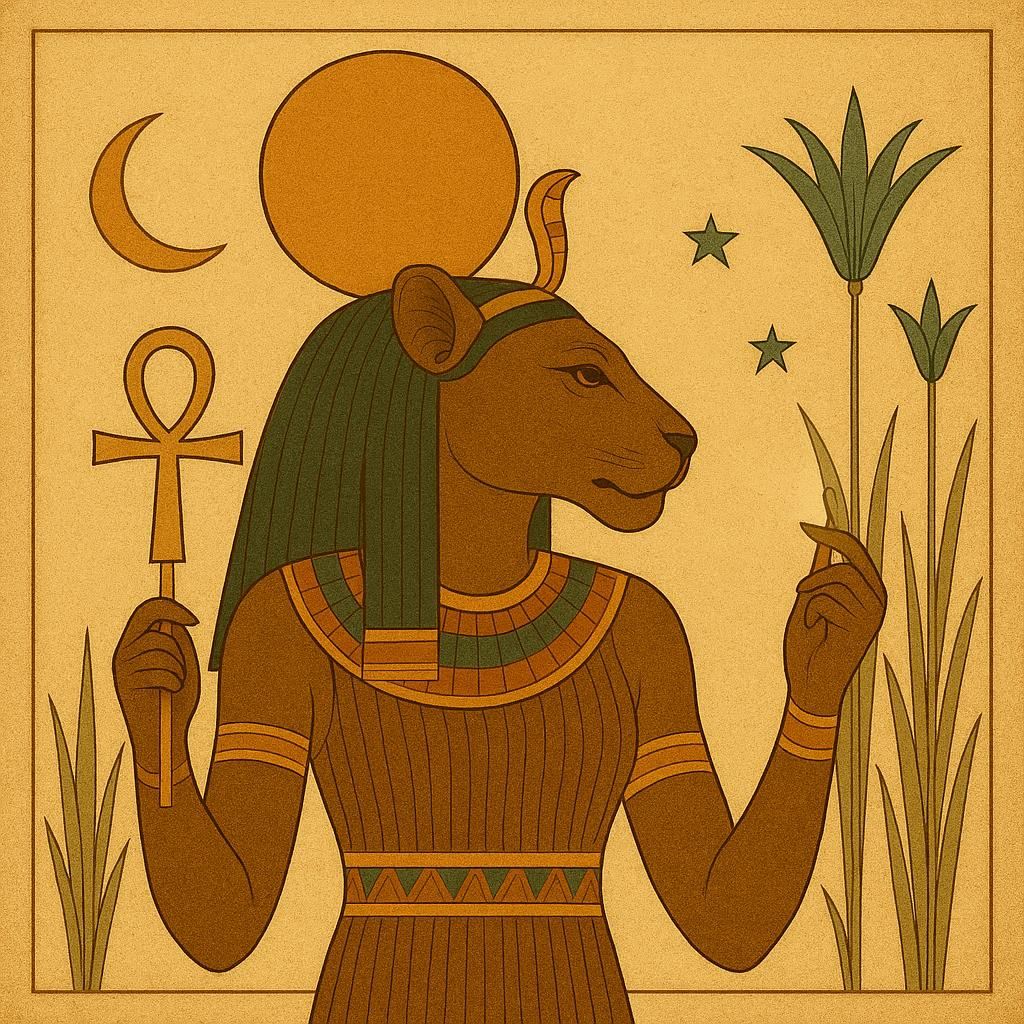
Sekhmet
Sekhmet is the most fearsome of the Egyptian goddesses — the lioness of the burning desert sun, the Eye of Ra whose wrath can annihilate armies and plagues alike, the great destroyer who is simultaneously the great healer, because the same fire that burns also purifies, the same power that destroys also transforms. To be born under Sekhmet is to carry one of the most potent and demanding forces in the Egyptian zodiac: a power so great that it requires exceptional wisdom, discipline, and self-knowledge to wield without being consumed by it. Sekhmet people are the ones who change everything they touch — not always gently, not always comfortably, but always profoundly.
- Dates
- July 29 – August 11 · October 30 – November 7
- Element
- Fire / Sun
- Ruling Planet
- Sekhmet (Goddess of War)
- Quality
- Fixed
- Strengths
- Powerful · Healing · Fierce protector · Decisive · Transformative
- Weaknesses
- Wrathful · Unforgiving · Overwhelming · Destructive · Burning
Personality
Sekhmet people have a presence that is immediately felt — a quality of concentrated force that others register instinctively, whether as attraction, intimidation, or both. There is nothing tepid about them; they are at full intensity in almost everything they do, and this intensity can be exhilarating or exhausting for those around them, depending on whether it is currently directed at them or at something else. The paradox at the heart of Sekhmet's nature is the combination of destruction and healing. She is the goddess of war and the goddess of medicine simultaneously — and so are her people. Sekhmet natives have an unusual capacity to perceive what is wrong and to apply the force required to correct it: whether that is the surgeon's scalpel, the activist's challenge, the teacher's demanding standard, or the honest friend's refusal to pretend that everything is fine. They do not soften things; they cannot, and attempts to require them to do so are usually unsuccessful. The shadow quality of Sekhmet is the wrath that can become disproportionate and self-perpetuating — the force that was activated by a genuine wrong and then exceeded the correction needed, continuing to burn long after the original problem has been addressed. The growth challenge for Sekhmet is the management of righteous anger — to ensure that the fire that purifies does not become a fire that merely destroys.
Love & Relationships
In love, Sekhmet is one of the most intensely passionate and one of the most demanding of the Egyptian signs. When they love, they love with their whole enormous force — completely, committedly, with the full deployment of their extraordinary capacity for feeling. There is no half-measures with Sekhmet in love; they are either fully present or they are not there at all. The challenge in love for Sekhmet is the intensity that can become overwhelming. Their partners may feel, at times, as if they are standing very close to a very large fire — warmed, illuminated, but also in some danger of being singed. Sekhmet's high standards, their uncompromising honesty, and their fierce protectiveness can create a relationship that is intense to the point of being difficult to sustain over the long term. The ideal partner for Sekhmet is someone who has significant internal resources of their own — who does not need to be protected, managed, or carried, but who can stand as Sekhmet's genuine equal, meeting force with force, depth with depth, and offering back to Sekhmet the kind of honest, uncompromising engagement that Sekhmet gives to everything. When this is found, the love of Sekhmet is one of the most extraordinary experiences available in this zodiac.
Work & Career
Sekhmet excels in any work that requires the combination of great force and precise application — the surgeon who cuts to heal, the crisis manager who applies maximum effort at the critical moment, the researcher who pursues truth with relentless intensity, the reformer who dismantles what is wrong in order to replace it with what is right. Medicine, surgery, and healing in all their forms are the most natural territories — reflecting Sekhmet's paradoxical nature as both destroyer and healer. She is also gifted in any work that involves the confrontation of difficult truths: investigative journalism, forensic science, criminal prosecution, and any professional domain that requires the willingness to see and say what others prefer to avoid. The professional challenge for Sekhmet is the management of their formidable force. They can intimidate colleagues and clients who are not prepared for their level of intensity; they can burn through their own resources in the service of a goal that turns out not to be worth the fire they brought to it. Learning to calibrate their force — to apply precisely what each situation requires and no more — is Sekhmet's most important professional skill.
Health & Wellbeing
Sekhmet's health, like her mythology, is governed by the principle of fire: intense, purifying, and capable of both healing and consuming. Sekhmet natives tend to have remarkable constitutions — the capacity to endure what would defeat others, to recover from illness with unusual speed, and to maintain a high level of physical function even under conditions of extreme stress. But this resilience can be both a gift and a trap; it can lead them to push beyond what even their robust constitution can sustain. The characteristic vulnerabilities for Sekhmet involve the cardiovascular system (the heart as the engine of force), the immune system (chronically overactivated in this always-on-maximum-intensity sign), and any conditions related to inflammation and excess heat in the body. Fever, inflammatory conditions, and the physical manifestations of unprocessed rage are characteristic. The most important health practice for Sekhmet is the regular, safe discharge of the enormous energy they generate — exercise that genuinely challenges them, physical exertion that allows the fire to burn in a controlled and productive way. The second most important practice is the conscious processing of anger: Sekhmet who cannot find ways to express and release their wrath in healthy ways will find it expressed in their bodies instead.
Mythology & Symbolism
Sekhmet's central myth is one of the most dramatic in the Egyptian tradition — the story of how the goddess of war nearly destroyed all of humanity, and how she was stopped by the ingenuity of the gods. In the beginning of the story, Ra was growing old, and his human subjects were mocking and plotting against him. Enraged, Ra called upon his Eye — Sekhmet — to punish the conspirators. Sekhmet descended upon the earth in a fury and began destroying humanity with a thoroughness that exceeded her mandate; she was drunk on human blood and could not stop herself, slaughtering the innocent alongside the guilty. The gods, alarmed by Sekhmet's rampage, devised a plan. They mixed vast quantities of beer with red ochre (to make it look like blood) and flooded the fields. Sekhmet, believing it was blood, drank the entire flood, became intoxicated, and fell into a deep sleep — and when she woke, her rage had passed. This is why the Egyptians brewed sacred beer in connection with Sekhmet's festivals. In her healed aspect — after the rage has passed — Sekhmet becomes a goddess of medicine, healing, and the protection against disease. The same power that destroys becomes the power that heals; the fire that burns also purifies. Egyptian physicians were priests of Sekhmet; the power of healing was understood to be identical to the power that, improperly applied, causes harm.
This Sign in Other Cultures
The Sekhmet archetype — the fierce solar goddess, the destroyer who heals, the wrath that burns and purifies — appears in many traditions, often associated with lions, the sun, fire, and the paradoxical power that both destroys and restores. In Hindu tradition, Durga and Kali are the closest parallels — fierce warrior goddesses who are both terrible in their wrath and deeply compassionate in their protection of those they love. Kali in particular shares with Sekhmet the quality of righteous wrath that can exceed its mandate — the power that was summoned to defeat evil and must then be returned to its sheath before it consumes everything. The parallel between the myth of Sekhmet's rampage and Kali's similar excess is striking. In Greek mythology, Artemis in her most wrathful aspect — the huntress who punishes those who violate the sacred — shares something of Sekhmet's energy. Athena as goddess of war also shares the combination of fierce martial power and the capacity for wisdom and healing. Ares/Mars, the god of war, represents the martial dimension without the healing counterpart. In Norse mythology, the Valkyries share with Sekhmet the combination of power, fierceness, and the connection between war and death. Freyja, the Norse goddess of love and war, also parallels Sekhmet's dual nature: beauty and destruction in the same divine person.
Compatibility
Best with
Horus, The Nile
Challenging with
Isis, Thoth