


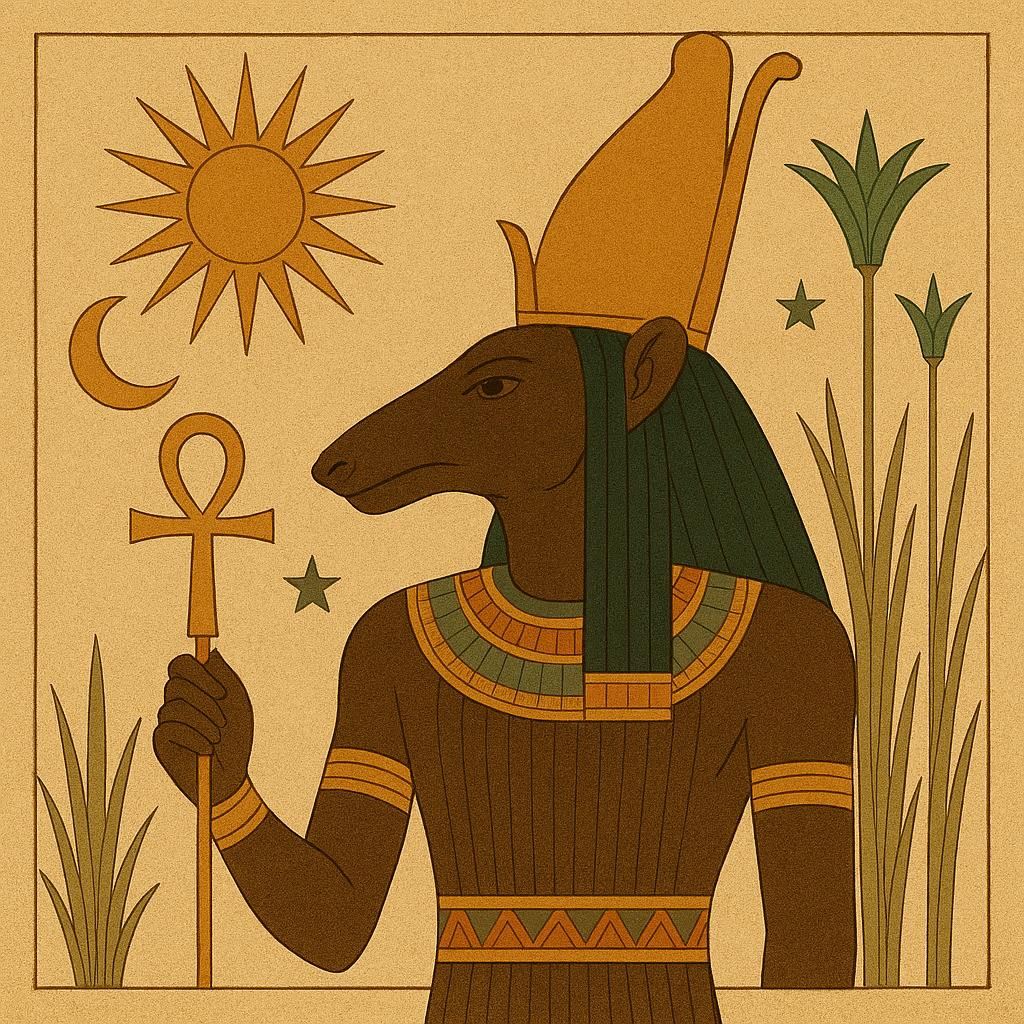
Seth
Seth is the most complex and most misunderstood of the Egyptian gods — not a villain but a necessity, not evil but the raw force of disruption that prevents stagnation, challenges the existing order, and makes transformation possible. Without Seth, there would be no storms to water the desert; without Seth, the eternal order of Ra would have no champion in the daily battle against Apophis, the serpent of chaos; without Seth, the gods themselves would have no adversarial force to test and strengthen them. Seth is the power of the desert wind, of the force that breaks apart what has become rigid, of the terrible creativity that precedes new order. To be born under Seth is to carry this force within — and to have the lifetime task of learning to channel it rather than be consumed by it.
- Dates
- May 28 – June 18 · September 28 – October 2
- Element
- Fire / Desert
- Ruling Planet
- Seth (God of Chaos)
- Quality
- Cardinal
- Strengths
- Powerful · Independent · Courageous · Rebellious · Energetic
- Weaknesses
- Destructive · Jealous · Impulsive · Ruthless · Chaotic
Personality
Seth people are forces of nature — high-energy, high-intensity, difficult to contain and impossible to ignore. They have an enormous appetite for experience, for challenge, for the new — a restlessness that is neither pathology nor immaturity but the expression of a genuine need to engage with the world at its full voltage. Boredom is their enemy, convention their prison, and the comfortable rut the most dangerous place they can inhabit. The defining qualities of Seth are power and independence. These people are not followers; they are not built for subordination, for playing small, for adjusting their nature to fit the expectations of others. This is not arrogance — it is constitutional: Seth cannot pretend to be less than they are without paying a severe interior price. When Seth is denied the expression of their full power, the suppressed force has to go somewhere — and it often goes somewhere destructive. The shadow quality of Seth is the capacity for real destruction — for the use of their enormous power in ways that damage rather than transform, that break rather than open. The difference between the force that breaks open a seed and releases it and the force that crushes it is not the quantity of power but its orientation. The central challenge for Seth is to develop the discipline that allows their enormous energy to be generative rather than simply explosive — to be the desert storm that waters rather than the storm that merely destroys.
Love & Relationships
In love, Seth is passionate, intense, and genuinely exciting — the partner who makes ordinary life feel charged and alive, who brings an erotic and emotional voltage to the relationship that their beloved will never quite forget, even if they eventually cannot sustain it. Seth loves with the full force of their enormous energy; there is nothing lukewarm or merely comfortable about the way they love. The challenge for Seth in love is the same as in all areas: their intensity can be too much for most partners, and their independence can make sustained commitment difficult. They need a great deal of autonomy within any relationship; partners who attempt to domesticate Seth — who try to contain, control, or manage the storm — will discover that this is not possible without extinguishing what they loved in the first place. The ideal partner for Seth is someone who is genuinely strong in their own right — someone who is not overwhelmed by Seth's intensity but energised by it, who can hold their own ground without needing Seth to be smaller, and who understands that Seth's independence is not disloyalty but necessity. The great love affair for Seth is one of two sovereign powers, each enlarged by the other.
Work & Career
Seth's enormous energy and his comfort with conflict and disruption make him naturally effective in competitive, high-stakes professional environments. He thrives in roles that require the courage to challenge existing systems, the resilience to survive opposition, and the capacity to operate effectively in chaos and uncertainty. Entrepreneurship, competitive sports, military leadership, emergency medicine, crisis management, and any domain that demands the full deployment of force at critical moments are natural territories. Seth is also particularly gifted in any work that involves the protection of others against external threats — whether physical, financial, or systemic. The same aggression that can be destructive in Seth's personal life becomes genuinely protective when it is directed at external threats rather than inward or toward the people Seth loves. The professional challenge for Seth is the same as the personal: the tendency toward escalation, toward responses that are larger than the situation requires, toward burning bridges and torching alliances in moments of frustration. Seth's professional survival depends on their ability to manage the timing and magnitude of their force — to strike decisively when decisive action is needed, and to refrain when restraint is the more powerful response.
Health & Wellbeing
Seth's health reflects his sign's enormous vitality and its characteristic mode of expression — the health challenge is not the absence of energy but its management. Seth types tend to have remarkable physical constitutions; they can push their bodies to extremes and recover with surprising speed. The danger is not depletion but excess — the tendency to push beyond what is sustainable, to ignore signals of overload in the pursuit of the next goal. The characteristic vulnerabilities for Seth involve the cardiovascular system (the heart driving the force), the adrenal glands (chronically activated in Seth's high-arousal lifestyle), and the musculoskeletal system (vulnerable to the injuries of a physical life lived at full speed). The skin and sun exposure are also associated with this sign — Seth's desert element. The most important health practice for Seth is learning to rest — genuinely, completely, without guilt or agitation. This is Seth's most difficult challenge: the nature that makes them so vital also makes stillness feel like death. But the capacity to move from maximum intensity to genuine rest and back again — to cycle through the desert day and the desert night — is the key to Seth's long-term vitality.
Mythology & Symbolism
Seth is one of the most ancient deities in the Egyptian tradition — and one of the most fascinating, precisely because he defies the simple categories of good and evil. In the earliest periods of Egyptian religion, Seth was not primarily an evil figure but a god of the desert, of foreign lands, of storms and thunder — a god of power and disruption who was as necessary as the forces he embodied. In the pre-dynastic period, Seth was actually the patron deity of Upper Egypt, while Horus was the patron of Lower Egypt. The mythological contest between them may reflect a historical memory of the political unification of Egypt under the first Pharaohs — the tension between the two ancient kingdoms transformed into cosmic myth. In this period, Seth and Horus were sometimes depicted as equals, the two halves of an integrated whole, each necessary to the other. It was later — particularly in the New Kingdom period — that Seth's character darkened, and he became the arch-villain of Egyptian mythology: the murderer of Osiris, the enemy of Horus, the god of foreigners and of chaos. This darkening may reflect Egypt's historical experiences with foreign invasion and the need to have a divine sanction for opposing what was foreign and disruptive. Yet even in this darkened form, Seth retained an important positive function: he was the champion of Ra, the sun god, in the daily battle against Apophis, the great serpent of chaos who threatened to swallow Ra's solar barque as it passed through the underworld each night. In this role, Seth's violence and power were not merely destructive but cosmically necessary — the force that kept the universe from being swallowed by primordial darkness.
This Sign in Other Cultures
The Seth archetype — the divine disruptor, the necessary force of chaos, the villain whose villainy serves a larger order, the god whose darkness is the precondition for transformation — appears in many traditions, often in more complex and ambivalent forms than a simple reading of the mythology suggests. In Norse mythology, Loki is the closest parallel: the trickster god whose interference disrupts the plans of the Aesir, who causes harm and enables growth in almost equal measure, who eventually becomes the agent of Ragnarök — the great catastrophe that destroys the old world and makes the new one possible. Both Seth and Loki are necessary to their pantheons; both are ultimately necessary to the cycles of destruction and renewal that cosmological mythology requires. In Hindu tradition, Shiva as Destroyer is associated with Seth's energy: the god who dances the dance of destruction that enables the subsequent creation. The difference is that in Hindu tradition, Shiva's destruction is explicitly understood as a phase in a greater cycle of creation, preservation, and dissolution; Seth's destructive aspect is similarly necessary but less clearly integrated in the later Egyptian mythology. In Greek mythology, Ares/Mars shares with Seth the domain of violence, war, and disruptive force. Both are necessary for the protection of order even as they threaten it; both are more complex than their reputation for violence suggests. Typhon, the monstrous primordial serpent of Greek mythology, is also associated with Seth — and the identification of Seth with Typhon was actually made in antiquity.
Compatibility
Best with
Bastet, The Nile
Challenging with
Osiris, Isis