


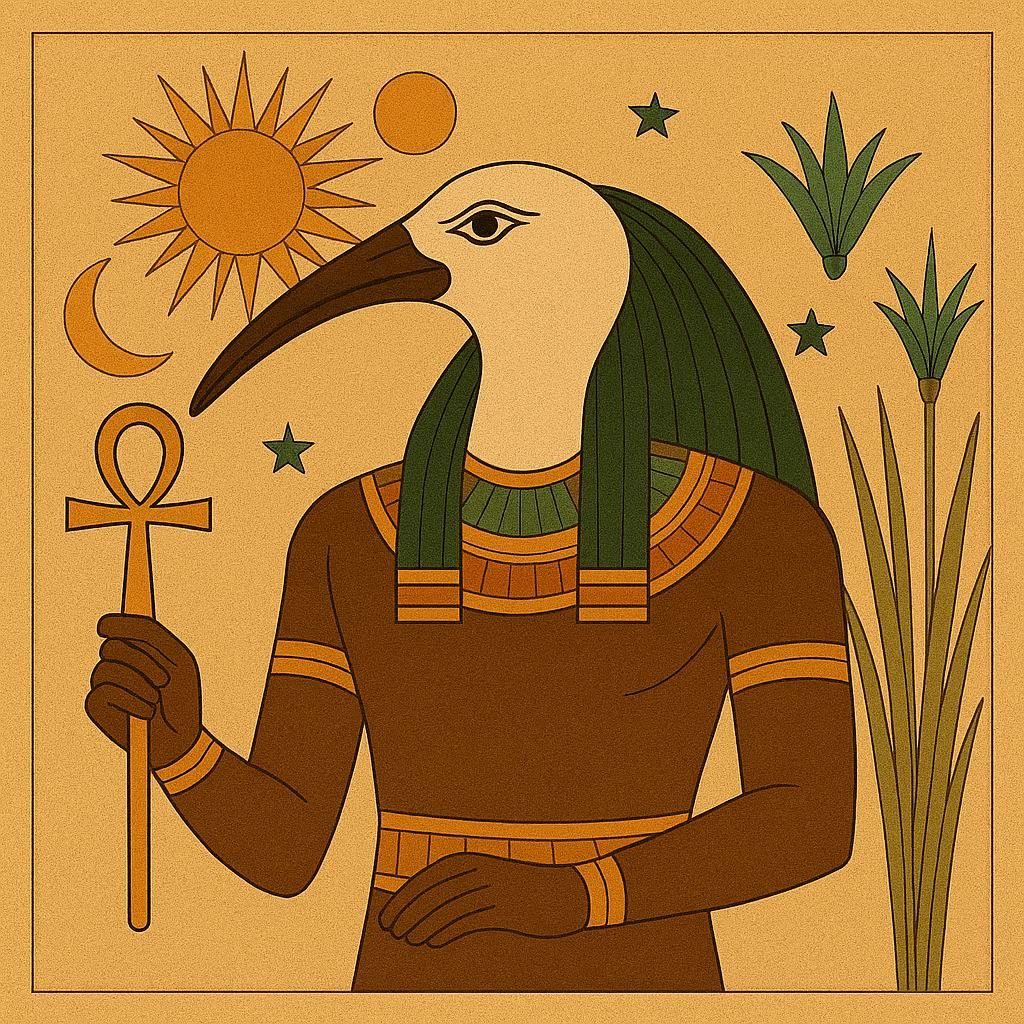
Thoth
Thoth is the divine scribe, the keeper of all knowledge, the inventor of writing and mathematics and astronomy, the measurer of time and the recorder of the deeds of the dead — the mind of the gods made conscious. To be born under Thoth is to have the universe's most precious quality: the ability to perceive patterns in the chaos of existence, to translate experience into understanding, and to communicate that understanding to others. Thoth people are the ones who always know more than they let on, who see the connections that others miss, who carry libraries in their heads and use those libraries not for display but for function.
- Dates
- April 1–19 · November 8–17
- Element
- Air / Ether
- Ruling Planet
- Thoth (God of Wisdom)
- Quality
- Fixed
- Strengths
- Wise · Analytical · Communicative · Impartial · Innovative
- Weaknesses
- Detached · Pedantic · Overthinking · Aloof · Overly cerebral
Personality
Thoth people have minds that are both broad and precise — a combination that is rarer than it sounds. They can hold vast amounts of information simultaneously and perceive the relationships between disparate fields of knowledge; they are the ones who make the unexpected connections, who notice that the problem in one domain has already been solved in another, who bring the insights of ancient philosophy to bear on contemporary technology. At the same time, their precision keeps this breadth from becoming mere dilettantism: when they engage with something, they engage with it fully. The characteristic emotional challenge for Thoth is the gap between understanding and feeling. These people can analyse a situation with extraordinary acuity — they can tell you exactly what is happening and why, what the patterns are and what the likely outcomes will be — and yet remain emotionally unmoved by what they so clearly see. This is not indifference but a kind of constitutional imbalance: the intellectual functions are so powerful that they tend to dominate the emotional ones. Thoth's great strength is also his great limitation: he knows so much that he can sometimes mistake knowing for living. The experience of writing about grief is not the experience of grief; the map is not the territory. The growth challenge for Thoth is to engage with experience not only as data to be processed but as life to be lived — to step out of the observer position and into the participant position, even when the participant position is less comfortable and less clear.
Love & Relationships
In love, Thoth is a fascinating and often puzzling partner. They are genuinely interested in their beloved — curious about who the person is, what they think and feel and dream, what patterns are visible in their history — but this interest can be experienced as more analytical than warmly affectionate. Thoth loves by understanding; the beloved may sometimes wish to be simply held rather than understood. The strengths that Thoth brings to a relationship are considerable: exceptional loyalty once committed, the ability to engage deeply and thoughtfully with their partner's inner life, an unwillingness to be dishonest that makes them trustworthy even when the truth is difficult, and the rare capacity to grow and change in response to understanding, rather than merely in response to emotion. The ideal relationship for Thoth is one in which intellectual engagement and emotional warmth are both present — a partnership in which the depth of conversation is as important as the depth of feeling, in which the beloved is also a fellow explorer of the universe. When Thoth finds this, the combination of their intellectual devotion and their fundamental steadiness creates a relationship of extraordinary durability.
Work & Career
Thoth is at home in every domain of knowledge and is capable of excellence in almost any intellectual field — but is particularly gifted in those that combine breadth with depth: philosophy, scientific research, linguistics, cryptography, archival work, mathematics, and any domain that requires both the accumulation of vast information and the capacity to synthesise and interpret that information. They are also natural teachers — not the enthusiastic, charismatic teacher who inspires through personality, but the precise, comprehensive teacher who actually transmits mastery. A student of Thoth knows not just what but why, not just the surface but the deep structure. This gift is exceptionally valuable in any era, but particularly in ours, when the sheer volume of available information has made the capacity to synthesise and interpret it more valuable than the capacity to accumulate it. The professional challenge for Thoth is finding work that challenges them sufficiently. Boredom is their professional enemy; when their intellectual capacity is underemployed, they disengage and become difficult. They need work that stretches them — problems that have not yet been solved, questions that require novel approaches, domains where the full scope of their capacity has room to operate.
Health & Wellbeing
Thoth's characteristic health vulnerabilities reflect the extraordinary predominance of the mental over the physical in this sign. They tend to live so much in the mind that they neglect the body — forgetting to eat when engrossed in a problem, losing sleep to the activity of a restless intelligence, failing to register physical warning signals because the attention is engaged elsewhere. The nervous system is Thoth's characteristic area of vulnerability: headaches, eye strain, insomnia, anxiety, and all the conditions that arise when the mind is chronically overactivated and the body chronically underattended. The great paradox is that Thoth's intellectual performance — the quality of the thinking they so value — actually deteriorates when the body is neglected, because a depleted physical foundation cannot support the full cognitive load they wish to carry. The most valuable health practices for Thoth are those that reconnect them with the body's wisdom: manual work, time in nature, physical exercise that requires presence rather than just mechanical repetition, and any practice that slows the racing mind and allows the quieter intelligence of the body to be heard.
Mythology & Symbolism
Thoth occupies a unique position in the Egyptian pantheon: he is not primarily a creator god, a warrior god, or a god of nature — he is the god of mind itself, of language and number and measurement, of all the tools through which consciousness apprehends and organises the universe. In a tradition that understood the cosmos as fundamentally divine intelligence made manifest, Thoth was the divine intelligence through which that manifestation was accomplished. He is usually depicted as a man with the head of an ibis — the sacred bird of the Nile whose long curved beak suggested the crescent moon — or as a baboon, the animal associated with wisdom and the dawn. His primary symbols are the writing palette, the scroll, and the lunar disc, and he is associated with the moon (as the measurer of time) and with the constellation of Orion. In the myth of Osiris, Thoth plays a critical role as the one who records the outcome of the judgment of the dead in the Hall of Two Truths — the cosmic accountant who ensures that the moral order of the universe is accurately maintained. He is also the one who taught Isis the magical knowledge she needed to resurrect Osiris — and so, indirectly, the source of the salvation of both Osiris and humanity. The Egyptians believed that Thoth had written the sacred texts — the Books of Wisdom, the magical spells, the medical knowledge — in a vast library of divine books known as the House of Life, kept in his temple at Hermopolis. The Greek tradition transformed this into the figure of Hermes Trismegistus ("Thrice-Great Hermes") — the divine magician-philosopher whose Hermetic Corpus became one of the foundational texts of Western occultism, alchemy, and esoteric philosophy.
This Sign in Other Cultures
The Thoth archetype — the divine scribe, the keeper of cosmic wisdom, the measurer of time and the recorder of truth — appears across the world's traditions in a variety of forms, suggesting that the figure of the divine mind made accessible to humanity addresses a universal human need. In Greek mythology, Thoth's most direct equivalent is Hermes — the messenger of the gods, the patron of eloquence and reason, the guide of souls to the underworld, and the divine trickster who operates at the boundaries of all categories. The identification of Thoth with Hermes was so complete in the Hellenistic period that the merged figure of Hermes Trismegistus became the central figure of an entire tradition of esoteric philosophy. Athena shares with Thoth the dimension of wisdom and skill in craft. In Hindu tradition, Saraswati is the goddess of knowledge, arts, music, and wisdom — a divine mind-principle closely analogous to Thoth. Ganesha, the elephant-headed remover of obstacles, is also the patron of scribes, writing, and learning. Brihaspati, the divine sage and guru of the gods, is another parallel. In the Norse tradition, Odin sacrificed his eye to gain wisdom and hung himself on the World Tree to gain the knowledge of the runes — both mythological scenarios that echo Thoth's role as the divine seeker and transmitter of sacred knowledge. Mercury in Western astrology (closely identified with Hermes and thereby Thoth) is the planet that governs communication, intellect, and the movement of information.
Compatibility
Best with
Isis, The Nile
Challenging with
Sekhmet, Anubis