


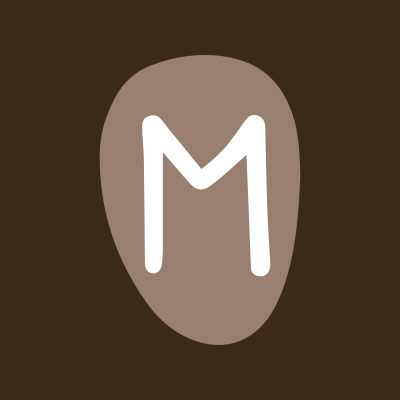
Ehwaz
Ehwaz (ᛖ) spans March 30 to April 14 and is the rune of the horse — one of the most powerful and multifaceted animal symbols in Norse culture. The horse was not merely a means of transport in ancient Germanic societies but a sacred animal associated with divine partnership, journey, and the bond between rider and mount. Ehwaz represents the quality of this bond: the perfect cooperation between two beings that allows them to move as one, accomplishing together what neither could achieve alone. It is the rune of partnership, trust, movement, and the journey — both outer and inner.
- Dates
- March 30 – April 14
- Element
- Earth
- Ruling Planet
- Mercury
- Quality
- Mutable
- Strengths
- Swift · Cooperative · Loyal · Adaptable · Harmonious · Trustworthy partner · Journey-oriented
- Weaknesses
- Restless · Over-dependent on partnership · Avoidant of solo work · Impulsive movement · Scattered
Personality
The Ehwaz personality is defined by an orientation toward movement, partnership, and the journey. These individuals are naturally cooperative — they find their best expression in collaboration, in the dynamic relationship between two aligned beings moving toward a shared destination. They are rarely at their best in isolation; their gifts emerge most fully in the context of relationship. There is an elegance to the Ehwaz personality — a grace in motion, a quality of flowing movement that makes them compelling to watch and to work with. Like the horse, they are at their finest when their natural energy is paired with clear direction and mutual trust. When they find the right partner — or the right cause, the right path, the right companion — they move with breathtaking efficiency and beauty. Their loyalty is a defining characteristic. Ehwaz individuals form deep attachments to the people and principles they travel with, and these attachments are durable. The horse does not abandon its rider mid-journey. This loyalty is precious and makes Ehwaz individuals extraordinarily valued by those who earn their commitment. They have a natural love of journey — not necessarily in the physical sense, though many Ehwaz individuals are drawn to travel, but in the sense of movement, progression, and the experience of going somewhere meaningful. They thrive on change that is purposeful, on the sensation of forward movement, on progress. The shadow: Ehwaz can struggle with stillness, with periods of enforced waiting, with situations where the journey is on hold. Their orientation toward cooperative movement means they can also become too accommodating to their partner's direction, losing their own sense of where they want to go. The horse that follows the rider blindly has surrendered its own agency.
Love & Relationships
In love, Ehwaz is seeking the partnership that the rune itself represents — the rider-and-horse bond of perfect mutual trust and complementary movement toward a shared destination. They are not looking for someone to be half of them but someone to journey with — a companion in the fullest sense, aligned in direction, comfortable in motion, building something together. Their love is active and expressive through shared doing. The best Ehwaz relationships involve going places together — literally and metaphorically. Shared adventures, shared projects, shared growth. Ehwaz is bored by relationships that stand still. They are exceptionally loyal once their commitment is given. Like the horse's bond with a trusted rider, once Ehwaz commits, the bond is deep and durable. They will carry their partner through difficulty, adjust their pace to their partner's needs, remain steady when their partner is uncertain. Their communication in love is often more through action than words — they show up, they participate, they move. Partners who need more verbal affirmation may sometimes feel that Ehwaz's actions speak but their voice is quiet. Learning to verbally express what their partnership means to them deepens Ehwaz's relational capacity. The risk: Ehwaz can become so adapted to a partnership's rhythm that they lose their own independent direction. If the relationship ends or shifts, they may experience disorientation disproportionate to the loss — as though the journey itself has been taken away, not merely the companion.
Work & Career
Ehwaz's professional strengths emerge most strongly in contexts of partnership, movement, and progressive development. They are exceptional collaborators — they have an instinctive ability to work in tandem with others, sensing the rhythm of cooperation and adjusting their contribution to maximize the joint output. They are often the person who makes collaboration work where others can't quite manage it. Their relationship to journey means they thrive in roles that involve movement through time: project management (guiding something from beginning to completion), development work (taking something from early stage to maturity), and coaching or mentorship (accompanying someone through a developmental journey). They are excellent at pacing, at knowing when to push and when to hold steady. They are also drawn to professions that literally involve movement: transport, travel, diplomacy (the art of moving between worlds), and any field that requires bridging distances — whether physical, cultural, or conceptual. They make excellent interpreters, translators, and cross-cultural facilitators. Their challenge in work is sitting still — in environments where progress is glacial, where bureaucracy prevents movement, or where they are isolated from meaningful partnership, Ehwaz individuals can become profoundly restless and gradually drain their motivation. They need to feel they are going somewhere, not just maintaining position.
Health & Wellbeing
Ehwaz's health profile is closely linked to their need for movement and the state of their key relationships. When they are in productive motion — physically active, engaged in meaningful projects, in healthy partnership — their vitality is high and their resilience considerable. When movement is blocked and relationships are troubled, their health often reflects the stagnation. The musculoskeletal system is prominent for Ehwaz, particularly the legs and lower body (the horse's primary power source), the hips (center of lateral movement and adaptation), and the spine as the central axis of forward motion. Regular physical movement — ideally in forms that involve rhythm, flow, and collaborative elements (team sports, dance, partner yoga) — is genuinely therapeutic for Ehwaz, not merely pleasant. The nervous system also deserves attention, as Ehwaz's orientation toward movement can tip into restlessness that keeps the nervous system in a state of chronic low-level activation. Practices that develop the capacity for productive stillness — meditation, yoga, breathwork — are particularly valuable precisely because they counter Ehwaz's natural tendency. Their psychological health is significantly impacted by the quality of their partnerships. Ehwaz individuals in toxic or dead relationships can develop symptoms that seem physical but are essentially relational — anxiety, chronic fatigue, somatic tension — that resolve remarkably when the relationship is healed or ended. Equine therapy, unsurprisingly, can be especially resonant for Ehwaz — the literal embodiment of their rune's central symbol.
Mythology & Symbolism
The mythological foundation of Ehwaz is deep in Norse horse symbolism. Most prominently, the divine horse Sleipnir — Odin's eight-legged steed, the swiftest of all horses — embodies the rune's highest potential. Sleipnir could travel between the nine worlds of Norse cosmology, carrying Odin through life, death, and all realms in between. The horse as psychopomp (guide of souls between worlds) is a pan-Indo-European mythological concept, and Sleipnir represents it in its most extreme form. Sleipnir's birth is itself remarkable: he was born from Loki shapeshifted into a mare to distract the stallion Svaðilfari during a crucial building contest. Sleipnir thus carries a quality of trickster-wisdom alongside his supernatural swiftness — the Ehwaz horse is not merely a beast of burden but a being of unusual intelligence and otherworldly capacity. The divine twins Freyr and Freyja (who traveled in a wagon drawn by cats or boar) also resonate with Ehwaz, as does the concept of Yggdrasil (the World Tree) as itself a kind of cosmic vehicle through which Odin travels during his shamanic journeys. In Germanic culture more broadly, the horse sacrifice (blót) and horse-worshipping traditions suggest an almost sacred relationship between humans and horses that Ehwaz crystallizes: the divine partnership between rider and mount was a spiritual as much as practical relationship.
This Sign in Other Cultures
The Ehwaz archetype — the divine horse, sacred partnership, and the journey between worlds — is one of the most widely distributed mythological themes in Indo-European traditions, reflecting the enormous importance of the horse in the cultures that spread from the Eurasian steppe. In ancient Greece, the divine twins Castor and Pollux (Gemini) — one mortal, one divine, sharing their immortality between them — embody the Ehwaz quality of sacred duality and perfect complementary partnership. The Greek horse-gods Poseidon (creator of horses) and the centaurs (creatures that were literally half-human, half-horse) all carry Ehwaz energy. In Hindu mythology, Hayagriva (horse-headed deity of knowledge) and Ashvins (divine twin horsemen, healers, and journeyers) resonate with the Ehwaz archetype. The Vedic ritual of Ashvamedha (the horse sacrifice, used to define the king's realm) suggests the sacred-political dimension of horse symbolism. In Celtic tradition, Epona — the horse goddess worshipped from Britain to the Balkans — is perhaps the purest Celtic expression of Ehwaz. She is depicted riding or with horses, associated with sovereignty, fertility, and the journey between this world and the otherworld. In the Tarot, Ehwaz corresponds to The Chariot (Major Arcana VII) — the driver commanding two horses (or sphinxes) in cooperative harness, moving forward through mastery of contrasting forces — and to The Lovers (Major Arcana VI) — the rune of sacred partnership and aligned movement.
Compatibility
Best with
Raidho, Mannaz
Challenging with
Isa, Nauthiz