


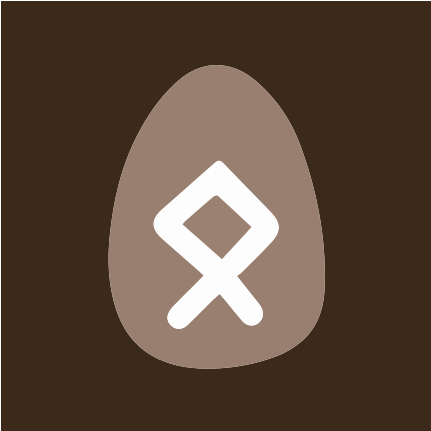
Othala
Othala (ᛟ) spans June 14 to June 29 and is the final rune of the Elder Futhark — and as the last rune, it carries the quality of completion, inheritance, and the distillation of all that has come before. Its name means "estate" or "ancestral home" in Proto-Germanic, and it represents the accumulated wealth of a lineage — not just material wealth but the wisdom, values, skills, and identity that a family or people pass from generation to generation. Othala is the rune of heritage in its deepest sense: the recognition that we stand on the shoulders of those who came before, that we inherit something precious, and that we have a responsibility to tend it wisely and pass it forward. Those born under this last rune carry the archetypal energy of the Elder — the keeper and transmitter of what is most essential, the one who knows what must be preserved.
- Dates
- June 14 – June 29
- Element
- Earth
- Ruling Planet
- Saturn
- Quality
- Mutable
- Strengths
- Heritage-conscious · Rooted · Ancestrally wise · Generous with legacy · Communal · Secure · Traditional in the best sense
- Weaknesses
- Clannish · Resistant to change · Nostalgic to a fault · Exclusionary · Bound by tradition · Status-protective
Personality
The Othala personality is oriented toward continuity, preservation, and the transmission of what is most valuable. These individuals have a deep and genuine sense of their own roots — their family, their cultural tradition, their community, their place in a larger story that extends both before and after their individual life. This is not mere sentimentality but a genuine ontological orientation: they understand themselves in terms of where they come from and where their contribution will go. They are natural stewards and keepers — of family histories, of traditional crafts and knowledge, of community values, of the cultural heritage that gives a people their identity. They have an instinct for what is genuinely worth preserving and what merely represents habit or resistance to necessary change. This discernment is a significant gift: the ability to distinguish living tradition from dead convention. Their generosity is often expressed through inheritance — through teaching what they know, through creating conditions for the next generation, through consciously building something that will outlast them. They are future-oriented in a backward-looking way: they care about the long arc of time, about what will be passed on and what will be lost. Their relationship to place is often profound. Othala individuals frequently have a strong connection to a specific landscape, home, or locality that feels like part of their identity — not merely a location but an extension of self. The shadow: this same quality of rootedness can tip into parochialism, into a defensiveness about the inherited that refuses necessary evolution. At their worst, Othala individuals can become guardians of what is dead rather than of what is living — preserving the shell of tradition while its animating spirit has long departed.
Love & Relationships
In love, Othala is the most devoted and family-oriented partner in the runic zodiac. They love with a vision that extends beyond the two individuals — they are building something, creating a home, establishing a foundation from which children (literal or metaphorical) can grow. Their love is long-range and deeply intentional. They are among the most reliable and consistent of partners. What they commit to, they honor with extraordinary faithfulness. They think in terms of decades rather than months; they are in it for the long arc. This quality of permanence and reliability is profoundly reassuring to partners who value stability and feel increasingly rare in contemporary life. Othala creates home — literal and metaphorical. They are exceptional at creating the conditions of belonging, of safety, of roots. Partners who feel rootless or without community often find that being loved by Othala gives them a sense of place and continuity they had not previously experienced. The challenges: their orientation toward tradition and continuity can create difficulty when a relationship needs to change significantly. They can be slow to recognize when a pattern that once served the relationship has become constraining. They can also have quite specific ideas about how a home and relationship should be organized that may not align with a partner's very different sense of how things should be. Their ideal partner is someone who shares their appreciation for roots while being able to grow — someone who can be a co-creator of heritage, a fellow builder of something that will last.
Work & Career
Othala's professional strengths emerge most fully in roles that involve the stewardship of heritage, the building of lasting institutions, and the transmission of knowledge across generations. They are exceptional historians, archivists, cultural preservationists, educators who build lasting influence, and anyone whose work involves curating and passing on what is most valuable from the past. They are also exceptional institution-builders — people who create organizations, communities, or practices that outlast their individual involvement. Their professional contributions are often felt most fully after they have moved on, as what they built continues to function and grow. In family businesses and traditional crafts, Othala individuals are often the ones who ensure continuity while thoughtfully navigating change — who know what of the tradition is genuinely valuable and must be preserved, and what was merely convenient and can be shed. Their relationship to property and land is often professionally expressed — in architecture, in landscape design, in agricultural work, in real estate development that genuinely serves community. They think about buildings and land in terms of stewardship and legacy, not merely transaction. Their challenge is innovation and disruption. In environments that require constant reinvention and the ability to leave the past behind, Othala can struggle. Learning that genuine honor for the past sometimes requires transforming it rather than merely preserving it is important professional development.
Health & Wellbeing
Othala's health profile is closely tied to the condition of their roots — the state of their family relationships, their connection to their ancestral heritage, and the quality of their home environment. When these are healthy and generative — when their roots are nourishing rather than constricting — Othala individuals have remarkable foundational health. When their family history is traumatic, their heritage is something to be escaped rather than claimed, or their home environment is toxic, their health often reflects these foundational fractures. The skeletal system (the body's structural foundation, its internal architecture) is Othala's primary physical domain — bones, joints, and the architecture of the body that determines how it stands, moves, and bears weight. The teeth (which in many traditional systems are understood as the ancestral archive stored in the body) and the colon (the body's process of deciding what to absorb and what to release from the past) are also traditionally associated with Othala. Ancestral healing — the deliberate work of examining and transforming inherited family patterns — is both psychologically and physically significant for Othala. The patterns they have inherited may include not just behaviors and beliefs but physiological tendencies (epigenetic inheritance), and conscious engagement with ancestral patterns can genuinely affect their health. Time in their ancestral landscape or homeland, connection with elders, the practice of traditional crafts or arts from their heritage, and gardening or tending to land are all particularly nourishing for Othala's health. Home as a place of genuine restoration — not merely shelter but sanctuary — is essential to their wellbeing.
Mythology & Symbolism
Othala is the final rune of the Elder Futhark, and its placement at the end of the runic sequence gives it a quality of summation and completion. It represents the return to origin after the entire journey of the runic cycle — the homecoming after the great adventure, the inheritance gathered and ready to be passed on. In Norse mythology, Othala resonates most profoundly with the concept of Ód (the divine animating essence, the ancestral spirit) — the quality of divine inheritance that flows through the bloodlines of gods and heroes. The Norse concept of hamingja (the protective family spirit discussed under Algiz) is also relevant here: Othala represents not just individual inheritance but the accumulated spiritual power of a lineage. The Aesir and Vanir in Norse cosmology are themselves inherited beings — the divine qualities they embody were not arbitrarily assigned but carry the weight of divine ancestry, of patterns that have been carried and developed over cosmic time. Odin himself is the inheritor of cosmic wisdom, built up through a long process of sacrifice and transmission that makes him the distillation of all that the divine lineage has learned. In the stories of the Norse heroes (such as those in the Volsunga Saga), the cursed gold of Andvari — inherited across generations and bringing doom to all who possess it — represents the shadow side of Othala: the inherited wound that is passed from generation to generation until someone has the wisdom to break the cycle. This is Othala's deepest teaching: inheritance includes both the gold and the curse, and the work of the Othala individual is to consciously receive what is genuinely valuable and to have the wisdom to transform or release what is harmful.
This Sign in Other Cultures
The Othala archetype — the ancestral estate, the inherited wisdom of a lineage, the sacred responsibility to tend and transmit what is most precious — appears across world cultures as one of the most fundamental human concerns. In Confucian tradition, the concept of filial piety (xiào) — the deep and active reverence for one's parents and ancestors — is essentially Othala as social virtue. The Confucian emphasis on education as the transmission of civilization's accumulated wisdom, on ancestor veneration, and on the family as the fundamental unit of social order all resonate with Othala's core values. In Indigenous traditions worldwide, the concept of ancestral relationship to land — the sense that specific places are held in sacred trust by specific peoples, that landscapes carry the accumulated memory and spiritual power of all who have lived there — is a profoundly Othala understanding. The responsibility to "seven generations" embedded in many Native American traditions is Othala's temporal horizon made explicit. In the Hindu tradition, the concept of dharma (sacred duty) as it relates to one's specific role within the lineage — the duties of a householder, of a parent, of an inheritor of a specific caste and family tradition — carries Othala's sense of inherited responsibility. The elaborate system of ancestor veneration (śrāddha ceremonies) speaks to the same understanding. In the Tarot, Othala corresponds most directly to The Hierophant (Major Arcana V) — the keeper and transmitter of tradition, the living link between the sacred past and the living present — and to The World (Major Arcana XXI) in its aspect of completion, integration, and the fullness of what has been achieved through the entire journey.
Compatibility
Best with
Fehu, Berkano
Challenging with
Dagaz, Raidho