


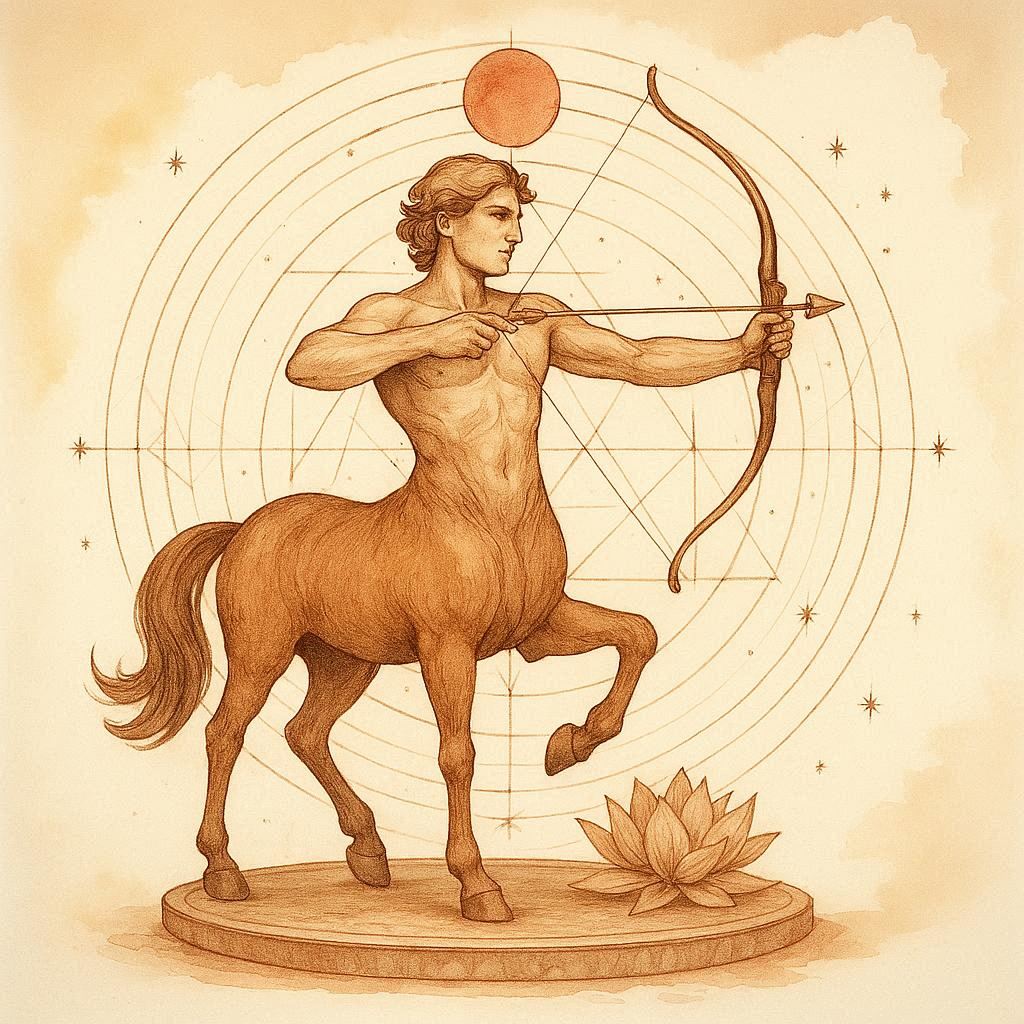
Dhanu
Dhanu is the ninth rashi of Jyotish — the sign that corresponds directly to the ninth house of dharma, higher learning, philosophy, long-distance travel, and the teacher-student relationship. Governed by Guru (Jupiter, also known as Brihaspati), the largest planet and the preceptor of the gods in Vedic mythology, Dhanu natives carry the expansive, generous, and truth-seeking qualities of the Guru principle: the arrow aimed at the distant horizon, the perpetual orientation toward a larger meaning that gives even mundane events their deeper significance. The centaur-archer symbol of Dhanu captures the essential dual nature of this Dwiswabhava sign: half animal instinct, half human aspiration, always aiming beyond the current horizon. In Jyotish, a strong Jupiter is one of the most benefic influences in the entire chart — it expands whatever it touches with wisdom, good fortune, and the sense that existence is fundamentally trustworthy and abundant. Dhanu is the rashi of philosophers, teachers, explorers, theologians, and all those who have made the quest for expanded understanding the central axis of their lives.
- Dates
- December 15 – January 13 (sidereal). Note: Vedic astrology uses the sidereal zodiac — dates differ from Western tropical signs by approximately 23 days.
- Element
- Fire
- Ruling Planet
- Jupiter (Guru/Brihaspati)
- Quality
- Dwiswabhava (Dual/Mutable)
- Strengths
- Philosophical · Optimistic · Adventurous · Generous · Visionary
- Weaknesses
- Overconfident · Tactless · Irresponsible · Restless · Dogmatic
Personality
The Dhanu personality is built around the experience of meaning — these individuals need to understand not just what is happening but why it matters in the larger scheme of things. Guru's influence gives a natural optimism that borders on faith: a deep, experiential trust that existence is organised around a meaningful principle, that difficulty has purpose, and that the arc of lived experience bends toward wisdom if one remains open and honest. The Fire-Dwiswabhava combination gives Dhanu both the enthusiasm to launch into new territory and the philosophical flexibility to revise their worldview when new experiences require it. The shadow of this remarkable quality is the same expansive principle operating without containment: overconfidence, the assumption that good intentions excuse careless impact on others, and a tendency toward grand visions that lack the patience for careful implementation. In Jyotish, Jupiter's placement in the natal chart tells the story of Dhanu's specific relationship with good fortune, wisdom teachers, and the quality of philosophical insight available to that individual in this lifetime.
Love & Relationships
In love, Dhanu is ardent, generous, and remarkably open — these individuals bring the same expansive Guru quality to intimate relationships that they bring to everything: a genuine belief in the beloved's potential, a warmth that celebrates rather than criticises, and an instinct to keep the relationship growing toward larger possibility. The challenge is the Dhanu need for freedom, which in intimate relationship can express as difficulty with constraint, resistance to the mundane demands of daily partnership, and a restlessness that perpetually seeks the next horizon rather than fully inhabiting the current one. The Vedic tradition understands Guru's influence on the seventh house as creating the potential for a deeply dharmic partnership — a relationship structured around shared philosophical journey, mutual growth, and the sense that two people are accompanying each other toward wisdom. When Dhanu finds a partner who can match its intellectual and philosophical range while also providing the grounding that this fire sign genuinely needs, the relationship can be one of the most expansive and joyful in the Vedic zodiac.
Work & Career
Dhanu excels in careers that combine knowledge, expansion, and the transmission of wisdom. Education at all levels (particularly higher education), law (especially international law and jurisprudence), philosophy, religion and spiritual teaching, publishing, international business, exploration, and any field requiring the integration of diverse knowledge systems resonate with the Guru-Fire Dhanu energy. The Vedic tradition connects Guru with the function of the spiritual preceptor — the teacher whose role is not merely to transmit information but to catalyse the student's own inner awakening to larger truth. In Jyotish career analysis, a strong Jupiter in the ninth or tenth house amplifies the potential for a career built on teaching, advising, and the wise guidance of others. The shadow in professional life: the Dhanu tendency to overpromise, to commit to more than the available time and energy can support, and to rely on Guru's natural good fortune to compensate for inadequate preparation.
Health & Wellbeing
Jyotish associates Dhanu with the hips, thighs, sciatic nerve, and the liver — the organs of locomotion, physical expansion, and metabolic processing. The liver connection is particularly resonant: Jupiter governs the liver in Ayurvedic anatomy, and the Dhanu tendency toward excess (Jupiter's expansive principle operating without restraint) creates specific vulnerability to liver-related conditions when the Guru energy is channelled into physical overindulgence — rich food, alcohol, and the pleasure-seeking dimension of Jupiter's sensory appreciation. In Ayurvedic terms, Dhanu types tend toward Kapha-Pitta combination: Kapha providing the physical size and endurance that Dhanu often displays, and Pitta providing the internal heat and digestive fire. The prescription for Dhanu health: physical movement that works the hips and thighs (a natural domain given the centaur symbol), conscious moderation of the Jovian tendency toward excess in eating and drinking, and attention to the liver through bitter herbs and periodic cleansing practices.
Mythology & Symbolism
Guru (Jupiter, Brihaspati) is one of the most beloved and auspicious deities in the Vedic pantheon — the teacher of the gods, the master of sacred knowledge, and the planet whose influence brings expansion, abundance, wisdom, and dharmic alignment to whatever it touches. In the Puranas, Brihaspati is depicted as golden-coloured, riding an elephant, carrying a lotus and a staff of spiritual authority, and presiding over the knowledge of the Vedas, sacrificial rituals, and the science of right action (dharma shastra). Thursday (Guruvara, the day of Guru) is the most auspicious day of the week in the Hindu tradition for beginning new ventures, taking spiritual initiation, and honouring teachers. The centaur-archer symbol of Dhanu finds its Vedic counterpart in the figure of the brahmin sage who also bears arms — the rare individual who combines the intellectual and spiritual depth of Brahma with the warrior courage of Kshatriya, capable of both profound contemplation and decisive action when dharma requires it.
This Sign in Other Cultures
The centaur-archer of Dhanu finds remarkable cross-cultural echoes. The Greek Chiron — the wise centaur who taught heroes like Achilles and Asclepius — embodies precisely the Dhanu combination of animal strength and philosophical wisdom. In Mesopotamian astrology, the equivalent figure was the god Pabilsag — depicted as a creature with the head of a man, wings, and the tail of a scorpion, carrying a bow — a similarly composite symbol of the power that crosses boundaries between the natural and supernatural. Western tropical astrology places Sagittarius from approximately November 22 to December 21 — about 23 days earlier than sidereal Dhanu — with the same Jupiter rulership and emphasis on philosophy, freedom, and the quest for higher meaning. In Chinese astrology, the Dhanu period overlaps with the Rat month, associated with intelligence, quick thinking, and the capacity to navigate complex situations with opportunistic grace — a curious but recognisable counterpart to the Jyotish Dhanu quality of using wisdom and quick insight to navigate the terrain of existence.
Compatibility
Best with
Mesha, Simha, Tula
Challenging with
Mithuna, Kanya