


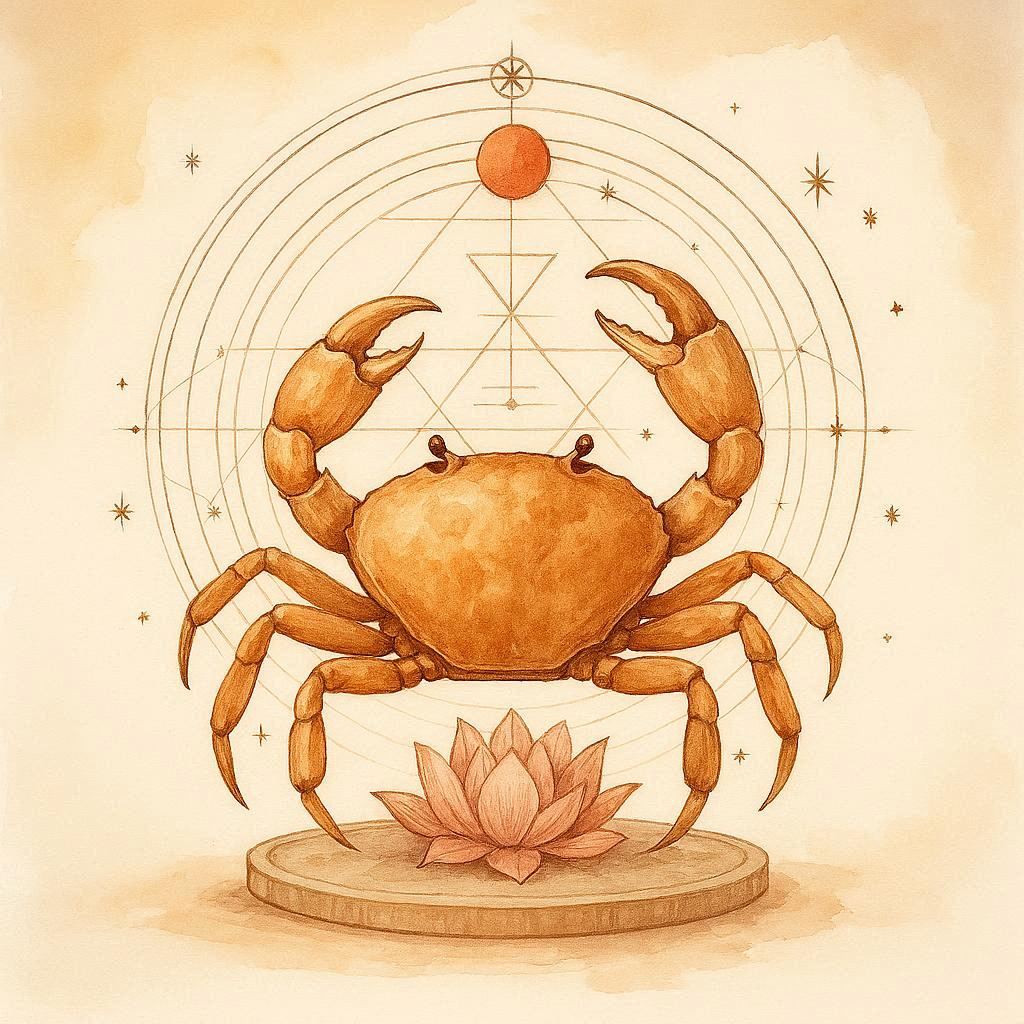
Karka
Karka is the fourth rashi of Jyotish and the only sign ruled by Chandra (the Moon) — the most emotionally sensitive and psychically permeable of all the Vedic rashis. Like the crab that symbolises it, Karka carries its home with it wherever it goes: home, family, ancestral memory, and emotional security are not merely preferences for this rashi but existential necessities. In Jyotish, the fourth house — which Karka governs by natural correspondence — rules the mother, the home environment, property, the emotional subconscious, and early childhood imprinting, all themes that define the Karka experience of the world. Chandra's influence makes Karka natives highly receptive to the emotional atmosphere around them; they absorb feeling states the way a sponge absorbs water, which gives them extraordinary empathy and equally extraordinary vulnerability to psychic overwhelm. The sidereal placement of Karka, ruled by the moving Moon, amplifies the Chara (movable) quality — these individuals adapt with remarkable fluidity when feeling emotionally safe, and contract with equal speed when threatened.
- Dates
- July 15 – August 14 (sidereal). Note: Vedic astrology uses the sidereal zodiac — dates differ from Western tropical signs by approximately 23 days.
- Element
- Water
- Ruling Planet
- Moon (Chandra)
- Quality
- Chara (Movable)
- Strengths
- Nurturing · Intuitive · Empathetic · Protective · Imaginative
- Weaknesses
- Moody · Over-sensitive · Clingy · Fearful · Manipulative
Personality
The Karka personality is organised around the axis of emotional safety and belonging. These individuals have a memory that functions with extraordinary depth and fidelity — they remember not just events but the emotional texture of those events: how a room smelled, what was left unsaid, the quality of light at a particular moment of childhood. This capacity for emotional memory is both their greatest gift and their most significant challenge, because Karka holds on to hurt and love with equal tenacity. The Moon's phases are reflected in the Karka temperament: there are periods of luminous emotional generosity (the full Moon quality) and periods of withdrawal and internality (the new Moon quality), and these cycles are as natural and necessary as breathing. In the Jyotish framework, a strongly placed Chandra in the natal chart amplifies the Karka qualities of nurturing, psychic sensitivity, and the capacity for unconditional love; a challenged Chandra can deepen the tendencies toward emotional reactivity, fear, and dependency.
Love & Relationships
In love, Karka is among the most devoted and emotionally invested signs of the Vedic zodiac — but this depth of feeling comes with corresponding requirements for security, constancy, and emotional reciprocity. Chandra's influence means that Karka experiences love as a fundamentally nourishing act: to love is to feed, to shelter, to remember the details that matter to a beloved, to create the conditions in which another person can feel completely held. The challenge is the clinginess that can develop when this nourishing impulse is driven by anxiety rather than genuine abundance: Karka must learn that love offered from fear of abandonment is fundamentally different from love offered from fullness. In Jyotish, the Moon's placement relative to Venus and the seventh house will show the specific texture of Karka's romantic life; a Chandra-Shukra connection in the chart often creates great beauty and emotional richness in relationship.
Work & Career
Karka thrives in careers that allow for the expression of nurturing, creative, and protective instincts. Healthcare, social work, education (particularly of young children), psychology, hospitality, real estate, food-related industries, and the creative arts are all natural domains. The Chandra influence gives Karka an instinctive understanding of what people need — a quality that makes them superb caregivers, counsellors, and marketers who understand emotional resonance. In Jyotish career analysis, the Moon in the tenth house or in strong placement relative to the tenth house amplifies public recognition and the capacity to build a career on emotional intelligence. The shadow in professional life mirrors the personal: Karka can take professional criticism as a personal attack, struggle with authority figures who remind them of difficult parental dynamics, and allow fear of failure to prevent them from claiming visible leadership roles.
Health & Wellbeing
Jyotish associates Karka with the chest, breasts, stomach, and digestive system — the body's organs of nourishment and emotional holding. Karka natives are prone to digestive sensitivity, especially when emotionally stressed, because Chandra's influence creates a direct link between emotional state and physical digestion. In Ayurvedic terms, Karka types often run with a Kapha-dominant base combined with Vata sensitivity in the mind: the body tends toward fluid retention, mucous accumulation, and a susceptibility to cold and damp conditions, while the mind tends toward anxiety when the Moon is waning. The prescription for Karka health: consistent emotional support networks, conscious digestion of both food and experience (giving adequate time to process emotional events), avoiding eating when emotionally overwhelmed, and regular exposure to natural water — rivers, ocean, lakes — which has a deeply calming effect on the Karka lunar nervous system.
Mythology & Symbolism
Chandra, the ruling planet of Karka, is one of the most beloved and complex deities in the Hindu pantheon. The Moon god is depicted as white or silver in appearance, riding a chariot drawn by ten white horses, carrying a crescent moon and a lotus, and is associated with the nectar of immortality (Amrita) that the gods churn from the cosmic ocean. In the famous myth of the Samudra Manthan (churning of the cosmic ocean), Chandra emerges from the depths carrying Amrita — an image that perfectly encodes the Karka quality of bringing emotional nourishment from the unconscious depths to the surface of life. Monday (Somavara, the day of Soma/Moon) is sacred to Chandra, and Moon puja involves white flowers, milk, rice, and the chanting of the Chandra Stotra. The crab as a symbol appears in the Vedic tradition through the nakshatra Punarvasu, which governs part of the Karka rashi — associated with the concept of return and renewal, the quality of coming home after long absence.
This Sign in Other Cultures
The crab as a zodiac symbol appears with surprising cross-cultural consistency — in Greek mythology, the Crab (Karkinos) was sent by Hera to distract Heracles during his battle with the Lernaean Hydra; though crushed underfoot, it was immortalised as a constellation — a symbol of loyal service and the willingness to sacrifice in service of a greater cause. In Egyptian astrology, the equivalent position corresponds to a scarab beetle — another creature associated with protective regeneration and the sacred cycle of birth, death, and rebirth. Western tropical astrology places Cancer from approximately June 21 to July 22 — about 23 days earlier than sidereal Karka — with the same Moon rulership and emphasis on home, family, and emotional depth. In Chinese astrology, the Karka period overlaps with the Sheep/Goat month, associated with gentleness, nurturing, and the deep bonds of family — a clear parallel to the Jyotish Karka themes of maternal care and belonging.
Compatibility
Best with
Vrishchika, Meena, Vrishabha
Challenging with
Makara, Mesha