


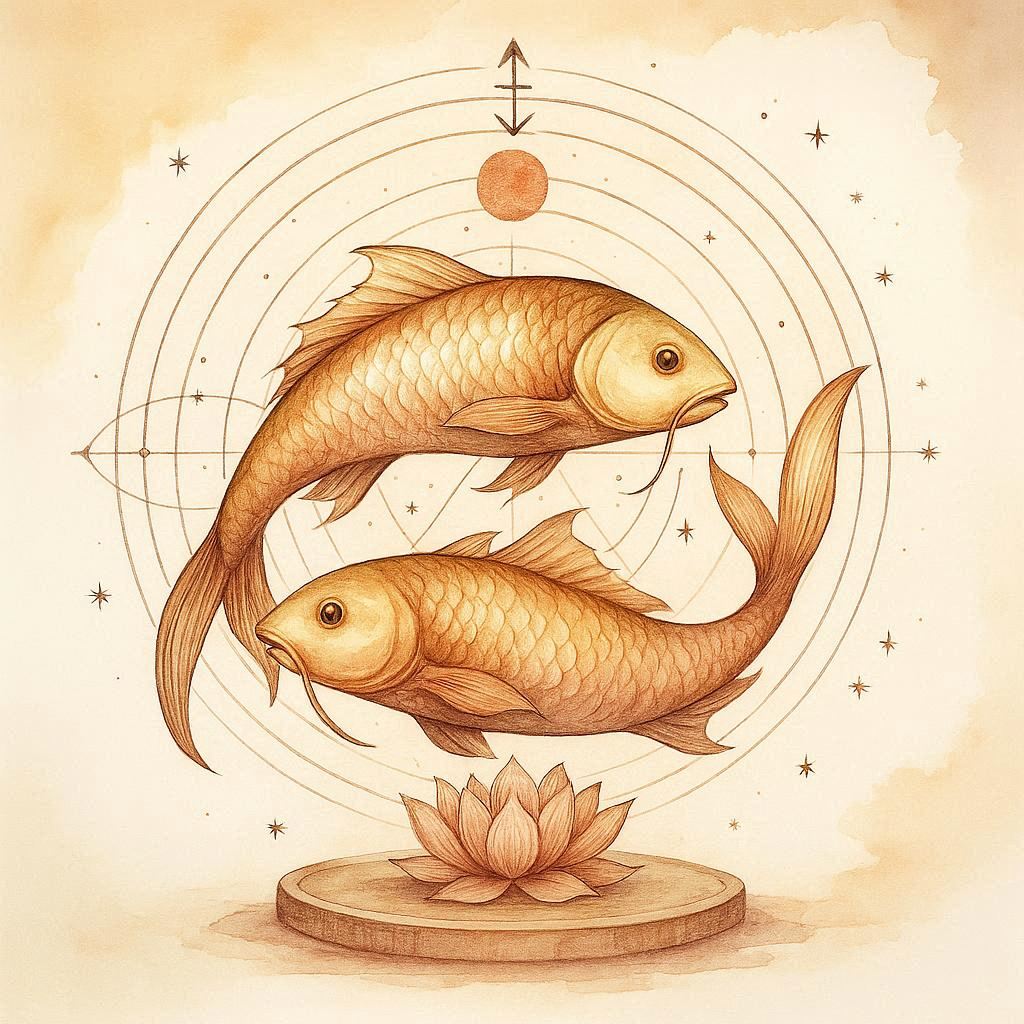
Meena
Meena is the twelfth and final rashi of Jyotish — the sign that completes the great cycle of the Vedic zodiac, dissolving the boundaries that the other eleven rashis have progressively constructed and returning the soul to the oceanic wholeness from which Mesha will once again emerge. Governed by Guru (Jupiter), Meena operates in the Water element with the Dwiswabhava quality of mutability — two fish swimming in opposite directions, a perfect symbol of the Meena experience of existing simultaneously in multiple dimensions of reality, never fully anchored to any single one. In Jyotish, the twelfth house — which Meena governs by natural correspondence — rules loss, liberation (moksha), sleep and dreams, foreign lands, the unconscious, hospitals and retreats, and the dissolution of ego boundaries: the most spiritually charged house in the Vedic system. Guru's influence elevates the twelfth house themes from mere loss to the possibility of liberating release: in Meena, what is surrendered is not merely lost but transformed into the compassionate wisdom of one who has travelled the full circle of experience and returned to know, in the depths, that all forms are expressions of a single undivided reality.
- Dates
- March 13 – April 13 (sidereal). Note: Vedic astrology uses the sidereal zodiac — dates differ from Western tropical signs by approximately 23 days.
- Element
- Water
- Ruling Planet
- Jupiter (Guru/Brihaspati)
- Quality
- Dwiswabhava (Dual/Mutable)
- Strengths
- Compassionate · Intuitive · Spiritual · Artistic · Selfless
- Weaknesses
- Escapist · Over-idealistic · Boundary-less · Indecisive · Vulnerable
Personality
The Meena personality is the most permeable and psychically open of all the Vedic rashis — where Vrishchika dives deep into the hidden waters and retains full control of what it finds there, Meena dissolves into the waters, losing the hard edges of self-definition in favour of a fluid receptivity that can receive impressions from every direction simultaneously. Guru's influence in the Water element creates an oceanic generosity — these individuals give freely of themselves without careful calculation of cost, extend compassion without reservation, and often find that the boundaries between self and other are less clearly marked for them than for most people. The Dwiswabhava quality means that Meena contains within itself the entire cycle of the zodiac in condensed form: the twelfth sign holds the karmic residues of all eleven preceding rashis, and Meena individuals often carry a quality of ancient knowing — of having been through everything before — that gives them an unusual empathy and equally unusual fatigue. The shadow of Meena is the same quality that makes it so magnificent: the dissolution of self-boundaries that enables profound compassion can also produce a chronic inability to maintain healthy limits, a vulnerability to absorbing others' suffering without adequate protection, and a retreat into fantasy or addictive behaviour when the pain of the world becomes too great to bear directly.
Love & Relationships
In love, Meena is the most romantically idealistic sign in the Vedic zodiac — capable of a quality of devotion that approaches the Vedic concept of prema (divine love) when expressed toward a truly worthy object. Guru's influence in the twelfth house creates the possibility of love as a spiritual practice — the relationship understood not as mere companionship but as a vehicle for the dissolution of the separate self into something larger. The challenge is that the idealism of Meena's love creates a risk of projection: Meena can fall in love with the ideal it projects onto a real person, and be devastated when the actual person fails to match the divine template. In Jyotish, the combination of Jupiter and the twelfth house in the context of relationships suggests that Meena's deepest love connections will often have a quality of spiritual significance — meetings that feel fated, connections that span multiple lifetimes, and the experience of recognising in another person something that reaches beyond personality to the soul. The prescription for Meena in love: developing the capacity for clear seeing alongside devotion, learning to love the specific person rather than the ideal they temporarily embody, and maintaining enough selfhood to remain a distinct presence rather than dissolving entirely into the beloved.
Work & Career
Meena excels in careers that allow for the expression of compassion, creativity, and spiritual service. Healthcare (particularly in roles involving care for the dying, the mentally ill, or those who are marginalised), psychology, art (especially music, dance, film, and poetry), spiritual teaching, charitable work, oceanography, marine biology, and any career requiring the ability to hold ambiguity and complexity without needing premature resolution — all resonate with the Guru-Water Meena energy. The twelfth house connection means Meena is naturally drawn to work in spaces where the normal social world thins: hospitals, retreat centres, prisons, orphanages, and the liminal zones where people are most vulnerable and most in need of compassionate, non-judgmental presence. In Jyotish career analysis, a strong Jupiter in the twelfth or ninth house for a Meena native amplifies the potential for a career in spiritual or healing service; the shadow is the Meena difficulty with self-promotion, asserting boundaries with clients, and accepting the material compensation that quality work deserves.
Health & Wellbeing
Jyotish associates Meena with the feet — the final body part in the anatomical sequence that begins with Mesha's head, completing the full human form — and with the lymphatic system, immune function, and the body's mechanisms for processing what can and cannot be assimilated. The feet connection is symbolically rich: feet are the means by which we are grounded in the earth while simultaneously in contact with a reality larger than the individual body, and caring for the feet is one of the most sacred practices in the Hindu tradition — the washing of a guru's feet as an act of devotion, the reverence shown to another's feet as the lowest point of the divine form. Meena natives are prone to foot conditions, immune system sensitivity, and the psychosomatic illnesses that result from absorbing too much of others' emotional and physical suffering without adequate self-care. In Ayurvedic terms, Meena types tend toward Kapha-Vata constitution: the Kapha providing the compassionate, fluid emotional life and the Vata producing the sensitivity and the tendency toward mental diffusion. The prescription for Meena health: establishing a consistent daily practice that creates grounding (particularly practices involving the feet and earth connection), careful management of the social environment to avoid the chronic psychic drain that comes from unlimited emotional availability, and attention to the immune system through consistent sleep, nourishing food, and the avoidance of substances that Meena's escapist tendencies can make particularly problematic.
Mythology & Symbolism
In Vedic mythology, Meena's symbol of two fish swimming in opposite directions connects to the ancient cosmological understanding of the dual currents within the ocean of consciousness — the pravritti marga (the path of engagement with the world) and the nivritti marga (the path of withdrawal and liberation) — which the Meena soul must navigate, choosing at every moment between the world's pull and the call of the infinite. Guru (Jupiter/Brihaspati), as the preceptor of the gods and master of the sacred knowledge, presides over Meena's twelfth house themes of liberation and moksha, suggesting that the spiritual wisdom associated with Jupiter is most directly accessible through the renunciation and surrender that characterise the twelfth house journey. The Matsya avatar — the fish incarnation of Vishnu, the first of the ten great avatars — is directly connected to Meena: the divine fish who warned Manu of the coming deluge and guided the ark of sacred knowledge to safety, saving both the Vedic wisdom and the seeds of all living beings. This myth encodes the Meena principle of salvation through surrender, of being carried by something larger than the individual will, and of the wisdom that comes from complete trust in the divine current.
This Sign in Other Cultures
The two fish of Meena appear across ancient cultures with the consistent symbolic association of the deep waters of spiritual reality and the dual nature of existence. In Greek mythology, the fish were identified with the goddess Aphrodite and her son Eros, who transformed themselves into fish to escape Typhon's assault — connecting the Meena symbol with love, beauty, and the power of transformation through surrender. In Babylonian astrology, the fish constellation was associated with the tails of two fish tied together by a cord — the cord of Pisces — suggesting the Meena theme of connection across apparent separation. Western tropical astrology places Pisces from approximately February 19 to March 20 — about 23 days earlier than sidereal Meena — with the same Jupiter rulership (and in modern Western astrology, the additional rulership of Neptune) and identical themes of compassion, spiritual depth, and transcendent sensitivity. The Matsya avatar in the Vedic tradition gives Meena a cosmological significance that no other zodiac tradition fully matches: in Jyotish, Meena is not merely the last sign but the gate of liberation itself — the rashi through which, when the entire cycle has been completed, the individual soul returns to the source from which all individual existence emerged.
Compatibility
Best with
Karka, Vrishchika, Makara
Challenging with
Kanya, Mithuna