


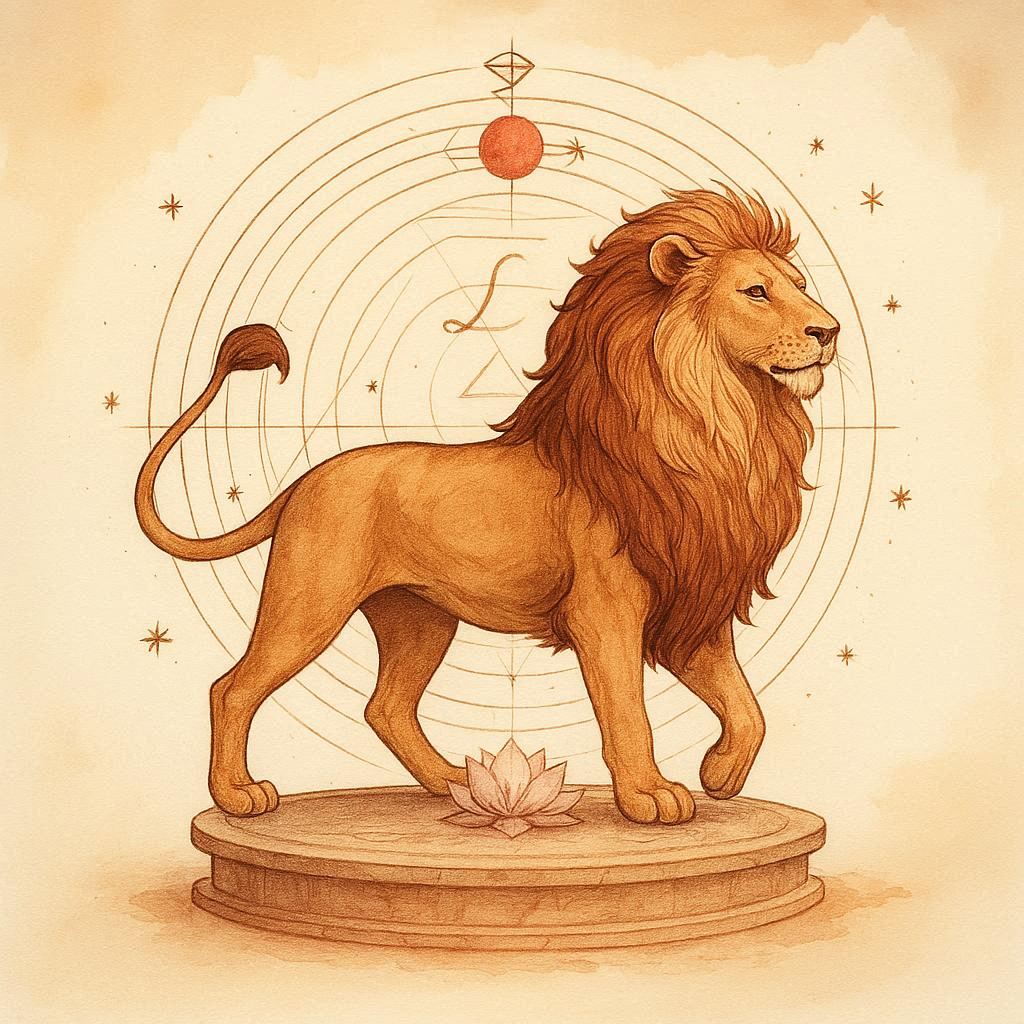
Simha
Simha is the fifth rashi of Jyotish and the only sign ruled by Surya (the Sun) — the singular luminary that stands at the centre of the solar system and the Vedic cosmic order. As the Sun neither rises nor sets from its own perspective but simply radiates, so Simha natives do not seek a stage — they are the stage: their natural condition is one of self-expression, creative radiance, and the expectation that others will orient themselves to this light. In Jyotish, the fifth house — which Simha governs by natural correspondence — rules creativity, children, intelligence (particularly creative intelligence), romance, and past-life meritorious karma (purva punya). The lion that symbolises Simha is not merely a predator but the Vedic embodiment of solar kingship: the beast that does not hunt but presides, whose authority is natural rather than asserted, whose power requires no justification. Simha is the rashi of dharmic self-expression — the radiance that, when aligned with righteous purpose, becomes the light that others navigate by.
- Dates
- August 15 – September 15 (sidereal). Note: Vedic astrology uses the sidereal zodiac — dates differ from Western tropical signs by approximately 23 days.
- Element
- Fire
- Ruling Planet
- Sun (Surya)
- Quality
- Sthira (Fixed)
- Strengths
- Regal · Generous · Charismatic · Creative · Loyal
- Weaknesses
- Arrogant · Domineering · Vain · Inflexible · Attention-seeking
Personality
The Simha personality is built around the solar principle of Atman — the individual self understood as a reflection of the divine light. There is a quality of natural authority here that is not about domination but about presence: Simha individuals enter a room and something shifts, because there is a coherence to their self-expression that commands attention without demanding it. Surya's influence gives tremendous creative energy, the instinct to lead, and a genuine, warm-hearted generosity — the Sun that gives light asks nothing in return. The shadow is the same solar quality inverted: when the Sun cannot shine freely, it generates heat without light — and the Simha personality, denied recognition or creative expression, can become domineering, arrogant, and hungry for the validation it has been denied. In Jyotish, the placement of Surya in the natal chart tells the whole story of the Simha native's relationship with authority, recognition, father figures, and their fundamental sense of self-worth.
Love & Relationships
In love, Simha is ardent, loyal, and deeply romantic — there is a quality of regal devotion here that treats the beloved like royalty, because Simha experiences love as an expression of magnanimous generosity rather than mere attraction. The Sun's influence means Simha needs to be seen, appreciated, and admired in relationship; a partner who consistently ignores or minimises the Simha contribution will find the lion withdrawn and eventually gone. The positive expression of this need is the radiant warmth Simha brings to a partner who honours it: few signs are as dramatically loving, as willing to celebrate a beloved publicly, as naturally gifted at creating occasions of joy and beauty in shared life. In Jyotish, the fifth house ruled by Simha governs romance — and a strong Simha ascendant or Sun placement often indicates a capacity for grand romantic gestures and a life genuinely enriched by love, creativity, and the joy of shared expression.
Work & Career
Simha excels in careers that provide a stage for self-expression and leadership — politics, performing arts, film, fashion, jewellery design, education (at high levels), law, and executive roles all resonate with the solar Simha energy. The Vedic tradition connects Surya with Kshatriya dharma — the warrior-king archetype whose function is to uphold justice, protect the weak, and lead with courage and integrity. In professional life, Simha natives are at their best when given visible authority and genuine creative latitude; they wilt under micromanagement and in environments that consistently deny them recognition. In Jyotish career analysis, a strong Sun in the tenth house (the house of career and public standing) is one of the most powerful indicators of visible professional success — and when Simha is the ascendant, the entire life is organised around questions of identity, recognition, and the creative expression of one's essential nature.
Health & Wellbeing
Jyotish associates Simha with the heart, upper back, and spine — the structures that support upright posture and the circulation of vital prana through the body. The heart connection is both literal and symbolic: Simha natives must take care of cardiovascular health, and their emotional health is equally dependent on keeping the heart open — the great danger for Simha is the armoured heart, closed against vulnerability in defence of pride. In Ayurvedic terms, Simha types are strongly Pitta-dominant: intense, fiery, with excellent digestion and a tendency toward inflammatory conditions when the inner fire is misdirected. The solar connection means that Simha health flourishes with sunlight, physical activity that allows for full-body expression (dance, martial arts, competitive athletics), and creative work that gives the solar energy a channel. When pride prevents Simha from acknowledging physical weakness or seeking medical attention, this stubbornness becomes the primary health liability.
Mythology & Symbolism
Surya, the ruling deity of Simha, occupies the most exalted position in the Vedic cosmic order: the Sun is the source of light, life, and consciousness for the entire solar system, and is revered as the visible form of Brahman in the material world. In the Vedic hymns of the Rigveda, Surya is praised as the eye of the cosmic Purusha, the force that drives away darkness and illuminates the path of dharma. The Gayatri Mantra — the most sacred of all Vedic mantras — is a direct invocation of Savitur, the creative aspect of the Sun, and is traditionally recited at sunrise by all initiated Hindus as a daily renewal of the solar connection. Simha is the natural home of Surya, the rashi in which the Sun operates with its full dignity and power; unlike other planets that have signs of exaltation and debilitation, the Sun in its own sign is in a state of natural royalty. Sunday (Ravivara) is sacred to Surya, and Sun puja involves copper vessels, red flowers, and the Aditya Hridayam — the ancient hymn of the solar heart.
This Sign in Other Cultures
The lion as a symbol of regal power appears across virtually every ancient culture with remarkable consistency. In Egypt, the Sphinx — the lion-bodied guardian of the pyramids — embodies the synthesis of solar power and royal intelligence; the goddess Sekhmet, the lion-headed deity of solar fire and healing, is among Egypt's most ancient divine figures. In Mesopotamia, the lion was the symbol of Ishtar/Inanna and of the great city of Babylon, appearing on the Ishtar Gate as the embodiment of divine power and protection. Western tropical astrology places Leo from approximately July 23 to August 22 — about 23 days earlier than sidereal Simha — with the same Sun rulership, creative emphasis, and solar personality archetype. In Chinese astrology, the Simha period overlaps with the Monkey month, associated with intelligence, performance, and self-expression — a curious but not coincidental parallel to the Jyotish Simha's dramatic and creative nature.
Compatibility
Best with
Mesha, Dhanu, Mithuna
Challenging with
Kumbha, Vrishabha