


Tula
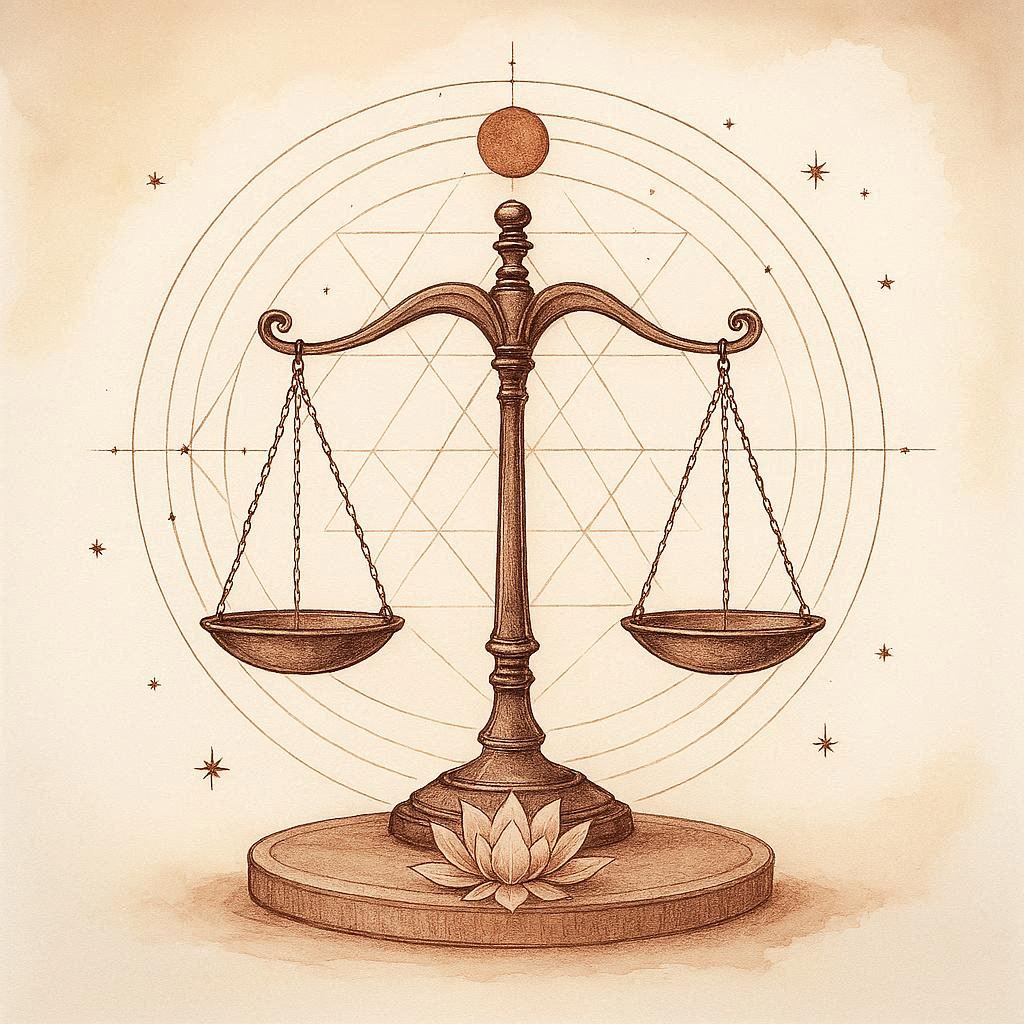
Tula is the seventh rashi of Jyotish — the sign of the scales, of balance, of the sacred meeting point between self and other. Ruled by Shukra (Venus), Tula operates in the Air element where the Shukra qualities of beauty, harmony, and relational intelligence reach their highest social expression. In Jyotish, the seventh house — which Tula governs by natural correspondence — rules partnerships of all kinds: marriage, business partnerships, open enemies, and the quality of the self that is revealed through relationship. Tula is the rashi that cannot exist without the mirror of the other — where Mesha defines itself through direct action, Tula defines itself through dialogue, negotiation, and the continuous dance of give and take. The scales as symbol are not merely decorative: they embody the Tula compulsion to weigh all sides, to see every perspective, to resist the premature closure of a balanced assessment. This quality makes Tula the natural diplomat and mediator of the Vedic zodiac — and its most notable liability is the indecisiveness that can arise when the scales remain perpetually in motion, unable to commit to a final verdict.
- Dates
- October 16 – November 14 (sidereal). Note: Vedic astrology uses the sidereal zodiac — dates differ from Western tropical signs by approximately 23 days.
- Element
- Air
- Ruling Planet
- Venus (Shukra)
- Quality
- Chara (Movable)
- Strengths
- Diplomatic · Fair-minded · Gracious · Cooperative · Idealistic
- Weaknesses
- Indecisive · Avoidant · People-pleasing · Vain · Self-pitying
Personality
The Tula personality is fundamentally relational — these individuals think in terms of relationships, comparisons, and the resolution of apparent opposites. Shukra's influence in the Air element gives Tula a quality of civilised grace: an instinct for beauty in social situations, an ability to say difficult things in ways that do not wound unnecessarily, and a genuine appreciation for the complexity of other people's perspectives. The challenge of Tula is the same quality that makes it elegant: the capacity to see all sides simultaneously can paralyse decision-making, and the desire for harmony can suppress legitimate personal needs and resentments until they accumulate into a sudden, surprising imbalance. In Jyotish, a well-placed Shukra in the natal chart amplifies Tula's natural diplomatic gifts, artistic sensibility, and capacity for genuine, fair-minded partnership; a challenged Shukra can create the Tula shadow of self-erasure, where the compulsive need to maintain peace in relationship leads to the suppression of one's own authentic truth.
Love & Relationships
In love, Tula is among the most naturally partnership-oriented signs of the Vedic zodiac. Shukra's full expression in the Air element creates individuals for whom relationship is not an optional component of a happy life but the primary context in which life becomes fully meaningful. Tula natives are romantic in the deepest sense — they create beauty in shared life, they celebrate their partners, and they bring aesthetic refinement to the everyday rituals of cohabitation. The seventh house ruled by Tula governs marriage directly, and Shukra's influence here creates a genuine capacity for long-term, devoted partnership — but only when the Tula need for peace does not prevent authentic negotiation of conflict. The deepest Tula love lesson is the paradox that genuine harmony requires the willingness to pass through genuine disharmony: avoidance of conflict does not produce peace but merely postpones the imbalance until it becomes unmanageable.
Work & Career
Tula excels in careers requiring mediation, aesthetic judgment, and the capacity to bring disparate parties to agreement. Law (particularly civil and family law), diplomacy, HR, counselling, fashion, interior design, the art market, public relations, and entertainment management all resonate with the Shukra-Air Tula combination. In the Vedic tradition, Tula is the rashi in which Shani (Saturn) reaches its point of exaltation (Uccha) — a profound alignment suggesting that Tula's highest professional expression involves not just beauty and relationship but justice, structure, and the patient construction of fair systems. In Jyotish career analysis, a strong Shukra in the tenth house alongside Tula's natural relational gifts creates the capacity for careers built on personal relationships and the management of beauty — art dealership, fashion houses, and positions requiring both creative vision and social finesse.
Health & Wellbeing
Jyotish associates Tula with the kidneys, lower back, and skin — the organs of filtration, balance, and the body's most visible boundary with the external world. The kidney connection is particularly apt: the kidneys maintain the body's chemical equilibrium in the same way Tula seeks social equilibrium, constantly filtering and adjusting to maintain the right balance of minerals and fluids. Tula natives are prone to kidney conditions, lower back pain, and skin disorders — the last of which often have a psychological stress component reflecting the Shukra-Air quality of sensitivity to relational atmosphere. In Ayurvedic terms, Tula types tend toward Vata-Pitta combination, with the social Vata producing the anxiety of maintaining relational harmony and the Pitta producing the inflammatory skin and urinary conditions. The prescription for Tula health: adequate hydration, stress-reduction practices that address the specific Tula anxiety (relational conflict), and conscious attention to asserting personal needs rather than systematically prioritising the needs of others.
Mythology & Symbolism
In Vedic mythology, Tula corresponds to the cosmic scales of Yama — the god of death and dharmic justice — who weighs the karma of souls with perfect impartiality before directing them toward their next state of existence. The scales of Yama are not a punitive instrument but a scientific one: they measure the precise weight of righteous and unrighteous action accumulated over a lifetime, applying cosmic law with the same impersonality that the physical scales apply to matter. Shukra, as the ruling planet, brings a different mythological energy: the god of love, beauty, and the knowledge of the Asuras, whose refinement and aesthetic wisdom balance the stark justice of the scales with the understanding that beauty, harmony, and right relationship are themselves forms of dharma. Tula is the rashi in which Shani (Saturn) is exalted — suggesting that Tula's highest expression involves not just the Shukra qualities of aesthetic harmony but the Shani qualities of systemic justice, patient construction, and the long-term commitment to fair structures.
This Sign in Other Cultures
The scales of justice appear as a cross-cultural symbol with remarkable persistence across ancient civilisations. In Egypt, the weighing of the heart ceremony (the Weighing of the Feather) — where the heart of the deceased was weighed against the feather of Ma'at, the goddess of truth and cosmic order — is the most famous mythological expression of the scales archetype. In Greek mythology, the equivalent figure is Themis, the goddess of divine law, and her daughter Dike (Justice), who held the scales by which human conduct was measured. Western tropical astrology places Libra from approximately September 23 to October 22 — about 23 days earlier than sidereal Tula — with the same Venus rulership and emphasis on partnership, beauty, and balance. In Chinese astrology, the Tula period overlaps with the Dog month, associated with loyalty, fairness, and the honest mediation of conflict — qualities that resonate directly with the Jyotish Tula archetype of the just and gracious partner.
Compatibility
Best with
Mithuna, Kumbha, Vrishabha
Challenging with
Mesha, Vrishchika