


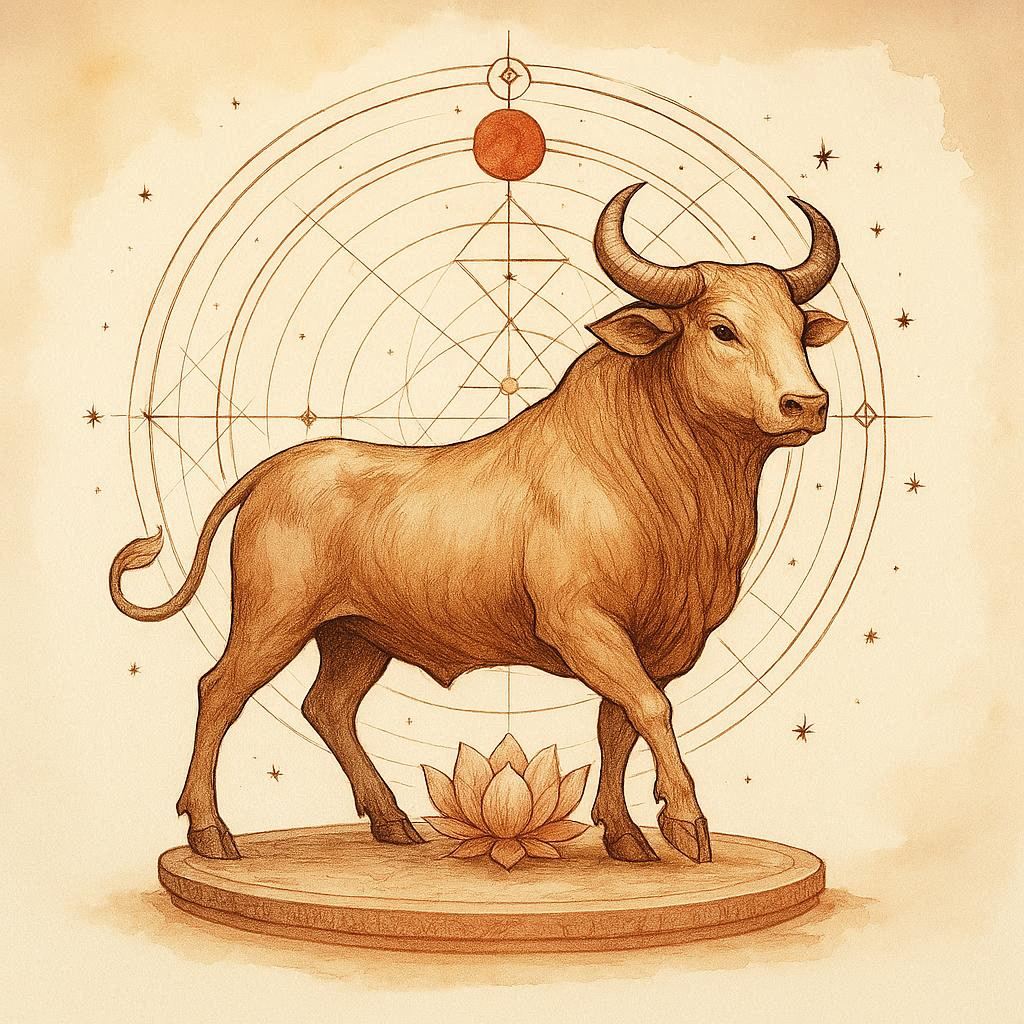
Vrishabha
Vrishabha is the second rashi of Jyotish, carrying the quality of Sthira — the fixed, immovable principle that consolidates what Mesha initiates. Ruled by Shukra (Venus), the planet of beauty, sensory pleasure, and artistic refinement, Vrishabha natives embody the Vedic ideal of bhoga — the righteous enjoyment of earthly pleasures when pursued with awareness. The bull that symbolises this rashi does not charge forward rashly; it plants its feet and will not be moved until it chooses to move. In the Jyotish system, Vrishabha governs the second house themes of speech, accumulated wealth, and early family environment — the foundations that give life its texture and material sustenance. Shukra's influence here creates individuals who seek beauty in all things: in art, in food, in the arrangement of their homes, and in the quality of their intimate bonds.
- Dates
- May 15 – June 14 (sidereal). Note: Vedic astrology uses the sidereal zodiac — dates differ from Western tropical signs by approximately 23 days.
- Element
- Earth
- Ruling Planet
- Venus (Shukra)
- Quality
- Sthira (Fixed)
- Strengths
- Steadfast · Sensual · Patient · Reliable · Artistic
- Weaknesses
- Stubborn · Possessive · Indulgent · Resistant to change · Materialistic
Personality
The Vrishabha personality is defined by its relationship to the material and sensory world — not as a weakness but as a sacred engagement with Prakriti, the manifest creation. These individuals build slowly, accumulate deliberately, and rarely abandon what they have invested their energy in. The Sthira quality means Vrishabha holds its position under pressure that would scatter lesser signs; this is the same quality that makes them excellent stewards of resources, businesses, and long-term commitments. Shukra as ruling planet gives a refined aesthetic sensibility — Vrishabha natives often have beautiful speaking voices, appreciation for music, and a talent for creating environments of comfort and elegance. The shadow of this sign is Tamas — the quality of inertia that, when excess accumulates, can make Vrishabha resistant to necessary change, possessive in relationships, or overly attached to comfort at the expense of growth.
Love & Relationships
In love, Vrishabha is among the most devoted and sensually present partners of the Vedic zodiac. Shukra, the planet of kama (desire and pleasure), governs the erotic and romantic dimensions of life, and in Vrishabha this influence reaches its greatest natural expression. These individuals do not love lightly — they invest fully, and they expect the same in return. Loyalty is not a virtue for Vrishabha; it is the minimum prerequisite for relationship. The difficulty arises when this devotion curdles into possession: Vrishabha can confuse love with ownership, and must learn that security comes from inner rootedness, not from controlling a partner. In Jyotish, Shukra's placement in the natal chart will refine the exact expression of Vrishabha's romantic and creative life significantly.
Work & Career
Vrishabha excels in careers that combine sustained effort with tangible, beautiful results. Finance, banking, agriculture, architecture, culinary arts, music, interior design, and the luxury goods industry all resonate with the Venus-Earth combination of this rashi. Unlike the Mesha impulse to initiate, Vrishabha's gift is completion — these individuals will see a project through to its most refined finish. In Jyotish career analysis, a strong Shukra in the tenth house amplifies success in the arts, beauty industries, and anything involving the management of valuable resources. The Vedic tradition also connects Vrishabha with Lakshmi, the goddess of prosperity, suggesting that material abundance tends to flow toward those who honour both the aesthetic and practical dimensions of wealth.
Health & Wellbeing
Jyotish associates Vrishabha with the throat, neck, vocal cords, and thyroid gland — the structures that enable speech and song, both ruled by Shukra. Vrishabha natives must care for their throat: singers, speakers, and teachers with this rashi should warm up their voices carefully and avoid cold drinks in excess. In Ayurvedic terms, Vrishabha types tend toward Kapha constitution — cool, stable, and slow-moving — with a natural tendency toward accumulation, both of nourishment and of weight. When Kapha excess builds without adequate physical movement, it manifests as sluggishness, weight gain, sinus congestion, and a general resistance to change that extends from body to mind. The prescription for Vrishabha health: regular physical exertion (which Vrishabha naturally resists), warming foods and spices to counter Kapha, and conscious attention to sensory moderation.
Mythology & Symbolism
In Hindu mythology, Shukra (Venus) is one of the most complex planetary deities — a great sage and guru of the Asuras (divine adversaries), possessor of the Mritasanjivani vidya (the science of reviving the dead), and one of the navagrahas whose influence on human fortune is both powerful and subtle. Shukra is depicted as white in colour, riding a white horse or chariot, adorned with white garments — all colours associated with purity, luminosity, and the refined beauty of consciousness. The bull itself is sacred in the Vedic tradition through its association with Nandi, the celestial bull who serves as vehicle and guardian of Shiva — an emblem of patient devotion and dharmic steadfastness. Friday (Shukravara in Sanskrit) is the day of Venus, and Shukra puja involves offerings of white flowers, white rice, and silver — materials that embody the cool, reflective, aesthetic quality of the planet. The myth of Vrishabha Sankranti — the solar transition into this rashi — marks a period when the earth is considered most fertile and receptive.
This Sign in Other Cultures
The bull as a symbol of earthly power and fertility appears with remarkable consistency across ancient civilisations. In Mesopotamia, the constellation Taurus was associated with the Bull of Heaven (Gudanna), a celestial beast sent by the gods in the Epic of Gilgamesh — a direct ancestor of the mythological tradition later absorbed into Western and Vedic astrological frameworks. In Egyptian culture, the Apis bull was worshipped as a living manifestation of Ptah, the creator god — its attributes of strength, fertility, and sacred beauty mirroring the Vedic Vrishabha qualities. Western tropical astrology places Taurus from approximately April 20 to May 20, about 23 days earlier than sidereal Vrishabha, with similar emphasis on Venus rulership, sensory pleasure, and financial instinct. In Chinese astrology, the Vrishabha period overlaps with the Snake year energy — patience, beauty, and hidden wisdom — suggesting a cross-cultural resonance around the slow, deliberate, aesthetically refined archetype.
Compatibility
Best with
Kanya, Makara, Karka
Challenging with
Vrishchika, Kumbha