


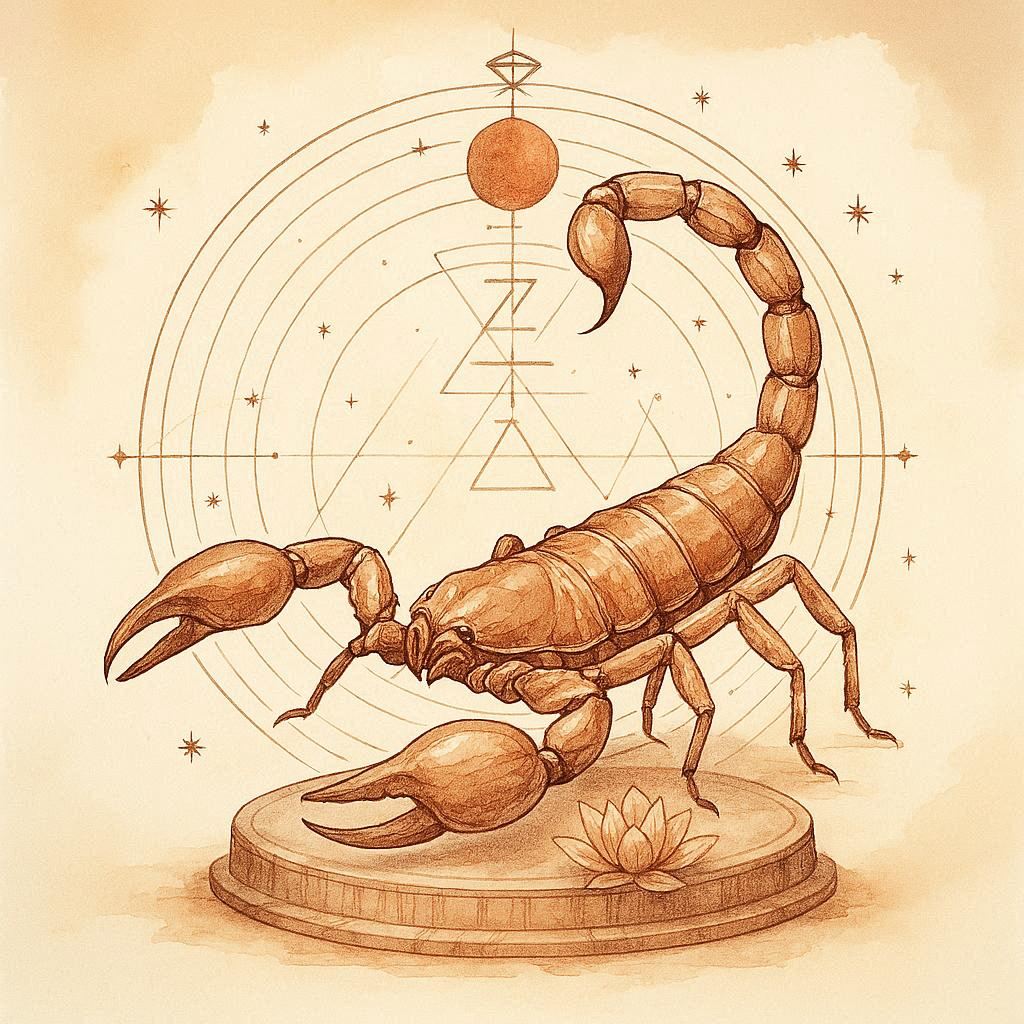
Vrishchika
Vrishchika is the eighth rashi of Jyotish — one of the most complex and psychologically profound signs in the entire Vedic system. Governed by both Mangala (Mars) and Ketu (the south node of the Moon), this Water-Sthira sign carries an intensity that operates beneath the surface, in the hidden layers of motive, desire, and the inexorable drive toward transformation. In Jyotish, the eighth house — which Vrishchika governs by natural correspondence — rules death, longevity, the occult, hidden knowledge, inheritance, radical transformation, and the secrets that others keep: this is the most mysterious house in the Vedic chart, and Vrishchika natives feel its themes with unusual directness. The scorpion carries its venom in its tail and its armour on its back — a perfect image of the Vrishchika combination of apparent vulnerability (the soft underbelly) and devastating capacity to strike when genuinely threatened. Ketu's co-rulership adds a dimension of spiritual renunciation and past-life karmic intensity to the already powerful Mangala energy, making Vrishchika the rashi most directly engaged with the transformative passage from one state of being to another.
- Dates
- November 15 – December 14 (sidereal). Note: Vedic astrology uses the sidereal zodiac — dates differ from Western tropical signs by approximately 23 days.
- Element
- Water
- Ruling Planet
- Mars (Mangala) and Ketu
- Quality
- Sthira (Fixed)
- Strengths
- Perceptive · Determined · Magnetic · Transformative · Passionate
- Weaknesses
- Jealous · Secretive · Vengeful · Controlling · Obsessive
Personality
The Vrishchika personality is not easily read from the surface — these individuals present the controlled, armoured exterior of the scorpion while the real complexity of their inner life remains largely hidden from casual observation. Mangala's energy, operating in the Water element, transforms from the direct fire of Mesha into a concentrated, subterranean force: Vrishchika does not charge — it waits, it observes, it penetrates to the hidden truth of a situation before it acts, and when it does act, the action is total and decisive. Ketu's influence adds a quality of spiritual searching and past-life karmic intensity: there is often in Vrishchika a sense of ancient knowing, of having been through extreme experiences before, of being drawn toward the mysterious and the hidden with an urgency that others cannot quite explain. The eighth house quality means that Vrishchika is more comfortable with intensity, extremity, and the presence of death and transformation than any other rashi — these are not frightening topics but familiar terrain, and this ease with the shadowed dimensions of existence gives Vrishchika its characteristic power.
Love & Relationships
In love, Vrishchika is among the most deeply feeling and most intensely invested signs of the Vedic zodiac — but this depth comes wrapped in a paradox: these individuals want complete union and complete merger with a beloved while simultaneously armoring themselves against the vulnerability that genuine intimacy requires. Mangala's Water energy generates the capacity for transformative love — the kind that changes both partners fundamentally — and Ketu's influence gives a quality of searching for the perfect soul-level match that has been known in previous incarnations. The shadow is the possessiveness and jealousy that can arise when Vrishchika's trust has been activated and then violated: no rashi takes betrayal harder, and no rashi has a longer memory for wrong. The Vedic tradition notes that the eighth house placement of Vrishchika governs not just death but the erotic — in Jyotish, these two are understood as related transformative passageways, and Vrishchika's love life has this quality of transformation through dissolution of the separate self.
Work & Career
Vrishchika excels in careers that require penetrating intelligence, comfort with intensity, and the willingness to work with what others find uncomfortable or frightening. Psychology, psychiatry, surgery, research (particularly in hidden or dangerous domains), forensic science, intelligence work, tax and estate law, occult studies, and transformative healing modalities all resonate with the Vrishchika Mangala-Ketu-Water combination. The Vedic tradition connects the eighth house Vrishchika energy with the power of the tantric path — the understanding that transformation requires going through darkness rather than around it. In Jyotish career analysis, a strong Mangala and Ketu combination in the chart amplifies investigative and healing abilities; Vrishchika natives are often found in careers where they are regularly exposed to the extremes of human experience and where their comfort with intensity is a professional asset rather than a liability.
Health & Wellbeing
Jyotish associates Vrishchika with the reproductive organs, eliminative system, and the processes of regeneration at the cellular level — the body's mechanisms for transformation and renewal. The connection to the eighth house means Vrishchika rules the most intense physical transitions: surgery, childbirth, and the transformative processes that mark fundamental changes in bodily state. Vrishchika natives are often constitutionally strong — the Mangala energy gives resilience and rapid recovery — but the intensity of their inner life can create psychosomatic conditions that reflect unprocessed emotional transformation. In Ayurvedic terms, Vrishchika types tend toward Pitta-dominant constitution with a strong Kapha foundation, creating both the intensity of passion and the capacity to hold it; when the transformative pressure builds without adequate release — through creative, physical, or spiritual practice — it can manifest as chronic inflammation, reproductive health issues, or the compulsive behaviours that represent a distorted form of the Vrishchika transformation urge.
Mythology & Symbolism
In Vedic mythology, the dual rulership of Vrishchika reflects the ancient Indian understanding that some domains of existence require both the active principle of Mars and the dissolving principle of Ketu to navigate fully. Ketu, the south lunar node, represents the tail of Svarbhanu — the celestial serpent who was cut in two by Vishnu's Sudarshana Chakra when the gods discovered him disguised among them, drinking the nectar of immortality. The head became Rahu, the body Ketu — and both nodes became associated with the karmic axis of the soul's passage through successive lives. Vrishchika is deeply connected to the Naga tradition — the serpent wisdom that forms one of the oldest substrates of Indian spiritual culture — and the nakshatra Jyeshtha, which falls within Vrishchika, is associated with Indra's thunderbolt and the quality of the warrior-king who governs through power and wisdom combined. The scorpion as a symbol carries the Vedic understanding of death-in-life: the transformation that does not end existence but fundamentally alters its form.
This Sign in Other Cultures
The scorpion as a zodiac symbol appears in ancient cultures with a consistent association with death, transformation, and the dangerous power of the hidden. In Mesopotamia, the scorpion-people (Girtablilu) were divine guardians of the gateway between the world of the living and the underworld, presiding over the passage of the sun through the darkness — a perfect encapsulation of the Vrishchika eighth house themes of threshold-crossing and transformation. In Egyptian culture, the scorpion goddess Serqet was a protector of the dead and guardian of the Canopic jars holding the organs of the deceased — another image of protective power associated with the transformation of death. Western tropical astrology places Scorpio from approximately October 23 to November 21 — about 23 days earlier than sidereal Vrishchika — with the same transformation-rulership and emphasis on hidden power. In Chinese astrology, the Vrishchika period overlaps with the Pig/Boar month, associated with depth, sincerity, and the willingness to journey into darkness in search of truth.
Compatibility
Best with
Karka, Meena, Makara
Challenging with
Vrishabha, Simha