


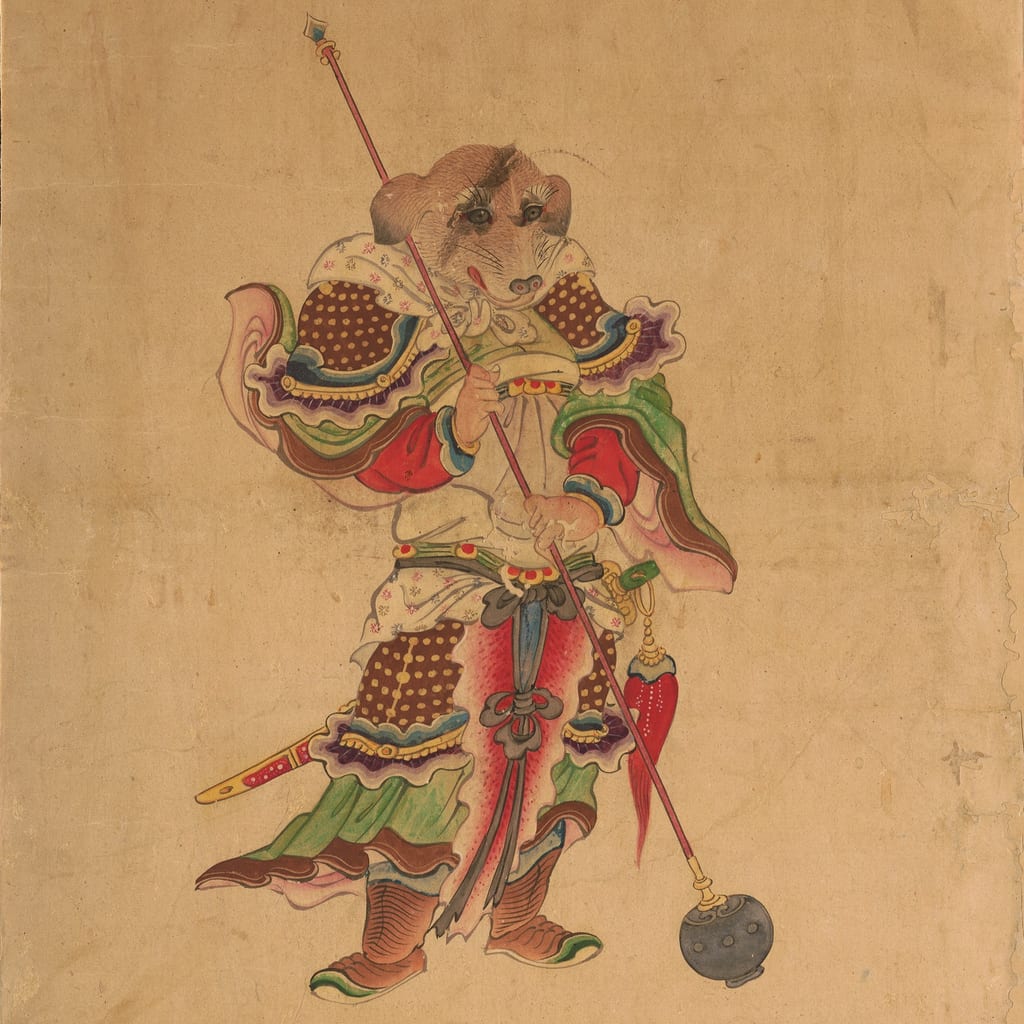
Sul (Dog)
戌 · 개띠
Sul (戌), the Dog, is the eleventh of the twelve animals of the Korean zodiac; people born in its year are gae-tti (개띠). As a god of the zodiac, the National Folk Museum of Korea writes, the dog drives away the evil spirits that dwell in its hours and its direction; as an animal, it is perhaps the closest of all to human beings, and the symbol of loyalty. Once it has set its heart on its master, the museum concludes, the dog never abandons them — and its unchanging loyalty can make people today want to look back on their own true nature.
Source: National Folk Museum of Korea, The Story of the Twelve Animals of the Korean Zodiac: Dog (nfm.go.kr)
- Hours
- 7–9 p.m.
- Month
- Ninth lunar month
- Direction
- West-northwest
Source: National Folk Museum of Korea, The Story of the Twelve Animals of the Korean Zodiac: Composition of the Twelve Zodiac Animals (nfm.go.kr); National Folk Museum of Korea, The Story of the Twelve Animals of the Korean Zodiac: Dog (nfm.go.kr)
Years and Seollal
The animal changes at Seollal, the Korean New Year, not on 1 January: if you were born in January or February, check the date of Seollal in your year. Dates from the Korean calendar, as published by the Korea Astronomy and Space Science Institute.
| Year | Seollal (the year begins) |
|---|---|
| 1910 | February 10 |
| 1922 | January 28 |
| 1934 | February 14 |
| 1946 | February 2 |
| 1958 | February 19 |
| 1970 | February 6 |
| 1982 | January 25 |
| 1994 | February 10 |
| 2006 | January 29 |
| 2018 | February 16 |
| 2030 | February 3 |
| 2042 | January 22 |
The dog in Korea
Korea has its own breeds. The Jindo, a hunting dog from the south of the peninsula, is known for its homing instinct, its bravery and a loyalty to its family that lasts a lifetime. The shaggy Sapsali, or sapsalgae, reminded the ancients of mountain gods and sages and was believed to drive away ghosts and evil spirits: "no evil comes near where a Sapsali is", says the proverb. The Pungsan, a rare hunting breed from the Gaema highlands in what is now North Korea, was so famous for its strength and courage that "with two Pungsan dogs you can catch a tiger". The tailless Daenggyeon dog nearly died out because of the superstition that an animal without a tail brings misfortune.
Koreans have long loved dogs, yet the word gae, "dog", also serves to call people or things low and vulgar: seodanggae, maenggyeon, motdoen-gae, ttonggae and many more, and anything poor or wild is prefixed with gae- — gae-salgu, the wild apricot. No other animal, the museum notes, appears so often in Korean sayings. However clever and lovable, the dog was often treated as low and dirty, left outside and fed on scraps: in Korean folklore it is both the symbol of loyalty and the symbol of baseness.
Source: National Folk Museum of Korea, The Story of the Twelve Animals of the Korean Zodiac: Dog (nfm.go.kr)
Symbol and beliefs
The dog guarded the home, hunted and guided the blind; but it was also believed to guard the unseen, as a household god and a deflector of evil that brought fortune and happiness, keeping away plague, goblins and ghosts. In shamanic myths it is a white dog that leads the dead who come back to life on their way back to this world — the dog as a link between the other world and this one.
Its cry could be an omen. The Memorabilia of the Three Kingdoms records that before the fall of Baekje the dogs of Sabiseong wailed in despair; so if a house dog howled mournfully it was taken as a bad sign and the dog was sold at once, and a dog that dug the ground for no reason was thought to be digging its own grave: it was sent away, and a rite was held to pray for the family's safety.
Source: National Folk Museum of Korea, The Story of the Twelve Animals of the Korean Zodiac: Dog (nfm.go.kr)
Legends and folk tales
Folk tales and legends are full of loyal, righteous dogs that prove their faith by giving their lives, and tales, statues and tombs commemorating such dogs are found all over Korea. One of them is the Dog of Osu, which gave its life to save its master: at Osu-myeon, in North Jeolla Province, a monument to the faithful dog, the Uigyeonbi, stands, and every April the Uigyeonje rite in its honour is held, now a local festival.
Source: National Folk Museum of Korea, The Story of the Twelve Animals of the Korean Zodiac: Dog (nfm.go.kr)
In art
In the murals of ancient tombs, dogs appear as loyal guardians of the dead and their tombs; in the Goguryeo tomb of Gakjeochong, the "Tomb of the Wrestlers", a dog is painted on the left wall of the front and main chambers to protect it. Dog bones and clay figurines of dogs have been found in prehistoric sites. In folk paintings the dog is usually part of the background, a realistic and humble presence behind the people; in the kind of folk painting called minhwa, by contrast, its image is exaggerated, to drive away ghosts and misfortune; and hunting scenes (horyeopdo) show brave, strong hunting dogs.
Classical painters loved dogs. Yi Am (李巖, 1499–?) painted flowers, birds and puppies and a mother dog, and Kim Du-ryang (金斗樑, 1696–1763) a dog scratching itself, each under a tree. The reason was a play on characters: the character for the dog (戌) was thought to resemble the one for "guarding" (守, su), which sounds the same as "tree" (樹, su), so a dog under a tree meant "watch against thieves", and such a painting was believed to keep thieves away.
Source: National Folk Museum of Korea, The Story of the Twelve Animals of the Korean Zodiac: Dog (nfm.go.kr)
Customs and everyday life
Dog meat was traditionally eaten in Korea as a food for stamina, above all in the hottest days of summer, the bok days, as bosintang, "stamina stew". It is an old custom, the museum notes, but modern controversy has led Koreans to look for a compromise.
Source: National Folk Museum of Korea, The Story of the Twelve Animals of the Korean Zodiac: Dog (nfm.go.kr)
Compatibility
Harmonious triad (samhap)
In conflict (wonjin)
The Dog, the Tiger and the Horse form one of the four harmonious triads (samhap, 삼합): in the museum's words, the tiger's roar, the dog's metallic bark and the horse's neigh are in harmony with one another.
The Snake is the Dog's wonjin (원진), the animal in conflict with it: in the mating season the dog's bark turns metallic and piercing, and though the snake has no eardrums, the sound shocks it so that a snake caught in the middle of shedding its skin cannot finish, and dies.