


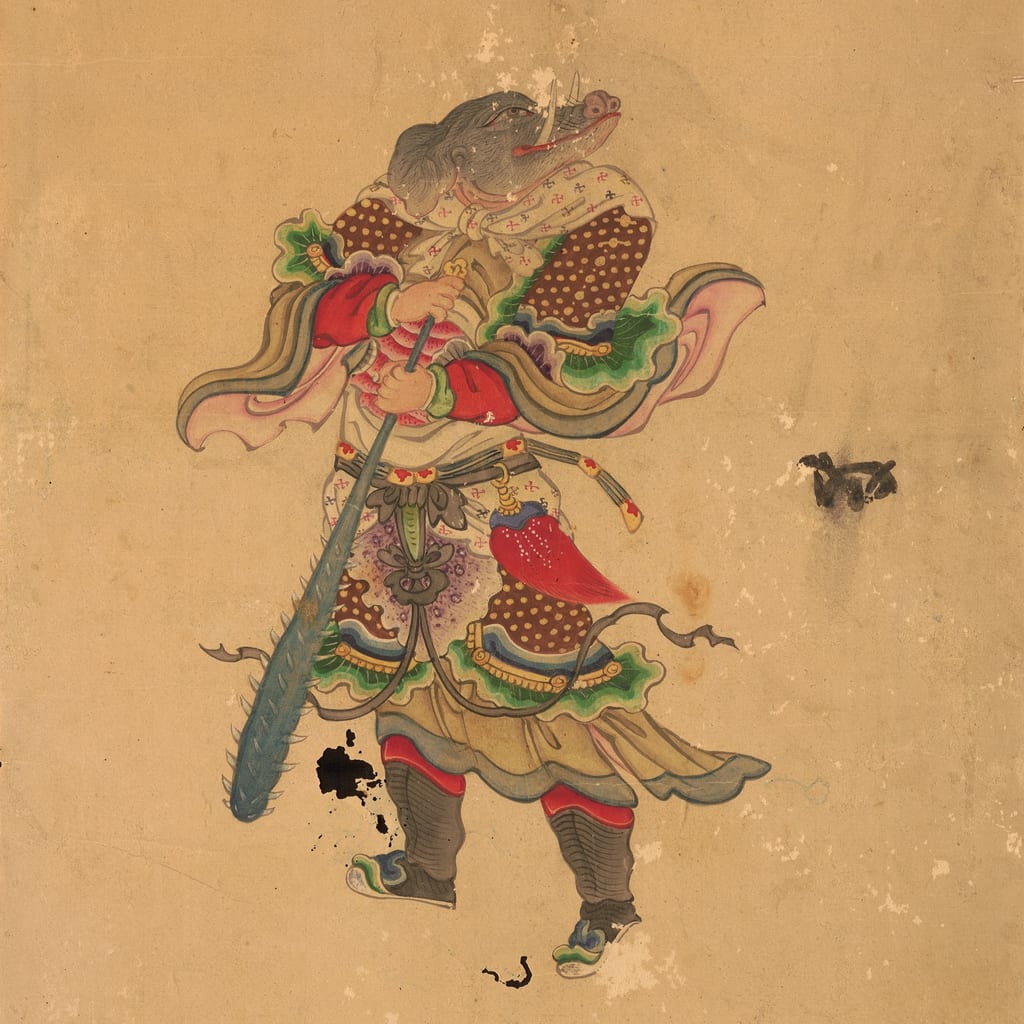
Hae (Pig)
亥 · 돼지띠
Hae (亥), the Pig, is the last of the twelve animals of the Korean zodiac; people born in its year are dwaeji-tti (돼지띠). Since ancient times, the National Folk Museum of Korea writes, the pig has been a sacred offering to the gods and a source of fortune and happiness: an auspicious animal that bears many young and grows fast, and so stands for prosperity, and a messenger of the gods. In childless families, a long-awaited son was nicknamed "pig", meaning "a bundle of happiness".
Source: National Folk Museum of Korea, The Story of the Twelve Animals of the Korean Zodiac: Pig (nfm.go.kr)
- Hours
- 9–11 p.m.
- Month
- Tenth lunar month
- Direction
- North-northwest
Source: National Folk Museum of Korea, The Story of the Twelve Animals of the Korean Zodiac: Composition of the Twelve Zodiac Animals (nfm.go.kr); National Folk Museum of Korea, The Story of the Twelve Animals of the Korean Zodiac: Pig (nfm.go.kr)
Years and Seollal
The animal changes at Seollal, the Korean New Year, not on 1 January: if you were born in January or February, check the date of Seollal in your year. Dates from the Korean calendar, as published by the Korea Astronomy and Space Science Institute.
| Year | Seollal (the year begins) |
|---|---|
| 1911 | January 30 |
| 1923 | February 16 |
| 1935 | February 4 |
| 1947 | January 22 |
| 1959 | February 8 |
| 1971 | January 27 |
| 1983 | February 13 |
| 1995 | January 31 |
| 2007 | February 18 |
| 2019 | February 5 |
| 2031 | January 23 |
| 2043 | February 10 |
The pig in Korea
Pigs have lived on the Korean peninsula for a very long time: boar fossils have been found at Stone Age sites and pig-shaped figurines in ancient shell mounds, and Koreans are thought to have begun raising pigs about two thousand years ago. In the kingdom of Buyeo one of the official ranks was called jeoga (猪加), "pig".
Korean feelings about the pig are mixed. It is the god of fortune (財神) and a guardian of the family; a dream of a pig is an excellent dream — after one, people buy a lottery ticket — merchants opened for business on the first Pig Day of the new year, and families hung a painting of a pig like a talisman. Yet the pig is also called greedy, dirty, lazy and slow, and many proverbs mock it; an overweight person may be teased as ttungdoeji, "fat pig", or kkotdoeji, "flower pig", if they are cute. In fact, the museum adds, pigs are clever animals that keep their place clean.
Source: National Folk Museum of Korea, The Story of the Twelve Animals of the Korean Zodiac: Pig (nfm.go.kr)
Symbol and beliefs
In myth the pig delivers the message of the gods, and the ancient kingdoms tell how a pig showed a king where to build his capital and found him an heir. Chasing a pig, King Yuri of Goguryeo came to Gungnae Winaam and, seeing a site deep among mountains and rivers, moved his capital there. The History of the Three Kingdoms tells that the childless King Sansang of Goguryeo, after praying to the gods of mountains and rivers, was promised by heaven a woman who would bear him a son; years later the pig meant for a sacrifice to heaven ran away, and chasing it the king came to a young woman's house — the son she bore him became King Dongcheon.
Because it was offered to the gods, the pig itself was believed to carry mythical power: it was sacrificed so as to carry people's wishes to the gods.
Source: National Folk Museum of Korea, The Story of the Twelve Animals of the Korean Zodiac: Pig (nfm.go.kr)
Legends and folk tales
The History of Goryeo tells that Jak Je-geon, grandfather of Wang Geon, the founder of Goryeo, was given a pig by the Dragon King of the West Sea for helping him. When he came home and tried to put it in a pen, the pig escaped, went up to the southern edge of Songak, today's Gaeseong, and lay down there; that was where Wang Geon was born, at Manwoldae, the site of the Goryeo royal palace.
In the tale of the birth of the Silla scholar Choe Chi-won, the pig's greed takes the stage: a golden pig carried off the wife of a village chief. Hearing that the pig loathed deerskin, the chief defeated it with a deer hide and saved his wife, who later gave birth to Choe Chi-won — "the son of the golden pig", as later generations called him. In some folk tales the pig is even a greedy monster of the underworld.
Source: National Folk Museum of Korea, The Story of the Twelve Animals of the Korean Zodiac: Pig (nfm.go.kr)
In art
The okdon (玉豚), a small pig carved in nephrite, symbolised food for the dead: in the Nangnang period (108 BC – AD 313), pig figures of jade or green-glazed ware were placed on the eyes, hands and ears of the deceased, in the belief that the dead would need food in the next world.
Source: National Folk Museum of Korea, The Story of the Twelve Animals of the Korean Zodiac: Pig (nfm.go.kr)
Customs and everyday life
The pig was one of the first animals offered in rites, a tradition that goes back to Goguryeo, where the sacrificial pig (郊豕) was held holy and specially raised and cared for; under Joseon a wild boar was offered at the napyang (臘享), the rite of the twelfth lunar month. To this day a pig is offered at village rites, great shaman rituals and family ancestral rites, and a pig's head in the middle of the altar is felt to make the ceremony complete: people make their wishes, bow, and slip money into the pig's mouth for good fortune — a boiled pig's head on the altar is also a familiar prayer for the success of a newly opened business.
Source: National Folk Museum of Korea, The Story of the Twelve Animals of the Korean Zodiac: Pig (nfm.go.kr)
Compatibility
Harmonious triad (samhap)
In conflict (wonjin)
The Pig, the Rabbit and the Sheep form one of the four harmonious triads (samhap, 삼합): the rabbit, the museum says, envies the pig's scent and strength and calmly accepts the sheep's plaintive manner, and its nose resembles those of the sheep and the pig.
The Dragon is the Pig's wonjin (원진), the animal in conflict with it: "the dragon hates the pig's nose" (龍嫌猪黑面). The dragon embodies the finest features of all the animals, but its nose is like a pig's snout, and it cannot stand the pig, which reminds it of that one blemish on its handsome face.