


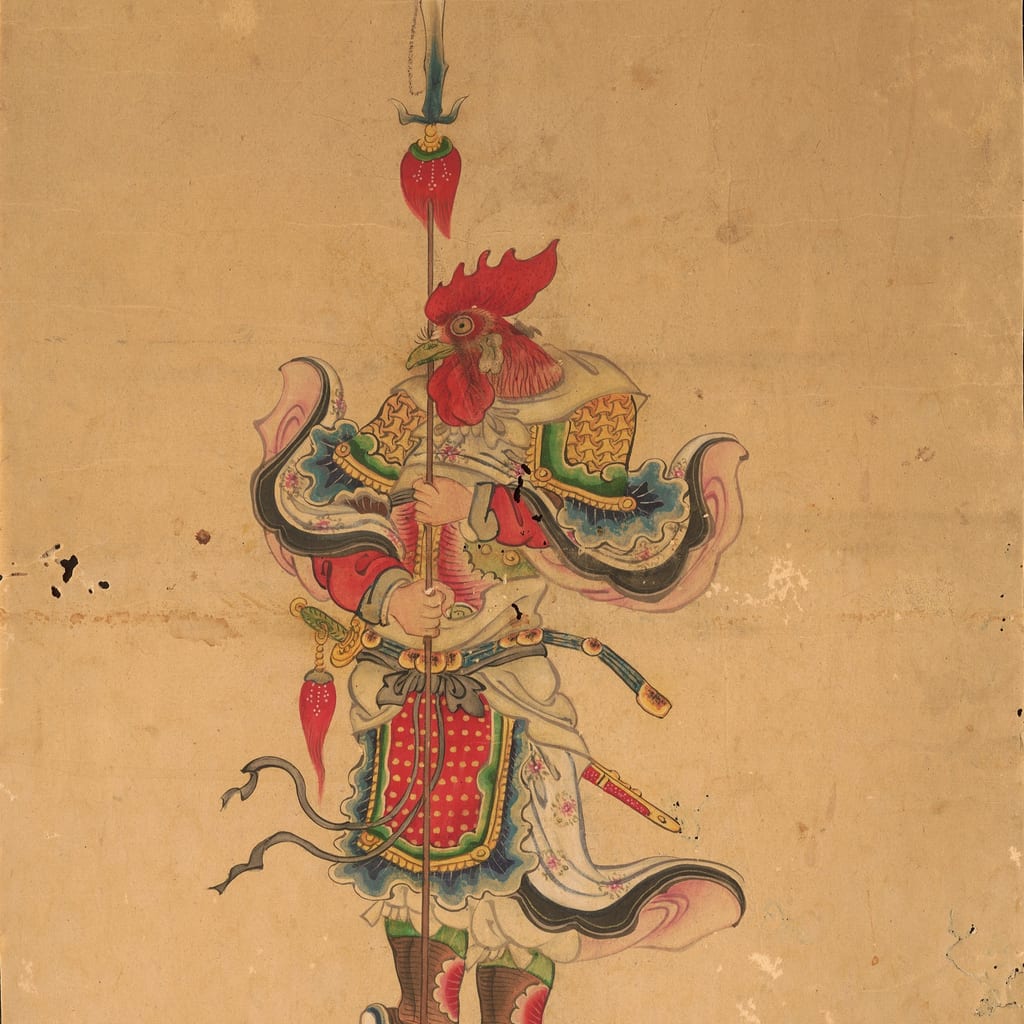
Yu (Rooster)
酉 · 닭띠
Yu (酉), the Rooster, is the tenth of the twelve animals of the Korean zodiac; people born in its year are dak-tti (닭띠). Before there were clocks, the National Folk Museum of Korea writes, the rooster announced the day: the bird of the sun, whose crow at dawn is the beginning of light and puts evil to flight. To Koreans it embodied five virtues — politeness (文) for its comb, martial valour (武) for its spurs, courage (勇) because it fights without fear, benevolence (仁) because it shares its grain, and trustworthiness (信) because it crows at daybreak without fail.
- Hours
- 5–7 p.m.
- Month
- Eighth lunar month
- Direction
- West
Source: National Folk Museum of Korea, The Story of the Twelve Animals of the Korean Zodiac: Composition of the Twelve Zodiac Animals (nfm.go.kr); National Folk Museum of Korea, The Story of the Twelve Animals of the Korean Zodiac: Rooster (nfm.go.kr)
Years and Seollal
The animal changes at Seollal, the Korean New Year, not on 1 January: if you were born in January or February, check the date of Seollal in your year. Dates from the Korean calendar, as published by the Korea Astronomy and Space Science Institute.
| Year | Seollal (the year begins) |
|---|---|
| 1909 | January 22 |
| 1921 | February 8 |
| 1933 | January 26 |
| 1945 | February 13 |
| 1957 | January 31 |
| 1969 | February 17 |
| 1981 | February 5 |
| 1993 | January 23 |
| 2005 | February 9 |
| 2017 | January 28 |
| 2029 | February 13 |
| 2041 | February 1 |
The rooster in Korea
Chickens were living in Korea by the Three Kingdoms period. Old texts say that India once called Goguryeo Kukutesvara (鷄貴國), "the country that worships the chicken", and the founding myths of Bak Hyeokgeose and of Gim Al-ji in the Memorabilia of the Three Kingdoms show how long the bird has been a symbol on the peninsula.
When there were no clocks, and especially at night or on cloudy days, people told the time by the rooster's cry; for ancestral rites, they relied on the rooster's cry to time the building of a tomb and the rite itself. In the classic novel Simcheongjeon, Simcheong hears the rooster at dawn on the day she is to be sold to the boatmen, and pleads: "O rooster, rooster, do not crow! If you crow, the day will break, and if the day breaks, I must die. I do not fear death — but how can I leave my father behind?"
Symbol and beliefs
The rooster that heralds the day in the darkness was long held to be an auspicious bird with mythical power. Koreans believed that when it pecked three times, shook its tail and crowed long and loud at daybreak, wild beasts went back to the mountains and evil spirits hid; at its crow the goblins and ghosts that roam the dark vanished. Its long crow at dawn was also a metaphor for the start of a new age.
In the Book of Changes the rooster belongs to the trigram 巽, whose direction is the southeast, where dawn begins; and the museum sees in the rooster's double nature — a bird with large wings, yet bound to the ground — the sign of a creature standing on the border between light and darkness.
Legends and folk tales
In myth the rooster's morning crow announces a new beginning, or the birth of a founder. A shaman song of creation from Jeju Island opens with three roosters — the Rooster of Heaven lifts its neck, the Rooster of Earth spreads its wings, the Rooster of Man crows aloud — and day breaks in the east: with the roosters' crowing, the creation of the world begins.
In the fourth reign of Silla, under King Talhae, a rooster was heard crowing in the forest west of the capital, today's Gyeongju. Light shone on the forest and purple clouds stretched from sky to earth; where they touched hung a golden chest, and beneath the tree a white rooster was crowing. The king opened the chest and found a boy curled up inside; believing him a son sent by heaven, he took him to the palace, named him Al-ji for his wisdom, and gave him the surname Gim (金), "gold", because he had come from a golden chest. Gim Al-ji is remembered as the ancestor of the Gim clans.
In art
To welcome the new year, families hung a painting of a rooster to drive evil spirits away, for the rooster was believed to banish and exorcise evil; many paintings also show a hen caring for her newborn chicks, a wish to be blessed with children. Under Joseon, men who hoped to become officials kept a painting of the rooster in their study, because its comb was like an official's headdress; painted with a cockscomb flower, which also stood for the headdress, it meant the highest success.
Customs and everyday life
The rooster also had its place at weddings: in the ceremony a rooster wrapped in blue and red silk was set on the altar, and at the pyebaek it was placed between the bride and groom. Dozens of eggshells and chicken bones found in the Cheonmachong tomb are believed to have been meant for rebirth, or as grave goods. There was a time when eggs were a precious gift for an honoured guest; samgyetang, chicken soup with ginseng, has long been eaten in summer to beat the heat.
Before Korea's liberation from Japan, cockfighting was a national pastime, and it is still held, legally, in parts of South Gyeongsang Province.
Compatibility
Harmonious triad (samhap)
In conflict (wonjin)
The Rooster, the Ox and the Snake form one of the four harmonious triads (samhap, 삼합). The museum explains it from nature: the snake likes the rooster's crowing, and the ox, after feeding, chews the cud and rests to the sound of the rooster.
The Tiger is the Rooster's wonjin (원진), the animal in conflict with it: the tiger hates the rooster's crow. The rooster is called seobaek (西白), a name that implies a white cock, and the tiger fears the white cock; when a rooster crowed long, more than three times, and shook its tail, people believed that even ghosts and tigers would leave the village.